

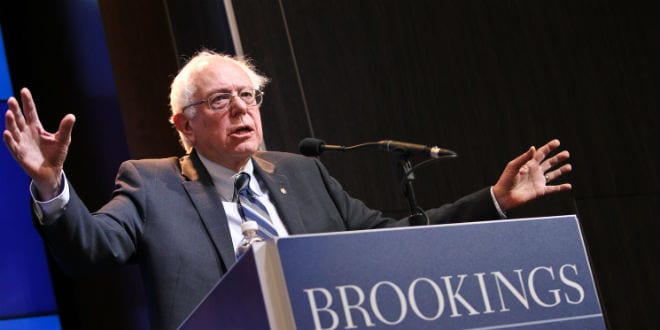
Israel’s Ambassador to the United States, Yechiel Leiter, addressed a Washington antisemitism conference last week. Standing before the National Task Force to Combat Antisemitism at the Museum of the Bible, Leiter called J Street “a cancer within the Jewish community,” accused the organization of being “duplicitous,” and — without naming him directly — effectively stripped Vermont Sen. Bernie Sanders of his Jewish identity. It was the sharpest public rebuke of a Jewish-American advocacy organization ever delivered by an Israeli envoy in Washington. And he was right to say it.
“Don’t be fooled by the fact that they appear to be Jewish,” Leiter told the gathering. “The sponsor is not a Jew. The sponsor is a Communist who may have a Jewish pedigree. That doesn’t make him a Jew.” He added pointedly: “It’s amazing that we have some of these people, who remember their Jewish pedigree only when they’re bashing the State of Israel.”
Despite being born Jewish, Sanders is one ot the most outspoken critics of Israel in Congress. For the better part of a year, Sanders called on Congress to block additional military aid and arms sales to Israel. He introduced multiple rounds of Joint Resolutions of Disapproval in the Senate aimed at halting weapons transfers, including bombs, tank rounds, mortar rounds, and precision munitions. As recently as March 2026, Sanders filed three new resolutions targeting $658.8 million in sales of 500- and 1,000-pound bombs to Israel, calling it an “illegal war” and demanding “no more weapons.” With each new round of votes, more Democratic senators have lined up behind him — a majority of the Democratic caucus, 27 lawmakers, voted to block at least one arms sale in July 2025.
J Street describes itself as a “liberal Zionist advocacy and lobby group whose aims include strengthening Jewish democracy in Israel” and “promoting a diplomatic end to the Israeli–Palestinian conflict with a two-state solution”. Its critics describe it as anti-Israel and according to Federal Election Commission filings in 2009, dozens of Arab and Muslim Americans and Iranian advocacy organizations donated tens of thousands of dollars to J Street. J Street has accused Israel of genocide in Gaza.
The “two-state solution” supported by J Street would create an unprecedented militarized Palestinian state in Judea and Samaria, ethnically cleansed of Jews, with its exclusively Muslim capital in Jerusalem.
The organization encouraged senators to vote for resolutions blocking weapons transfers and simultaneously called on the Biden administration to sanction Israeli ministers Bezalel Smotrich and Itamar Ben-Gvir. Now J Street has taken a further step: the group reversed its long-standing position supporting the full $3.8 billion annual U.S. aid package to Israel, previously a cornerstone of its endorsement criteria — candidates endorsed by J Street were once required to support funding for Iron Dome. Joel Rubin, a former Obama official and J Street founding director, said the move “undermines” the U.S.-Israel security relationship and warned, “It’s much easier to tear down a relationship than it is to build one up.”
Leiter, for his part, rejected the framing that opposing the Netanyahu government is merely a policy disagreement compatible with being pro-Israel. “If they said that they were pro-Palestinian, I wouldn’t have a problem meeting with them,” he said. “But when you come and say in such a two-faced manner, ‘We’re pro-Israel, we’re pro-democracy’ — there’s a democratically elected government in Israel.”
J Street president Jeremy Ben-Ami fired back, saying the ambassador should engage with critics rather than “call us names,” and that J Street “represents a large and growing segment of the American Jewish community.” But that defense rings hollow. The question is not whether a group can criticize Israeli policy — the question is whether a group can call itself pro-Israel while lobbying to strip Israel of offensive weapons during a multi-front war, pushing to sanction its elected ministers, and backing legislation authored by a man who calls IDF operations a “horrific war against the Palestinian people.” Disagreement is legitimate; deception about what you are is not.
Leiter urged pro-Israel activists to make J Street affiliation politically radioactive. “You’ve got to create an atmosphere where there’s going to be competition among candidates who say, ‘I don’t have anything to do with J Street,’ and have competition among candidates who say, ‘I’m proudly affiliated with AIPAC,'” he said.
An organization that wears the Jewish label as a diplomatic shield while working to cut weapons from a Jewish state under fire is not pro-Israel by any reasonable definition. It is, as Leiter said, duplicitous — and the Jewish community would do well to treat it accordingly.