
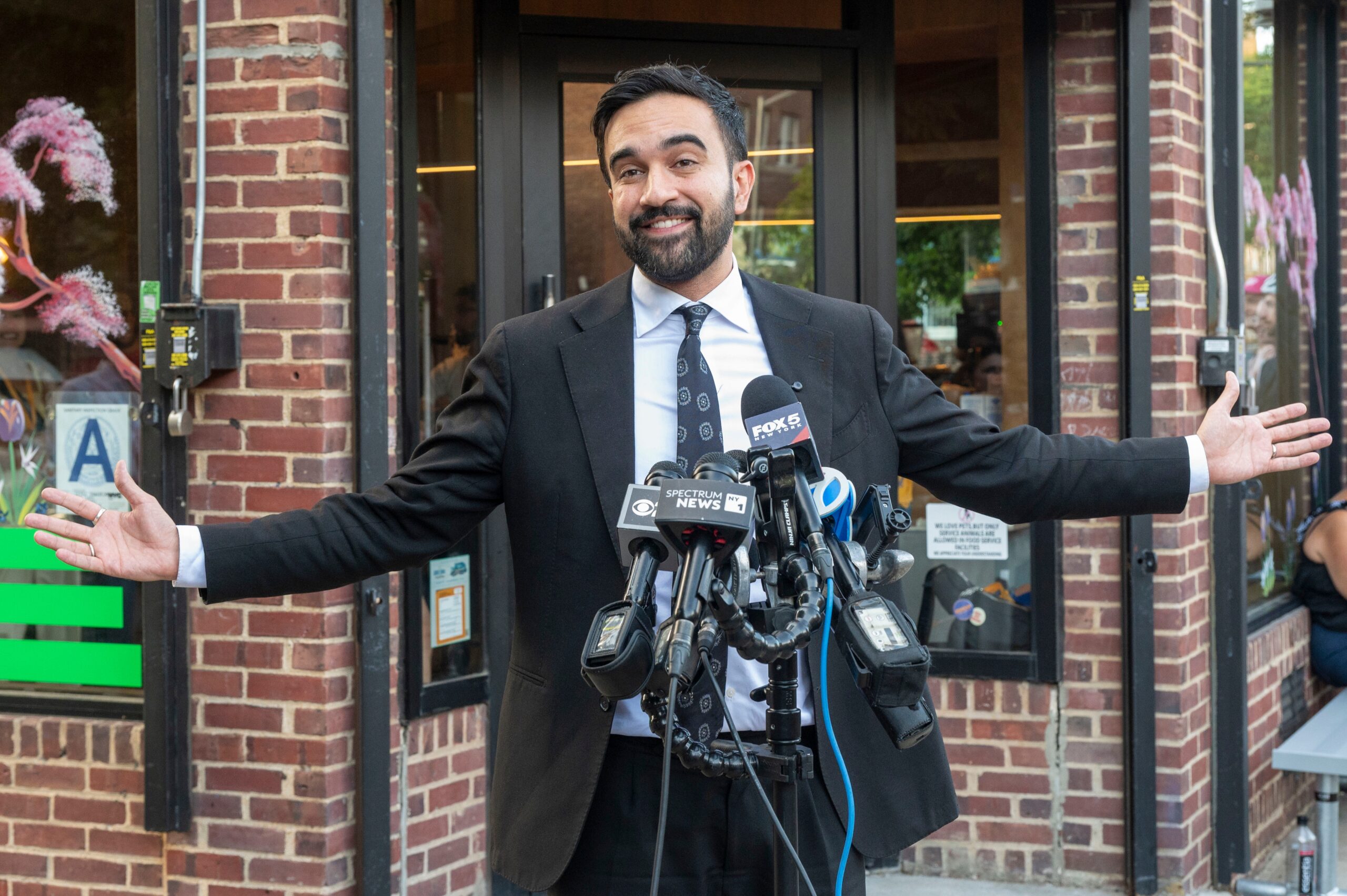
NEW YORK — New York City Mayor Zohran Mamdani released a slick, four-minute City Hall-produced video on Friday afternoon, timing it just before the Jewish Sabbath, marking Nakba Day, the Palestinian commemoration of Israel’s founding. The move drew immediate and furious condemnation from Jewish leaders across the city. What made it more than a political provocation was what the video left out: Arab armies that invaded a nascent Jewish state with the stated goal of its destruction, the 800,000 Jews expelled from Arab lands, the Jewish neighborhoods ethnically cleansed in Jerusalem, and the Arab rejection of a partition plan that could have created a Palestinian state without a single shot being fired.
What Mamdani’s City Hall video did not mention, what virtually no Nakba Day coverage ever mentions, is that the man who coined the term would not recognize what it has become.
The word Nakba was invented in August 1948 by Constantin Zureiq, a Syrian historian and Arab nationalist intellectual at the American University of Beirut. His book defined the conceptual parameters of the Arab tragedy to describe the Arab defeat of the War of 1948. In Zureiq’s original telling, the catastrophe was not what Israel did to the Palestinians. It was what seven Arab armies failed to do to Israel. “Seven Arab states declare war on Zionism, stop impotent before it, and then turn on their heels,” he wrote. He blamed Arab leaders for military incompetence, social backwardness, and self-delusion. “When the battle broke out, our public diplomacy began to speak of our imaginary victories, to put the Arab public to sleep and talk of the ability to overcome and win easily — until the Nakba happened,” Zureiq wrote. “We must admit our mistakes and recognize the extent of our responsibility for the disaster that is our lot.”
Then the word effectively vanished. It did not resurface for decades following the 1948 war, not even in the PLO’s founding document, the Palestinian Covenant of 1964, revised in 1968. It was only in the late 1980s that it began to be widely perceived as an Israeli-inflicted injustice.
The reinvention of Nakba as a Palestinian victimhood narrative was largely the political project of Yasser Arafat. Arafat grasped the immense potential of reincarnating the Nakba as a symbol of Palestinian victimhood rather than a self-inflicted disaster. In 1998, he proclaimed May 15 a national day of remembrance. What had been a term of Arab self-criticism, a demand for modernization and accountability, became a tool for erasing Arab aggression from the historical record and replacing it with the image of innocent Palestinians expelled by Zionist violence.
The man who invented the word was calling on Arabs to look in the mirror. The movement that resurrected it smashed the mirror entirely. That is the narrative Mayor Mamdani’s office packaged in a four-minute video and released to New York City taxpayers on the eve of Shabbat.
But the very name “Palestine,” which frames the entire Nakba narrative, carries an origin story that turns the modern narrative on its head. The term has nothing to do with Arab history in the land. It is Roman. It is colonial. And for most of its modern history, the people who called themselves Palestinians were Jews.
A Roman Stamp, Not an Arab Heritage
After the Bar Kokhba revolt, the Jewish uprising against Rome crushed in 135 CE, the Emperor Hadrian sought to erase every trace of Jewish connection to the land. He renamed Iudaea (Judea) “Syria Palaestina,” a name derived from Peleshet, the biblical Plishtim, known as the Philistines, an Aegean Sea People who had vanished from history more than a millennium before Hadrian’s decree. It was a deliberate act of cultural annihilation: strip a people of their name, strip them of their land.
The Philistines themselves had no connection to the Arabs who would arrive with the Muslim conquest of the 7th century CE. They were not Semitic. They were not ancestors of anyone living in the region today. Hadrian chose the name precisely because it was ancient, obscure, and maximally humiliating to the Jews.
Mayor Mamdani: the refugees you post about exist because 22 Arab states launched a war to destroy Israel on May 15, 1948—rejecting the UN plan that also called for a Palestinian state. In its aftermath, 800,000 Jews were expelled from Arab lands. Your post mentions none of this. https://t.co/Fn1aY788Tc
— UJA-Federation of New York (@UJAfedNY) May 15, 2026
When the British received the League of Nations Mandate for the territory after World War I, they resurrected this Roman label, calling the region “Palestine.” Under the British Mandate, the people who identified as “Palestinians” were overwhelmingly Jewish. The Jerusalem Post, founded in 1932, was called The Palestine Post. The Jewish Brigade that fought with the Allies in World War II was known as the Palestinian Regiment. The coin of the realm bore the Hebrew letters aleph-yod for Eretz Yisrael, the Land of Israel, alongside the word “Palestine.” Arab leaders of the era largely rejected the “Palestinian” designation, preferring pan-Arab or pan-Syrian identity frameworks. It was only after Israel’s founding, and particularly after the 1960s under Yasser Arafat’s leadership, that Arab residents of the land adopted “Palestinian” as a distinct national identity.
Yasser Arafat, Egyptian-born and Cairo-educated, was the architect of “Palestinian” as a distinct national identity, and he was candid about what he was doing. The 1964 PLO charter defined the Palestinians as “an integral part of the Arab nation,” rather than a distinct nationality, and vowed allegiance to the ideal of pan-Arab unity, that is, to Palestine’s eventual assimilation into “the greater Arab homeland.” The PLO was not founded to build a Palestinian state; it was founded to destroy a Jewish one. After pan-Arab nationalism collapsed in the humiliation of the 1967 Six-Day War, when Arab armies failed a second time to eliminate Israel, Arafat pivoted. By the 1960s, the dream of a pan-Arab state had given way to the goal of replacing the Jewish state of Israel with an Arab state of Palestine. A separate Palestinian people, with a distinct Palestinian identity rooted in the Roman-colonial name the British had resurrected, became the vehicle for continuing the same war by other means. Zuheir Mohsen, a senior PLO leader, admitted as much in 1977: “The Palestinian people do not exist. The creation of a Palestinian state is only a means for continuing our struggle against the state of Israel for our Arab unity. Only for political and tactical reasons do we speak today about the existence of a Palestinian people.” Arafat himself, according to his biographer Alan Hart, put it with characteristic bluntness: “The Palestinian people have no national identity. I, Yasser Arafat, man of destiny, will give them that identity through conflict with Israel.” The Nakba narrative, resurrected by Arafat in 1998 and now produced by New York City’s mayoral office in a four-minute video, is the latest chapter of that project.
Ironically, Arabic does not contain the letter ‘P’, so “Palestinians” cannot pronounce the name they have adopted.
In short: the name “Palestine” is a Roman colonial imposition, resurrected by a British colonial administration, and ultimately appropriated by Arab nationalist movements, while the people who bore that name through history, who published newspapers under it and fought wars under it, were Jews.
What Mamdani’s Video Said — and Didn’t Say
Mamdani’s video featured an interview with Inea Bushnaq, a New York resident who described fleeing Jerusalem because “the Zionists were coming.” The text accompanying the video declared that “the Haganah, Irgun and Lehi militias, among others, destroyed more than 400 Palestinian villages and cities, killing thousands of Palestinians and carrying out dozens of massacres.”
This claim in Mamdani’s video is partially true, significantly misleading, and stripped of all context that would make it meaningful. The video presents displacement as the product of a deliberate Zionist extermination policy. The actual history of why people fled is far more complex. Arab officers ordered the complete evacuation of specific villages in certain areas, lest their inhabitants “treacherously” acquiesce in Israeli rule or hamper Arab military deployments. There can be no exaggerating the importance of these early Arab-initiated evacuations in the demoralization and eventual exodus of the remaining rural and urban populations.
Also, the video said nothing about the Arab armies of Egypt, Jordan, Syria, Iraq, and Lebanon that invaded the moment Israel declared independence. It said nothing about the Arab Higher Committee’s rejection of the 1947 UN Partition Plan, which would have created an Arab state alongside a Jewish one. It said nothing about Arab massacres of Jewish civilians — the Hadassah Medical Convoy massacre, the Kfar Etzion massacre — or the ethnic cleansing of Jews from the Jewish Quarter of Jerusalem. It said nothing about the Farhud, the 1941 pogrom against Baghdad’s Jews that preceded the war by seven years, or the 850,000 Jews expelled from Arab countries in its aftermath.
The video also featured a 1936 “Visit Palestine” poster, created, as Israeli activist Hen Mazzig pointed out, by Frank Krausz, a Holocaust survivor and committed Zionist. Krausz survived the Nazi genocide. The poster that bore his work was repurposed by New York’s mayor’s office to illustrate a narrative in which the Jewish state is the villain.
“My grandmother fled North Africa and Iraq after the Farhud of 1941,” Mazzig wrote in response. “Six years before any war over Israel. Palestinians were expelled during a war Arab states launched against us. Over 850,000 Jews were driven from Arab lands. Almost none remain. Maybe the mayor of New York should stay out of it. Or speak to both. Don’t weaponize one trauma while actively erasing another.”
The Jewish Community Responds
The UJA-Federation of New York did not mince words. “Mayor Mamdani: The refugees you post about exist because 22 Arab states launched a war to destroy Israel. In its aftermath, 800,000 Jews were expelled from Arab lands. Your post mentions none of this. And you chose 5:40 PM on Friday to post it — as Jewish New Yorkers prepare to light Shabbat candles. We noticed.”
NOW: Protesters gathered in Washington Square Park in NYC for Nakba pic.twitter.com/wTWSsuLcus
— Oliya Scootercaster 🛴 (@ScooterCasterNY) May 15, 2026
New York State Assemblymember Simcha Eisenstein, from Brooklyn, connected the video directly to the surge in antisemitic violence the city is experiencing. “Still wondering why hatred against Jews is so high in NYC? We have a mayor who is using government resources to disseminate a narrative and incite hostile propaganda.” According to NYPD data, Jews are targeted in hate crimes more than all other groups combined in New York City.
Assemblymember Sam Berger, representing a largely Jewish district in Queens, called the video what it is. “Rewriting history to portray the existence of Israel itself as the original sin is not education or remembrance. It is propaganda. This mayor constantly tries to market himself as an ally to the Jewish community while amplifying narratives that fuel hatred against the Jewish people.”
Mamdani released the video on the same day that hardline anti-Zionist groups held Nakba Day rallies in Manhattan, where protesters waved Hezbollah flags, stomped on Israeli flags, and called for Israel’s destruction.
The timing is difficult to read as a coincidence. Mamdani, who joined the Democratic Socialists of America specifically, by his own account, because of his pro-Palestinian activism and his commitment to the Boycott, Divestment, and Sanctions strategy, has refused to march in the Jewish community’s annual Israel Day Parade on Fifth Avenue. His wife was recently in the news for liking Instagram posts about Hamas’s October 7 massacre. Several of his top staff members are vocal anti-Israel activists.
Mamdani, to his credit, condemned antisemitism in a separate statement the same day, following the arrest of an alleged Iranian-backed terrorist who had plotted to attack a New York synagogue. “Antisemitism, violent extremism, and terrorism have no place in our city,” he said.
He said that. And then he posted the video.
A Name, a Key, and a Very Old Lie
The Nakba narrative rests on a Palestinian identity constructed largely in the 20th century, attached to a Roman place-name that Jews carried for centuries while Arabs rejected it, and deployed to argue that Israel’s very existence is a crime that must be remedied through the “right of return” of millions of descendants, a formula that would end Israel as a Jewish state without a single rocket.
Bushnaq, in Mamdani’s video, held up the key to a house she says her family left in 1948. The Sages teach that Eretz Yisrael, the Land of Israel, was given to the Jewish people with a covenant that no Roman emperor, no British mandate, and no New York mayor can revoke. The Jewish people have their own key. It is 3,000 years older. And it is written not in metal, but in the words of the living God.
The mayor of the greatest city in the world used taxpayer resources to produce a video that erases Jewish history, ignores Arab aggression, and signals support for a “right of return” designed to dissolve the Jewish state. He did it on the eve of Shabbat. He did it while Hezbollah flags flew in Manhattan.