Javier Milei’s personal rabbi serves as Argentina’s ambassador to Israel. That single fact tells you more about this man than any speech he has given. And he has given many.
Milei was raised Catholic. He is today the most outspoken defender of Israel and the Jewish people among the leaders of major nations, a man who studies Torah weekly, quotes the weekly portion in national addresses, named his political movement after the Book of Maccabees, and declared at Yeshiva University in March that he was “sincerely proud to be the most Zionist president in the world.” How he got there is one of the stranger and more genuinely moving stories in contemporary politics.
The Chainsaw and the Torah
Milei burst onto the Argentine political scene as an economist who believed, with total conviction, that the state was the root of all economic evil — not a necessary inconvenience to be managed but a predatory force to be dismantled. He entered politics by going on television to attack the government with diagrams and insults, campaigned with a literal chainsaw to symbolize cutting government ministries, and named his cloned English mastiffs after his free-market heroes — Milton Friedman, Murray Rothbard, and Robert Lucas.
In 2021, as Milei’s star began to rise, accusations of antisemitism hit him on social media. His response was not to hire a communications team or issue a statement. He called a Jewish economist friend and asked to be introduced to a rabbi.
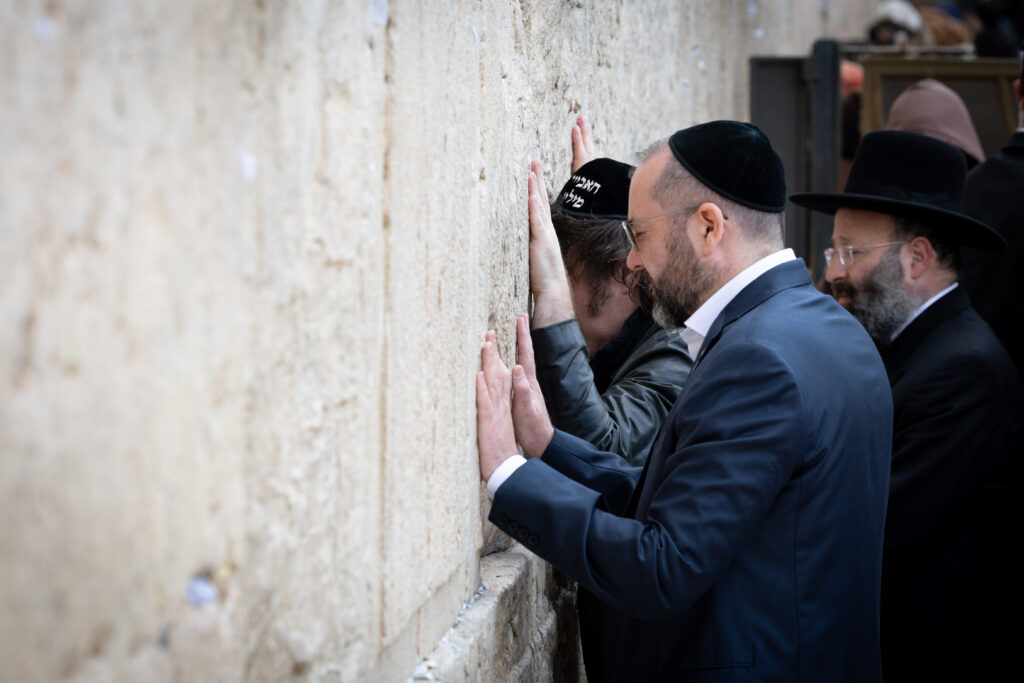
That rabbi was Shimon Axel Wahnish, head of the Moroccan-Argentine Jewish community, and their first meeting lasted hours. Wahnish told Milei, by his own account, that he was leading a liberation movement. Milei left transformed. He began studying Torah seriously — not as a political exercise but as a regular, sustained practice, sometimes meeting with Wahnish for two or three hours at a time. “He urges me to read the Torah from an economic point of view,” Milei has said of his rabbi. The study took hold. Milei began quoting the weekly Torah portion in national addresses and speaking openly about the possibility of one day converting to Judaism, though he has not yet done so.
He went on to win the Argentine presidency in November 2023 by almost twelve points, in a country with 140% inflation and 40% poverty. Pope Francis, whom Milei had called a communist, described him as “a messianic clown.” Milei won anyway, running against what he called “the entire political class.”
Wahnish is now Argentina’s ambassador to Israel.
The Forces of Heaven
What Milei found in Jewish sources was not simply spiritual comfort. He found a political vocabulary. He rallied his supporters under the slogan “the Forces of Heaven,” a phrase from the third chapter of the Book of Maccabees, which describes the Jewish Maccabean revolt against the Greek empire: “In a battle, victory does not depend on the number of soldiers, but on the forces of heaven.” The few against the many, the outnumbered fighting the empire. Milei had tapped into something powerful, and his young supporters — mostly men between sixteen and thirty, furious at a political establishment that had failed them their entire lives — were hooked by the message.
When he was inaugurated on December 10, 2023, he noted from the podium that his first day as president coincided with Hanukkah. “It is no coincidence,” he said, “that this presidential inauguration takes place during the festival of light, because it celebrates the true essence of freedom. The war of the Maccabees is the symbol of the triumph of the weak over the powerful, of the few over the many, of light over darkness, and above all of truth over lies.”
At the Wall, and at the Kibbutz
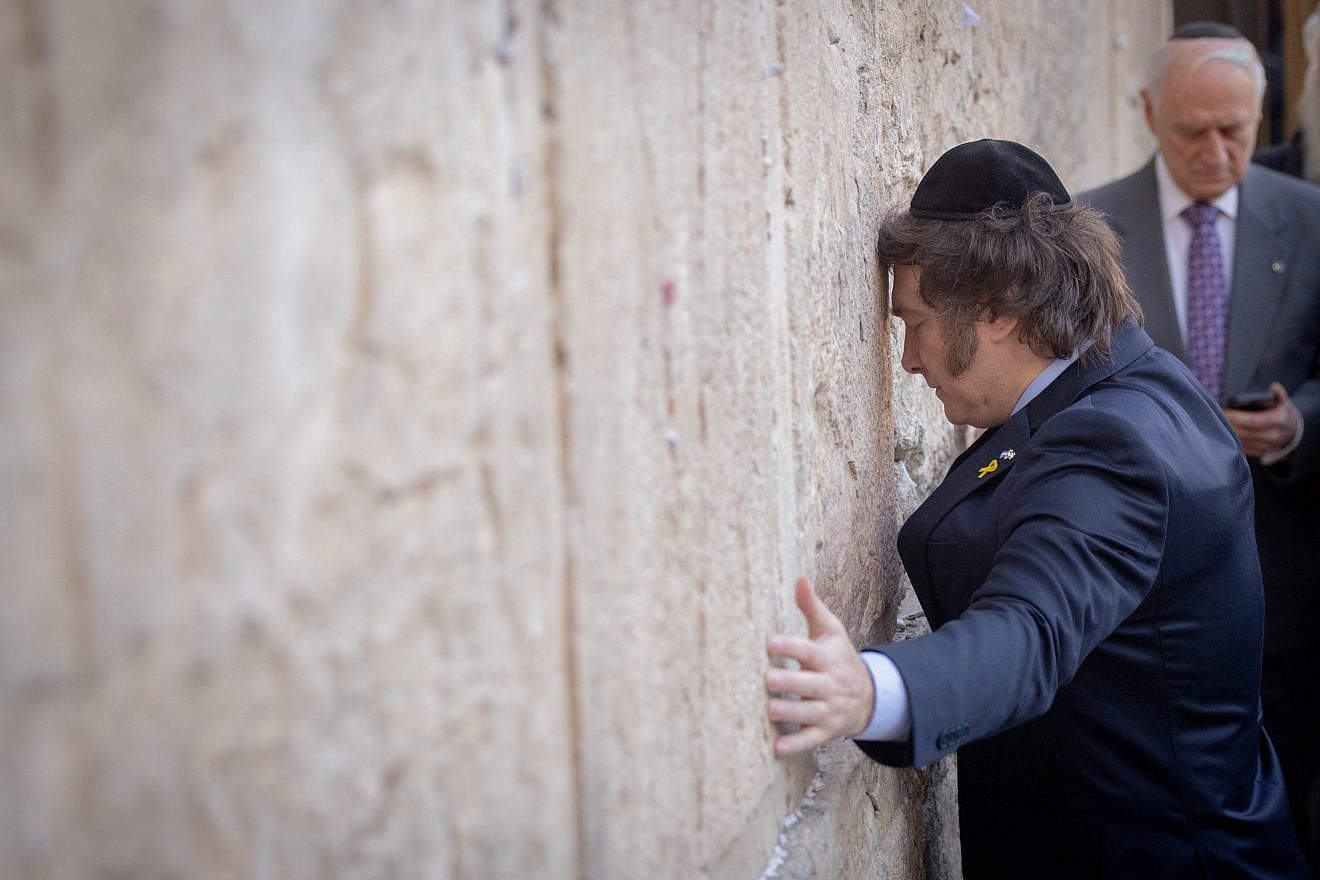
Milei visited Israel for the first time as president in early 2024, just months after October 7th. He went to the Western Wall in Jerusalem, put on a kippah, and wept. When the crowd recognized him, they lifted him up, literally, and danced with him. His security detail could only watch helplessly. He visited Kibbutz Nir Oz, one of the communities hardest hit by the Hamas massacre, where nearly a quarter of the residents were killed or taken hostage. He stood there and called Hamas terrorism “21st century Nazism.”
When the bodies of the murdered Bibas family were returned from Gaza, he declared two days of national mourning in Argentina. More than twenty Argentines were taken hostage on October 7th, and Milei’s government worked actively to secure their release. Last month, when Bar-Ilan University awarded him an honorary doctorate, freed hostages and their families were among the guests at the ceremony. Arie Zaban, the university’s president, said of Milei that “in one of the most difficult and painful periods for the Jewish people, President Milei has proven himself a true friend of our country.”
What He Actually Believes
The question people ask about Milei is whether this is real. Is the Torah study a political performance? Is the weeping at the Wall simply theater? The skepticism is understandable in a world where politicians are always calculating, always managing their image, and always looking for the next constituency to court.
But the evidence points in the other direction. His engagement with Judaism preceded his rise to national politics. He roots his entire economic philosophy in the Torah, arguing at Yeshiva University that the foundations of Western civilization — life, liberty, property — are inscribed in the Ten Commandments, that the concept of freedom is embedded in the first commandment’s declaration that God brought Israel out of Egypt. “Those values are non-negotiable,” he said. “There is a set of basic values that cannot be violated, and those values are found in the Holy Scriptures.” This is not a stump speech; it is a worldview.
The most Zionist president in the world was not born Jewish. He got there the hard way — by choosing it.
Unexpected Allies: This is the third in a series of articles exploring the surprising international friendships Israel is building at a moment when much of the world has turned its back on the Jewish state.