




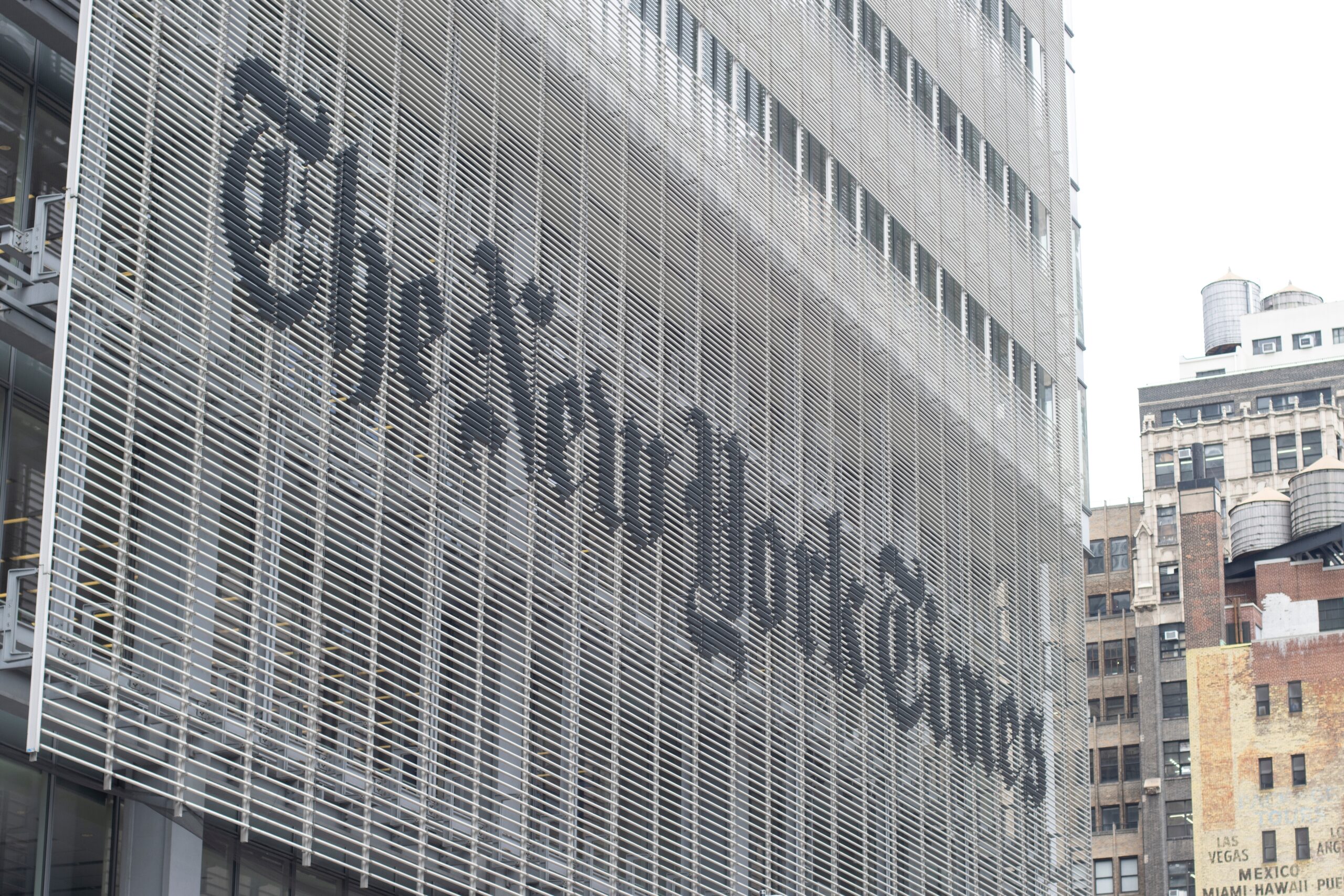
The New York Times ran an opinion column this week claiming Israel systematically rapes Palestinian prisoners — men, women, and children — including the allegation that Israeli prison guards use specially trained dogs to sexually assault detainees. The piece, written by columnist Nicholas Kristof, triggered a firestorm of condemnation from Israeli officials, media watchdogs, academics, and even a former Israeli prime minister who says Kristof misrepresented his words. Critics say the column is not journalism. They are calling it a blood libel.
Rather significantly, the NYT published the libelous op-ed accusing Israel of sexual violence by citing sources with documented ties to Hamas, on the very day a major report was released documenting Hamas’s systematic rape of Israeli women and children on October 7.
The Timing Is Not a Coincidence
On Monday morning, th eCivil Commission on October 7 Crimes by Hamas against Women and Children released a 300-page report documenting in forensic detail how Hamas terrorists used sexual violence as a deliberate weapon of war during their assault on southern Israel on October 7, 2023. The commission, an Israeli NGO established specifically to document the atrocities of that day, based its findings on 430 formal and informal interviews and more than 10,000 photographs and video segments. It documented 13 distinct categories of sexual violence committed by Hamas-led invaders: rape, gang rape, sexual torture and mutilation, executions linked to sexual violence, postmortem sexual abuse, and sexual assaults carried out in front of family members, among others. “The scale, coordination, and repetition of the conduct demonstrate a widespread and systematic attack against civilians in which sexual violence was deliberately used as a method of terror,” the report concluded.
Now we know @nytimes & @NickKristof knew precisely the timing of the release of a new major report on Hamas' sexual violence on 10/7. They declined to publish a story about it and then they preempted its release with the fake "dog rape" and Hamas front Euro-Med trash. Shameful. https://t.co/xo69RcKxzy
— Aizenberg (@Aizenberg55) May 12, 2026
There are those who have worked to deny or diminish the crimes of October 7, including the mass rapes that were committed.
— HonestReporting (@HonestReporting) May 12, 2026
Now, the full investigation, published today, into the horrors inflicted upon Israeli civilians by Hamas on Oct. 7, reveals a recurring pattern of:
✖️rape… https://t.co/20NX31jTqz pic.twitter.com/9OxYY1tqOz
On that same Monday morning, the New York Times published Nicholas Kristof‘s column alleging that Israel, not Hamas, is the side running a systematic sexual violence program.
HonestReporting, which published a detailed forensic analysis of the Kristof piece, stated the conclusion plainly: “It now appears that the New York Times and Kristof knew in advance about the release of the Civil Commission’s report on sexual violence. Instead of allowing attention to focus on documented crimes committed against Israelis, the Times shifted the conversation back toward alleged Israeli misconduct.” The watchdog called it deliberate narrative architecture: “The simultaneous publication of its story was revealing not because of what it uncovered, but because of what it appeared designed to accomplish: redirect attention, shape perception, and ensure that even as new evidence emerges about Hamas’ crimes, Israel remains the primary focus of condemnation. That is not a coincidence. It is narrative framing.”
1/
— HonestReporting (@HonestReporting) May 11, 2026
The @nytimes just published one of the most serious sets of allegations imaginable against Israel – claims of systematic sexual violence, including a bizarre story about carrots and trained rape dogs. We checked the sources.
What we found is journalistic malpractice. 🧵 pic.twitter.com/vBbLy0Lp0J
The contrast could not be starker. The Civil Commission’s report is based on 430 interviews, 10,000 photographs, video segments, and years of forensic work. Kristof’s column rests on 14 conversations, and he himself concedes in the piece that “there is no evidence that Israeli leaders order rapes.” The Civil Commission Report is an evidentiary record. The NYT article is an opinion column built on unverifiable, shifting, and in several cases, demonstrably tainted testimony. Yet it is the opinion column that landed in the pages of the world’s most influential newspaper on the day the evidentiary record was released. That tells you everything about what the Times was trying to accomplish.
After October 7, major media outlets, including the Times, faced sustained and damaging criticism for being slow to fully acknowledge and report on the evidence of Hamas’s sexual violence against Israeli civilians. The Times’ own “Screams Without Words” investigation into that violence triggered fierce internal and external controversy over sourcing and contributor qualifications. Now, when a comprehensive commission has finished its work and documented Hamas’s crimes with exhaustive evidence, the Times chose that exact moment to run an unsourced opinion column accusing Israel of the same category of crime.
“One of the Worst Blood Libels Ever to Appear in the Modern Press”
Israel’s Foreign Ministry slammed the NYT’s article, calling it a “blood libel.”
“Today, The New York Times chose to publish one of the worst blood libels ever to appear in the modern press,” the ministry said in a statement Monday. “In an unfathomable inversion of reality, and through an endless stream of baseless lies, propagandist Nicholas Kristof turns the victim into the accused.”
The ministry also charged that Kristof’s column was “part of a false and well-orchestrated anti-Israel campaign aimed at placing Israel on the UN Secretary-General’s blacklist,” a reference to UN Secretary-General Antonio Guterres placing Hamas, and putting Israel “on notice” of being placed on a UN blacklist of entities credibly suspected of committing patterns of sexual violence in armed conflict.
The Sources Behind the Story
The column, titled “The Silence That Meets the Rape of Palestinians,” alleges “a pattern of widespread Israeli sexual violence against men, women and even children — by soldiers, settlers, interrogators in the Shin Bet internal security agency and, above all, prison guards.”
Beyond Euro-Med, Kristof also cited reports from Save the Children, B’Tselem, the Committee to Protect Journalists, and a 49-page UN report published last year that accused Israel of “systematically” subjecting Palestinians to “sexualized torture.” He additionally reported that some former detainees claimed Israeli authorities had warned them not to speak publicly about alleged abuses after their release. In March 2025, UN Special Rapporteur Francesca Albanese told the UN Human Rights Council that “the Israeli prison system has degenerated into a laboratory of calculated cruelty,” including allegations of rape with bottles, metal rods, and knives. These claims have circulated widely in anti-Israel media and been amplified by outlets including Middle East Monitor and TRT World, both of which treated the Euro-Med report as authoritative and added additional allegations of their own.
Israeli Ambassador to the United States Yechiel Leiter went directly at the sourcing. “Kristof and the Times count on you not pulling the curtain back on their lies,” Leiter said in a video posted to X. “A principal NGO quoted in Mr. Kristof’s piece is Euro-Med Monitor. Sounds impartial, right? Balanced, so stately. But lo and behold, its leaders Ramy Abdu and Mazen Kahel have been repeatedly found to have links to Hamas.”
The @nytimes and @NickKristof count on you not pulling the curtain back on their lies.
— Ambassador Yechiel (Michael) Leiter (@yechielleiter) May 12, 2026
Don’t buy into their blood libels – watch and find out who’s really behind this narrative. pic.twitter.com/Rf94hYlIFw
Euro-Med’s Chairman: A Hamas Operative by Any Other Name
The extent of the ties between the founder and chairman of the Euro-Med Group, Ramy Abdu, and Hamas is not a matter of inference or suspicion. It is documented. Before establishing Euro-Med, Abdu led two organizations in Europe that were formally identified as Hamas structures, and both of which have since been dissolved. In 2013, he was listed by Israeli intelligence as one of Hamas’s main operatives in Europe. That same year, he served as a keynote speaker alongside senior Hamas official Osama Hamdan at a public event — the same Hamdan who appears in a separate photograph alongside Abdu published by NGO Monitor. In 2020, Israel’s Defense Minister issued an administrative order against Abdu under the counter-terrorism law.
Then, in March 2025, Abdu posted a tribute on social media to “our great commander” following an Israeli strike, inadvertently revealing that the man killed, Mohammed Daoud al-Jamasi, a senior Hamas political bureau official, was his brother-in-law. Abdu is not a human rights monitor. He is a Hamas family member, a documented Hamas operative in Europe, and the primary architect of the “trained rape dogs” allegation that Kristof placed in the pages of the New York Times.
Leiter highlighted a photograph from 2011 showing Abdu and Kahel posing directly behind senior Hamas official Ismail Haniyeh, who was subsequently killed by Israel, in a group photo originally posted to Facebook in 2012.
Euro-Med’s institutional record matches its chairman’s biography. The organization has promoted the conspiracy theory that the October 7 crime scene was “doctored.” It has described the murdered Israelis found in Israeli territory armed with assault rifles as civilians whose killing was a war crime. It described those taken hostage by Hamas as having been “arrested and moved to the Gaza Strip.” And in June 2024, Euro-Med explicitly pushed the claim that Israel “trains dogs to rape prisoners,” the same allegation Kristof placed in the New York Times without a word of disclosure about who manufactured it or why.
Eitan Fischberger, a Middle East analyst, described the dog rape allegation as “the handiwork of Ramy Abdu, head of the Hamas front group called Euro-Med,” and called Kristof’s column “utter depravity” for “parroting such cartoonishly evil Hamas propaganda that would make Goebbels blush.”
Gerald Steinberg, founder of NGO Monitor, called the column “perhaps the most toxic and idiotic piece that Nick Kristof has put his name on — a mix of lies sold by a Hamas-front propaganda NGO with zero credibility and ‘eyewitness testimony’ from Hamas terrorists.”
Who Believed It — and Who Didn’t
The column was embraced without reservation by predictable quarters. Middle East Eye accepted Kristof’s claims and stacked additional allegations on top, citing the West Bank Protection Consortium report on sexual violence and displacement, as well as Albanese’s UN Human Rights Council testimony. TRT World similarly amplified the Euro-Med report as though it were an established fact. In none of these cases was the documented Hamas provenance of Euro-Med’s leadership disclosed to readers.
The Times itself pushed back against suggestions it was reconsidering the piece. After former i24 personality David Shuster posted on X that the paper was having internal discussions about taking the column down due to it being “problematic,” the Times’ public relations office flatly denied it. “There is no truth to this at all,” the statement said. “Nicholas Kristof is a two-time Pulitzer Prize-winning journalist who has reported on sexual violence for decades, and is widely regarded as one of the world’s best on-the-ground reporters documenting and bearing witness to sexual abuse.”
Pulitzer Prizes, it turns out, do not substitute for source vetting.
More striking than the response from predictable pro-Palestinian outlets was the reaction from some left-wing voices and Jews who accepted the column’s framing. The piece generated significant social media traction in progressive circles, with several prominent Jewish commentators either amplifying it uncritically or refusing to challenge its sourcing.
Jacqueline Carroll, a former sexual crimes prosecutor in Cook County, Illinois, and founder of an extremism consulting group, told JNS that if legitimate evidence can be provided, it should be taken seriously, warning that many people “believe what they see in the media more than they search out the actual facts and truth.” For many in these circles, the byline and a newspaper’s institutional prestige alone often function as sufficient verification.
The most significant response within the pro-Palestinian camp came from Ahmed Fouad Alkhatib, a prominent anti-Hamas Palestinian-American activist. His voice cuts across the usual lines of this debate. Alkhatib did not simply dismiss the allegations. He acknowledged real cause for concern: “I have no doubt that since October 7 — amid the massive military operations in Gaza and the West Bank and the mass detention of thousands of Palestinians, from militants to civilians swept up in raids — incidents of sexual abuse have occurred in Israeli prisons. Such violations are not unique to Israel; the U.S. committed them in Abu Ghraib, UN peacekeepers have been implicated across Africa, and militaries and armed groups throughout the Middle East, Asia, and beyond have long histories of sexual violence.”
I have no doubt that since October 7 – amid the massive military operations in Gaza and the West Bank and the mass detention of thousands of Palestinians, from militants to civilians swept up in raids – incidents of sexual abuse have occurred in Israeli prisons. Such violations…
— Ahmed Fouad Alkhatib (@afalkhatib) May 12, 2026
But Alkhatib was equally direct about the sourcing failures at the heart of Kristof’s piece, and notably, he spoke from personal experience about the organizations Kristof relied upon. “It is also fair to scrutinize the sourcing of Nicholas Kristof’s NYT opinion article. Some cited entities and individuals, including the Euro-Med Human Rights Monitor and Shaiel Ben Ephraim, have troubling records on accuracy, conduct, and associations, and in my own case, have engaged in personal attacks and even doxxed my family. They are not credible sources, even if the article relied on others as well.”
Alkhatib acknowledged that anonymous Palestinian testimony presents genuine verification challenges — “Many Palestinian testimonies were anonymous due to shame and fear of retaliation for reporting sexual torture, which complicates verification but does not automatically invalidate their claims” — but he drew a firm line against weaponizing the allegations. “These allegations require a transparent, independent investigation to determine which claims are substantiated, whether they point to systemic abuse or isolated misconduct, and what accountability is warranted. At the same time, this reporting must not be weaponized to stoke antisemitism or collective blame. These are alleged acts by individuals, not an indictment of all Israelis or the Jewish people.”
That a prominent Palestinian anti-Hamas voice felt compelled to publicly challenge the credibility of Euro-Med and Ben Ephraim, sources the New York Times presented as authoritative, is a damning verdict on the column’s journalism.
HonestReporting: A Systematic Indictment
The media watchdog HonestReporting published what amounts to the most detailed forensic takedown of the Kristof column, and its findings go far beyond a disagreement over tone or framing. HonestReporting’s critique identified multiple layers of journalistic failure: sources with documented terror sympathies presented without disclosure, testimony that changed dramatically between accounts, an NGO with Hamas ties treated as a neutral authority, and timing that appears designed to suppress coverage of Hamas’s crimes.
“The New York Times opinion piece alleging sexual abuse against Palestinian prisoners relied on sources with documented pro-terror sympathies and failed to disclose crucial background information that would have helped readers assess their credibility,” HonestReporting wrote. “Several of the article’s central allegations appear to have evolved significantly over time, with major inconsistencies left unexplained or unchallenged by the paper.”
The watchdog zeroed in on Sami al-Sai, one of the two named Palestinian sources at the heart of Kristof’s piece. “Yet the Times failed to inform readers about al-Sai’s documented history of glorifying terrorists and celebrating armed attacks against Israelis.” The watchdog documented that on March 23, 2023, al-Sai referred to Amir Abu Khadija, the founder and leader of the Tulkarm Battalion terrorist organization, as “our martyred prince.” On October 8, 2023, one day after Hamas slaughtered over 1,200 Israelis, al-Sai praised what he called “the green flag” flying over “the camps of the occupier and his tanks,” celebrating the “heroic fighters” operating under the Hamas banner. “While Israelis were still identifying the dead and searching for kidnapped relatives, the Times’ source was openly glorifying the perpetrators of the October 7 atrocities,” HonestReporting wrote. “Readers were never told.”
5/
— HonestReporting (@HonestReporting) May 11, 2026
Al‑Sai has given two versions of his abuse story.
In early 2025 he gave B’Tselem a detailed testimony about his detention (Feb 2024–Jun 2025):
– Three guards pinned him down and pushed “something hard” into his anus
– They repeated this six times
– Poured some kind of liquid… pic.twitter.com/rZuTWDab6s
3/
— HonestReporting (@HonestReporting) May 11, 2026
On 23 March 2023 al‑Sai posted about Amir Abu Khadija, calling him “our martyred prince.”
Abu Khadija wasn’t some random victim. He was the founder and leader of the Tulkarm Battalion – a terrorist group behind multiple deadly attacks, including:
🔴30 May 2023 – Israeli… pic.twitter.com/Ebts3XQN8f
The watchdog was equally pointed about al-Sai’s escalating testimony. When al-Sai spoke to B’Tselem in early 2025 about his alleged detention, his account omitted several of the most explosive details that later appeared in the Times: being sodomized with a carrot, having his genitals grabbed by a female guard, and discovering “other people’s vomit, blood and broken teeth” in his skin. “These are not minor additions,” HonestReporting stated flatly. “They are highly specific, emotionally charged details that would ordinarily be central to any initial testimony about severe abuse. Yet they were absent from the earlier account. The Times never addresses the discrepancies or explains why such vivid details emerged only later.”
The same pattern applied to the second source, Issa Amro. In a February 2024 Washington Post interview, Amro said he had been threatened with sexual assault during a 10-hour detention on October 7. In Kristof’s column, he appears as an established victim of sexual assault, part of a documented pattern. “That is a major shift from a threat of assault to an asserted act of assault,” HonestReporting noted. “Yet the Times offers readers no clarification about what changed, when it changed, or why. Did Amro provide new testimony? Did the paper independently verify new allegations? Were earlier reports incomplete? Kristof never asks.”
6/
— HonestReporting (@HonestReporting) May 11, 2026
The article also leans heavily on Hebron activist Issa Amro – but his story has also changed over time.
Feb 2024 (Washington Post): Amro says he was threatened with sexual assault during a 10‑hour detention on Oct 7.
May 2026 (Kristof’s NYT piece): Amro is presented as an… pic.twitter.com/D1lVTRffHe
HonestReporting also scrutinized the column’s reliance on the Euro-Med Human Rights Monitor, which Kristof presented as a credible, independent watchdog. “It is not,” HonestReporting stated. “Euro-Med’s leadership has documented links to Hamas and a long record of promoting inflammatory and unverified accusations against Israel.” The watchdog noted that Euro-Med had in June 2024 pushed the claim that Israel “trains dogs to rape prisoners,” the same libel that appears in Kristof’s column. “There is no credible evidence whatsoever of any systematic program involving ‘trained rape dogs,’ nor is the scenario remotely plausible as a repeatable, controlled military practice,” HonestReporting wrote. “Yet instead of interrogating these allegations, the New York Times effectively launders them into mainstream discourse by citing activist groups as authoritative sources. This is not neutral fact-finding. It is advocacy journalism masquerading as investigative reporting.”
🧵 Thread exposing senior staff of @EuroMedHR, one of the main groups promoting antisemitic narratives and terrorist propaganda in the media since October 7th. Unsurprisingly, its team openly supports terror and has clear ties to Hamas. pic.twitter.com/qtch5NVpIo
— Eitan Fischberger (@EFischberger) January 22, 2024
HonestReporting also flagged the column’s citation of Shaiel Ben-Ephraim as an expert validator of the most serious allegations. Ben-Ephraim, the watchdog noted, previously left UCLA following multiple sexual-harassment allegations involving inappropriate conduct toward minors, and subsequently rebranded himself as a “geopolitical analyst” and “humanitarian activist” while pushing anti-Israel conspiracy theories online. “This is who the New York Times chose to rely on when attempting to validate some of the most incendiary allegations in the piece. Again, readers were given none of this context.”
HonestReporting’s conclusion was sweeping: “When Israelis are victims, the evidence is interrogated endlessly. When Israel is accused, suspicion quickly becomes accepted truth.” The watchdog called it “narrative activism,” a deliberate effort to redirect attention from Hamas crimes back onto Israel at the precise moment maximum scrutiny of those crimes was warranted.
Olmert Says He Was Misrepresented
Former Israeli Prime Minister Ehud Olmert says the column misrepresented a statement he made. Near the bottom of the piece, Kristof placed a quote from Olmert, appearing to validate the column’s central allegations: “Do I believe it happens? Definitely. There are war crimes committed every day in the territories.”
Olmert says that framing was deliberately misleading. “Mr. Kristof’s article includes claims of extraordinary gravity: that Israeli authorities have directed the rape of children, that dogs have been used as instruments of sexual assault, that systematic sexual torture is state policy. I did not validate these claims,” Olmert said in a statement reported by The Free Press. “I have no knowledge supporting these claims, as I said to Mr. Kristof. Therefore, the positioning of my quote after pages of such allegations misrepresents my views.”
Israel’s Prison Service Rejects the Allegations
The Israel Prison Service responded directly to the Times. “The allegations raised are false and entirely unfounded,” the IPS said. “The Israel Prison Service is a security organization that operates in accordance with the law and under the strict oversight of numerous official inspectors. All prisoners are held in accordance with the law, while safeguarding their basic rights and under the supervision of a professional and skilled prison staff.”
Ambassador Leiter added: “Any complaint of unlawful conduct by Israeli authorities should be submitted to investigative bodies and, as is customary in a democratic society, those complaints will be reviewed thoroughly.”
Nadav Pollak, a Middle East studies lecturer at Reichman University in Herzliya, called the column a blood libel. “Any actual case that happened needs to be investigated by Israel, and those who commit crimes need to be arrested and face justice in court, but Kristof here intentionally tries to create a distorted reality, like this is common practice by Israel, and compares it to Hamas,” Pollak said. “The New York Times, of course, ran with this blood libel, comparing Israel to Hamas sexual attacks against Israeli hostages.”
Deborah Lipstadt, former U.S. Special Envoy to Monitor and Combat Antisemitism, condemned the outlet directly: “Have they, the NY Times, no sense of decency and journalistic responsibility?”
A News\paper With a Track Record
The Kristof column was part of a long-standing pattern that has led the NYT to face repeated and serious credibility challenges in its coverage of Israel.
After October 7, the Times published “Screams Without Words,” a major investigation into Hamas’s sexual violence against Israeli women. The piece triggered intense controversy over the background and qualifications of one contributor, Anat Schwartz, and sparked internal newsroom tensions, leak investigations, and sustained external criticism — and it required exactly the kind of rigorous sourcing scrutiny that the Kristof column now spectacularly abandons.
The Times also faced sharp criticism after October 7 when HonestReporting and Israeli officials raised questions about Gaza-based freelance photographers who had worked for the Times, CNN, AP, and Reuters and who were present during the Hamas infiltration at unusually early hours. One freelancer at the center of that controversy, Hassan Eslaiah, was photographed with Hamas leader Yahya Sinwar. AP and CNN subsequently cut ties with him. The Times acknowledged that a different freelancer, Yousef Masoud, was not working for the paper that day, and denied any foreknowledge. The questions were never fully resolved.


