


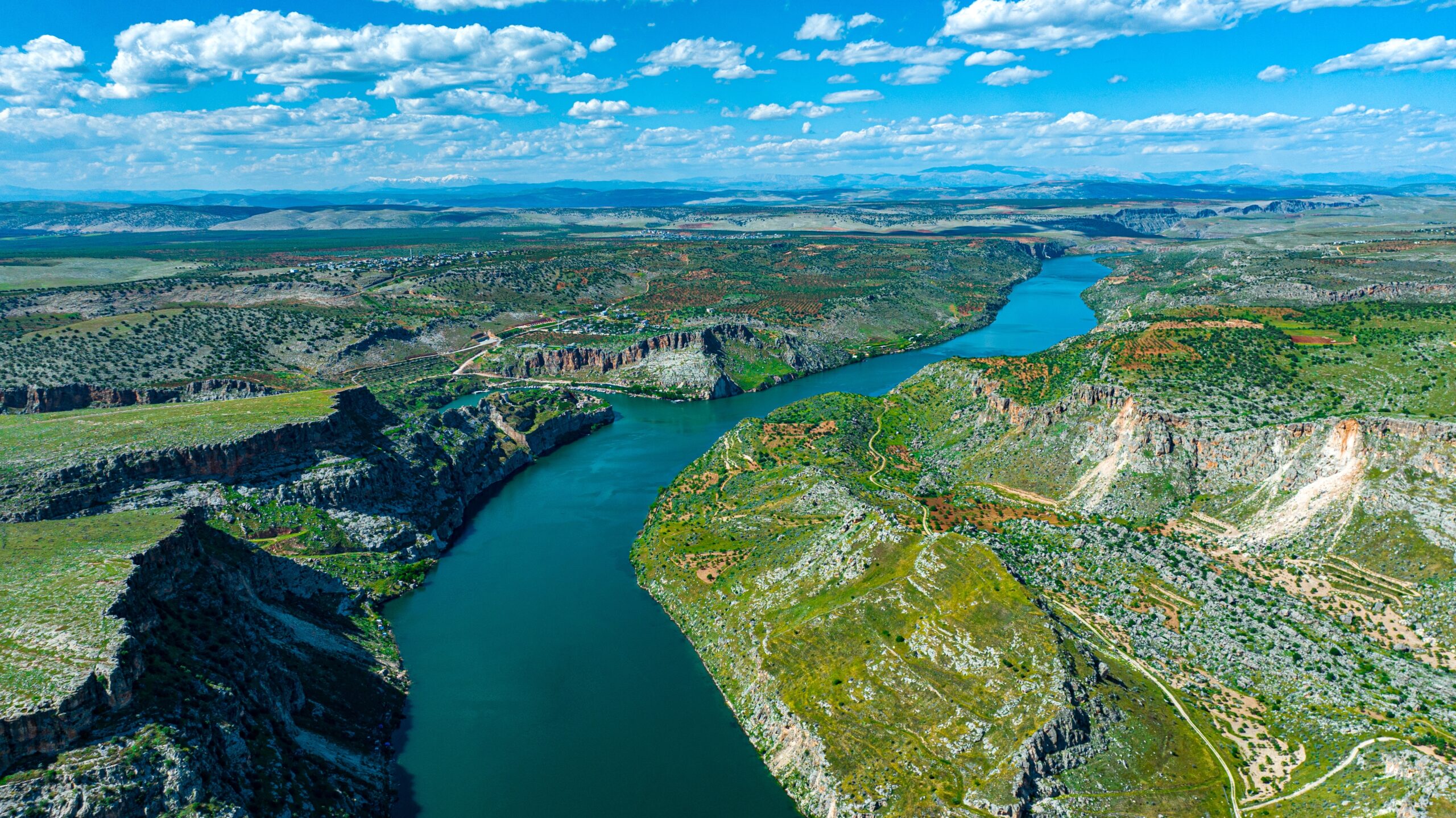
The river that watered the Garden of Eden, defined the borders of the Promised Land, and gave birth to the world’s first civilizations, is running dry. Scientists, government officials, and the United Nations now warn that the Euphrates River, the longest and most historically significant river in Western Asia, could be reduced to nothing more than a muddy trickle by 2040. This is happening now, in real time, and tens of millions of people are already suffering the consequences.
The Euphrates stretches 1,700 miles from the mountains of southern Turkey, flowing through Syria and Iraq before merging with the Tigris River to form the Shatt al-Arab, which then empties into the Persian Gulf. Together, the Euphrates and the Tigris form the Tigris-Euphrates river system — the ancient Mesopotamia, a Greek term meaning “the land between the rivers.” This was the Fertile Crescent, where human civilization first planted roots, where the Sumerians built the world’s first cities, where writing was invented, where agriculture transformed nomadic peoples into settled nations.
Today, that same basin is losing water at one of the fastest rates ever recorded on Earth.
Satellite data collected between 2003 and 2013 documented a staggering loss of 144 cubic kilometers, roughly 34 cubic miles, of freshwater from the Tigris-Euphrates basin. That is approximately 13 million Olympic-sized swimming pools, gone in a single decade. In a 2021 report, Iraq’s Ministry of Water Resources issued a direct warning: the rivers could run completely dry by 2040. Flow levels across the system have already dropped to less than half of average annual levels during dry years. At the Tishrin Dam, the first point at which the Euphrates enters Syria, water levels have fallen five meters, sitting a mere ten centimeters above “dead level,” the point at which turbines stop producing electricity entirely.
Roughly 60 million people across Turkey, Syria, and Iraq depend on this river system for survival. For Syria alone, the Euphrates has historically supplied 85 percent of the country’s agricultural water demand. That number tells the story of what is now unfolding.
The crisis is being driven by three converging forces. Climate change is the first. Rising temperatures have accelerated evaporation rates while simultaneously reducing the rainfall and snowmelt that replenish the river. The region is getting hotter and drier, and the river cannot keep pace.
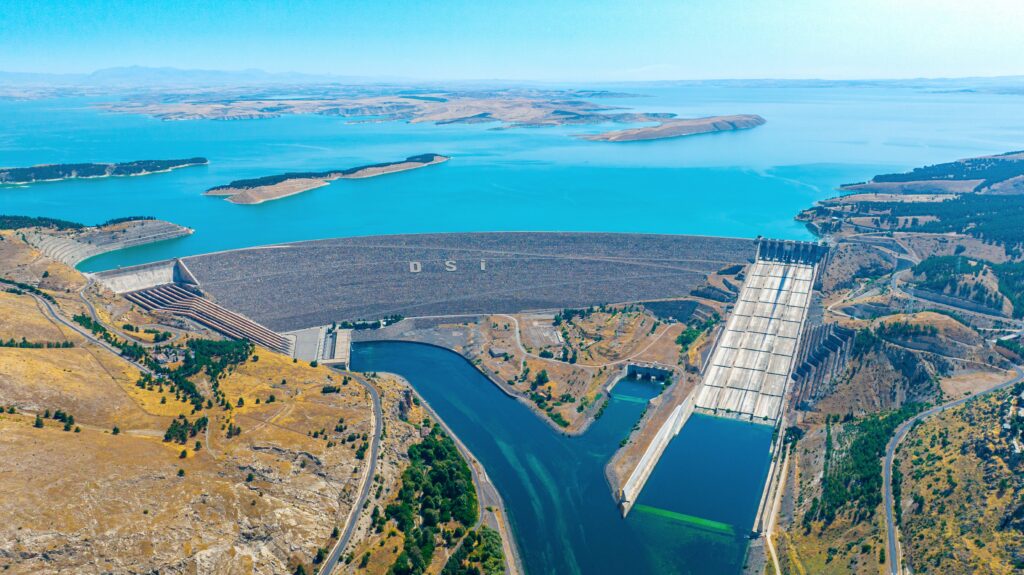
Damming is the second. Turkey alone built 22 dams along the Euphrates, including the massive Ataturk Dam constructed in the 1980s and 90s, designed to generate hydroelectric power and supply irrigation to Turkish agriculture. Each dam upstream is a drain on the countries downstream. Syria and Iraq, already politically unstable, receive what Turkey does not use. International negotiations over shared management of the basin have stalled since the early 2000s, leaving downstream nations with no legal leverage and diminishing water.
The third driver is environmental collapse compounding itself. As water levels fall, what water remains becomes more saline and contaminated, making it unusable for both agriculture and drinking. The marshes of southern Iraq, once a vast and thriving ecosystem, are drying up again after a brief restoration following Saddam Hussein’s drainage campaigns.
The consequences are already catastrophic. Syria’s wheat harvest has dropped by 75 percent since the civil war broke out in 2011, and the drought has made the situation even more desperate. In northeastern Syria, farmers are losing crops not only to low water levels but to the contamination of whatever water remains. The United Nations Food and Agriculture Organization (FAO) reports that nearly 90 percent of rain-fed crops, primarily wheat and barley, failed in recent seasons in Iraq.
Three million people in Syria rely on hydroelectric plants powered by the Euphrates for their electricity. Two dams in northern Syria are facing imminent closure. In Iraq, the water crisis is spawning a public health emergency. A March 2023 article in the British Medical Journal documented surging rates of cholera, typhoid, measles, and chickenpox — all tied directly to the collapse of access to clean water. The potential for mass displacement and regional conflict over water resources is the direction everything is pointing.
Beneath the dried riverbed in Iraq, archaeologists have already begun uncovering what the receding waters leave behind: the remains of nearly 80 sites from the ancient city of Telbas, including jails and cemeteries, once submerged and now exposed by the dying river.
The Euphrates appears in the Hebrew Bible from its very opening pages. In the book of Bereishit (Genesis), the river is described as one of the four rivers flowing from the Garden of Eden:
“The name of the third river is Tigris, the one that flows east of Assyria. And the fourth river is the Euphrates.” (Genesis 2:14)
Later in that same book, God establishes the borders of the land He covenanted to Abraham’s descendants, with the Euphrates as the northeastern boundary:
“On that day Hashem made a covenant with Avram, saying, ‘To your offspring I assign this land, from the river of Egypt to the great river, the river Euphrates.'” (Genesis 15:18)
The Euphrates marks the outer edge of the Promised Land. Its fate is woven into the fate of the nations that dwell in its basin.
The prophet Jeremiah did not mince words about what would befall the land of Babylon, the region encompassing modern-day Syria and Iraq, because of its idolatry. His prophecy was a warning that the land itself would be cursed:
“A drought against its waters, that they be dried up! For it is a land of idols; They are besotted by their dread images. Assuredly, wildcats and hyenas shall dwell there, and ostriches shall dwell there; It shall never be settled again, nor inhabited throughout the ages.” (Jeremiah 50:38-39)
Jeremiah did not merely predict drought as a natural phenomenon. He described it as divine consequence: the land’s water supply stripped away as a direct result of the spiritual condition of the people who inhabit it. The region he described, once the most agriculturally productive in the ancient world, once the very Fertile Crescent that fed the rise of civilization, is now watching its food supply collapse and its water disappear. Those who study prophecy take note: Jeremiah’s words describe not just an ancient moment but an ongoing trajectory.
The Sages understood the prophets as speaking across time. The Nevi’im, the Prophets, were not merely reporting on their own era; they were transmitting divine communication about the arc of history. When Jeremiah describes the waters of Babylon drying up, he is pointing to a reality that unfolds in stages — and the stage being set right now along the banks of the Euphrates fits his description with precision.
Both Islamic and Jewish prophetic traditions assign enormous significance to the fate of the Euphrates in the end of days. In Islamic hadith, Muhammad warned that the Euphrates would dry up, exposing a mountain of gold over which a catastrophic war would be fought, a war in which 99 of every 100 combatants would perish. The hadith frames this not as metaphor but as one of the concrete minor signs of the approaching Day of Judgment.
The biblical prophetic framework, read through Jewish eyes, sees the Euphrates not as a random river but as a boundary marker for world history. The drying of those waters signals the unraveling of a world order, not as an environmental tragedy alone, but as a divine statement about the civilizations that built themselves along its banks and the choices those civilizations made.
The great river is dying. The Bible told us it would.