

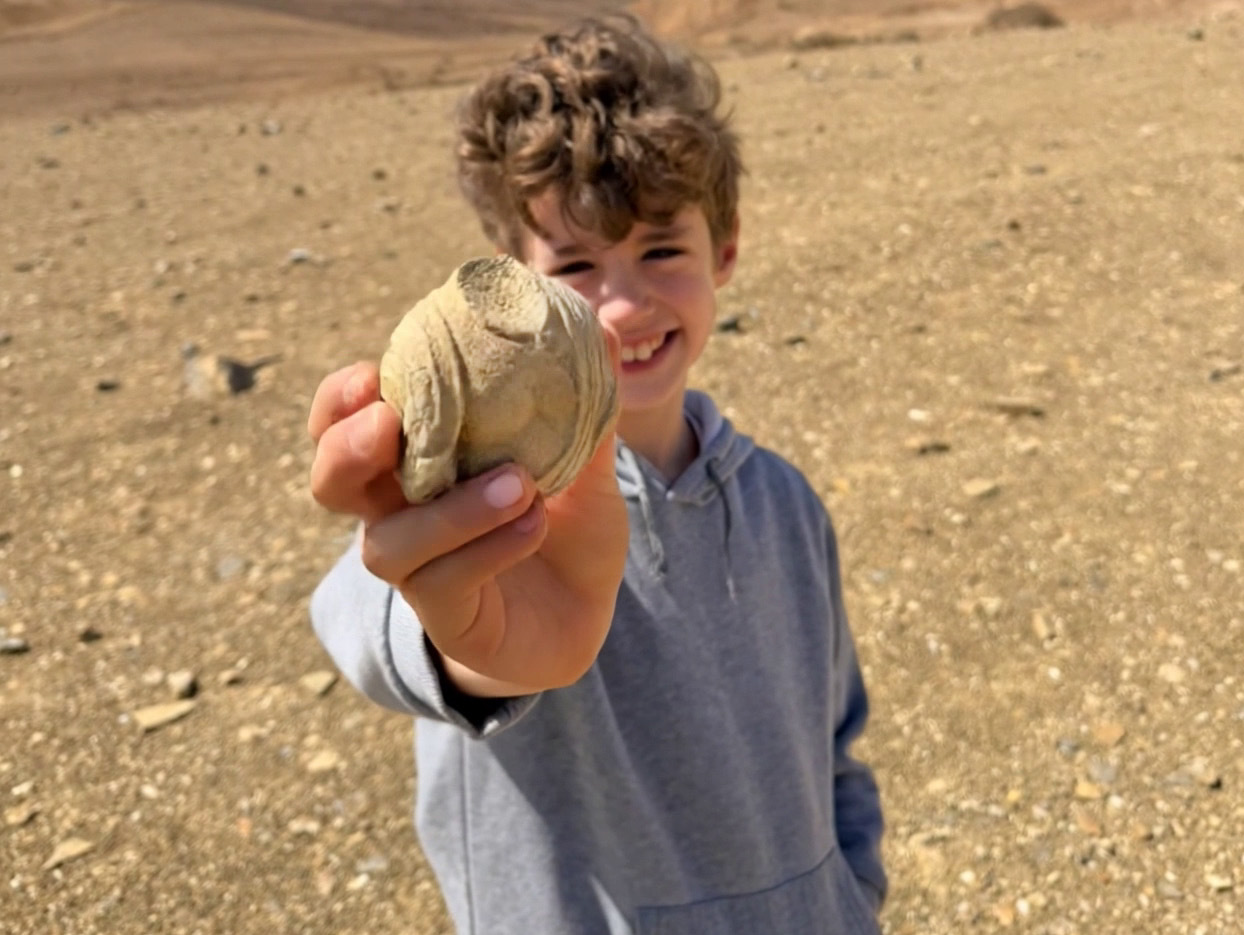
An eight-year-old boy from Rehovot was picking up interesting-looking rocks on a family trip when he unknowingly reached back 1,700 years and pulled out a piece of history. During a reserve paratrooper unit family weekend in the Makhtesh Ramon — the Ramon Crater — Dor Wolynitz spotted what he thought was a striped stone on the ground and handed it to an archaeologist friend of his father’s. It turned out to be a finely sculpted Roman-period statuette fragment, and Dor had no idea what he had found.
In antiquity, the Negev, including Makhtesh Ramon, was remembered as the place where the Israelites wandered in the wilderness for 40 years. The Nabateans, who made their capital at Petra, eventually controlled trade in perfumes and spices and built numerous fortresses along the branch of the Spice Route cutting across the Makhtesh Ramon towards Gaza on the Mediterranean. This is the desert floor where Dor was walking when he spotted the fragment lying in the open.
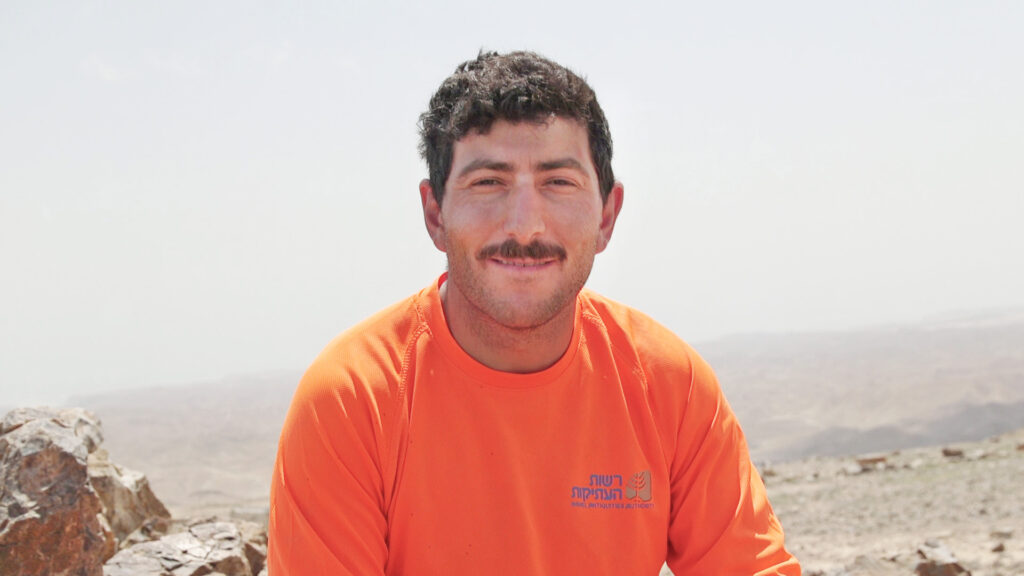
Akiva Goldenhersh, Photo Israel Antiquities Authority
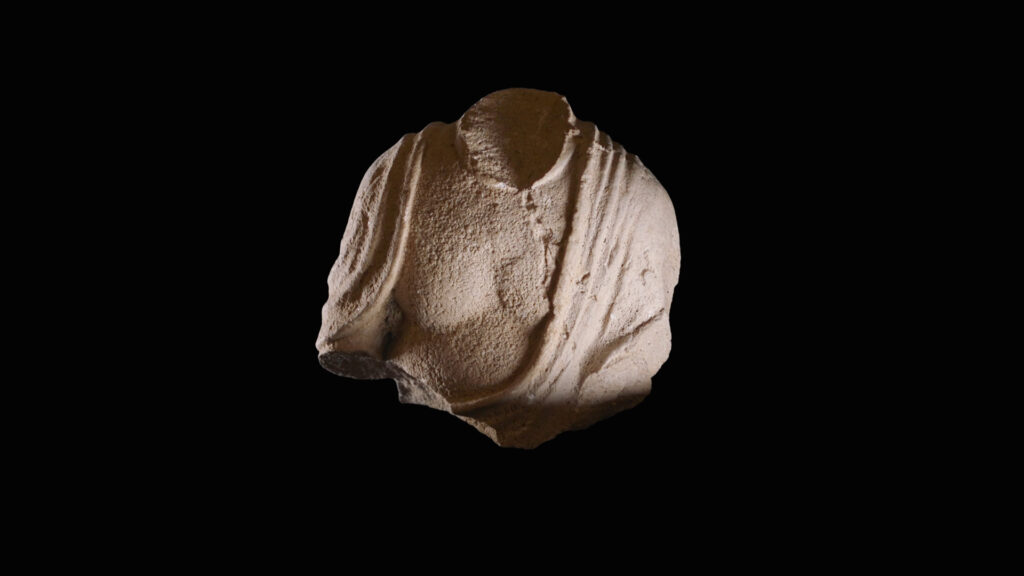
Akiva Goldenhersh, a supervisor at the Israel Antiquities Authority’s Antiquities Theft Prevention Unit, was on the family trip when Dor showed him the find. “At first I thought it was a fossil,” Goldenhersh said, “but then I noticed the sculpted folds of the garment — and I was very excited!” The fragment measures approximately 6×6 cm and depicts part of a human figure wearing a heavy mantle, called a himation, with sculpted fabric folds that create the appearance of a flowing cloak.
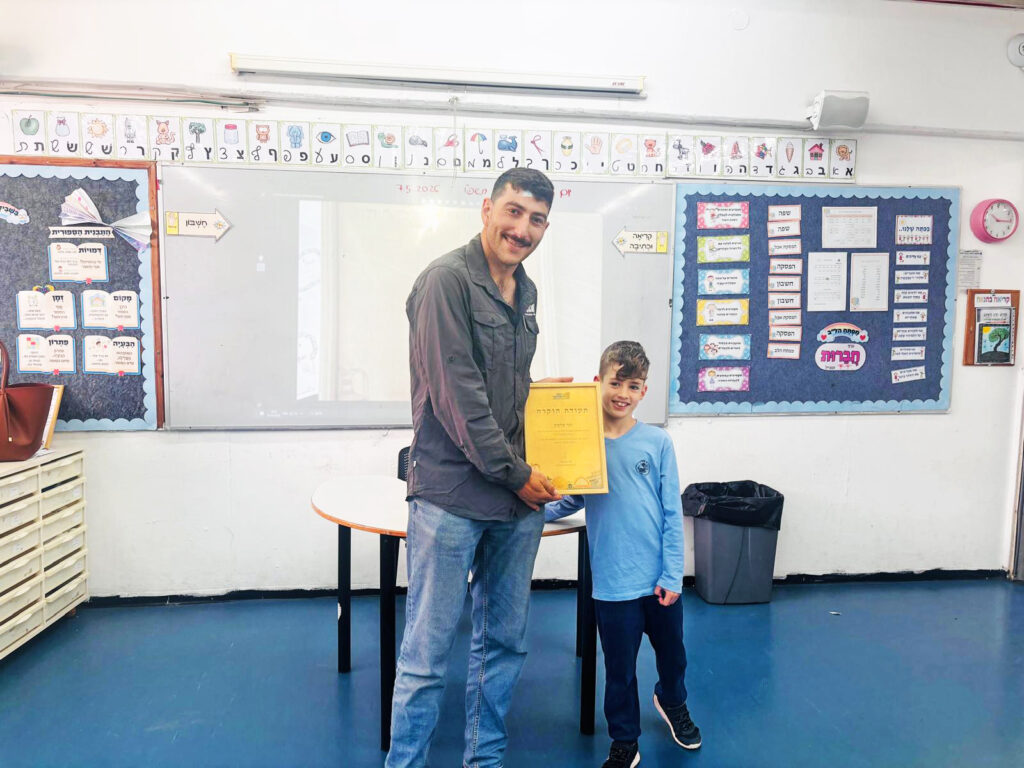
Photo of the boy Dor in the Ramon Crater trip: Akiva Goldenhersh, Israel Antiquities Authority
Laboratory analysis by IAA geologist Dr. Nimrod Wieler identified the material as a light-colored phosphorite, common in the Negev region. That finding carries archaeological weight. “Being made of local material reasonably indicates the statuette was made in Israel and not imported,” Goldenhersh said. “The style of clothing and sculpture is appropriate for the Roman period.” He added that the absence of identifying markings makes definitive identification difficult, “but stylistically, it might be of the god Jupiter, or Zeus-Dushara — a Nabatean god who was identified and merged with Zeus in the context of the encounter between the Nabatean culture that was widespread in the Negev region, and the Hellenistic-Roman world; it is also found in Petra.” In Goldenhersh’s words, “This tiny find thus reflects the combination of local traditions with influences from the classical world.”
Along the Incense Route, every 30 km — roughly the distance a camel can cover in a day’s journey — the Nabateans built caravanserais, stopping points where caravans could rest during the crossing through the desert. It was along these ancient roads that the statuette fragment lay, waiting in the phosphorite dust for a boy with sharp eyes.
Dor handed the find over to the IAA’s National Treasures Department and received a certificate for good citizenship. Israel’s Minister of Heritage, Rabbi Amichai Eliyahu, called the discovery “a moment that illustrates how much history is right under our feet,” and praised Dor directly: “Thanks to him, the find was discovered, will be preserved, and will be able to tell us all the story of the people and cultures that passed through here thousands of years ago.”
Goldenhersh put it plainly: “Every archaeological find is part of our joint heritage in this land. The responsible conduct of Dor and his family is an example of proper civic responsibility and the preservation of our country’s cultural assets. Dor is a role model for us all.”
The Sages taught that the land of Israel speaks — that its stones cry out and its soil holds memory. Dor Wolynitz just proved they were right.
Yes, significantly. The Makhtesh Ramon sits squarely within the Midbar Tzin — the Wilderness of Zin — the same desolate terrain through which the Israelites wandered for forty years after leaving Egypt.
According to scholarly analysis of Numbers 34:3 and its parallel in Joshua 15:1, the entire desert region south of the Dead Sea — including the Makhtesh Ramon area and the territory to its west, “south of Kadesh-barnea” — was called the Midbar Tzin, the Wilderness of Zin.
The location, referred to as Kadesh in the Bible, was the chief encampment site for the Israelites during their wandering in the Midbar Tzin (Deuteronomy 1:46), and the place from which the Israelite spies were sent to scout out Canaan (Numbers 13:1–26). The first failed attempt to capture Canaan was launched from Kadesh (Numbers 14:40–45). Moses struck the rock that brought forth water at Kadesh (Numbers 20:11). Miriam and Aaron both died and were buried near Kadesh.
The Midbar Tzin was where Israel’s greatest crisis of faith played out. The Bible records: “The Lord spoke to Moses and Aaron: ‘Because you did not trust in Me enough to honor Me as holy in the sight of the Israelites, you will not bring this community into the land I give them'” (Numbers 20:12). The forty-year punishment — one year for each of the forty days the spies spent in the land — was handed down in this wilderness.
The word makhtesh itself appears in the Bible. It is a biblical term for a hollow place, and the word Maktesh is used as one of the names for Jerusalem in the book of Zephaniah (1:11): “Wail, O inhabitants of the Maktesh, for all the merchant people are cut down.”
There is also a military connection to the area that dates back to the Bible’s account of the Israelites’ entry into the land. The Negev and its wilderness routes were the staging ground for Joshua’s campaigns and the tribal allotments of Judah and Simeon. The southern border of the Promised Land as described in Numbers 34 runs directly through this terrain.
This is the land where Israel was forged in fire and failure, where God’s miracles were answered with rebellion, and where the generation that left Egypt was buried. That a fragment of a pagan idol — possibly Zeus or a Nabatean fusion deity — was lying in the same dust is its own kind of irony. The desert that witnessed Israel’s covenant with the living God later became a thoroughfare for the gods of Greece and Rome. And now an Israeli child — the grandson of a generation that came back to this land — picks it up and hands it to the State of Israel.