

Elie Mischel
On a Thursday night in Lubbock, Texas, I stood in a room full of Christian teenagers covered in flour.
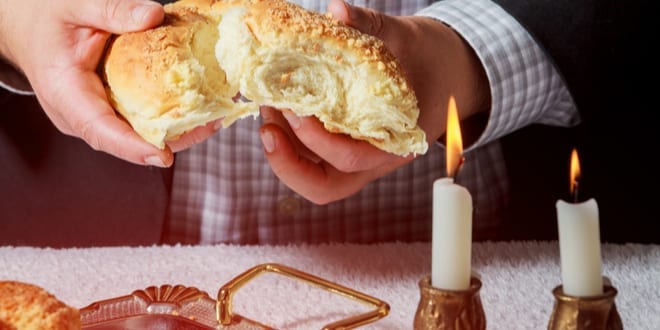
They had come together to bake challah — the braided bread that Jewish families have been preparing on Friday afternoons for thousands of years. I was explaining the meaning behind it: why we braid it this way, why we cover it during the Friday night meal, how something as ordinary as bread becomes a vehicle for holiness, how a dinner table can be more than a place where you eat. These teenagers, not one of them Jewish, living in a city with almost no Jewish community, were leaning in with a kind of hunger I wasn’t expecting.
I travel across America regularly. I’ve done Shabbat programs in Spokane and Colorado and cities in between. But Lubbock stopped me.
The next afternoon, before Shabbat began, more than a hundred Christians gathered for a model Shabbat meal. What struck me wasn’t the size of the crowd. It was where they had come from. They were not one organized group, but many: small Bible study circles, home fellowships, individual families who had been quietly exploring the Jewish roots of their faith and independently, without knowing about each other, arriving at the same place. Several of them had been meeting in separate living rooms across Lubbock for months, studying the same Hebrew Bible, asking the same questions, feeling the same pull toward Shabbat. They had never all been in a room together before.
And every one of them was hungry for exactly this.

Give to the Rise Up with Israel campaign here.
Nobody sent these Christians to Shabbat. No organization recruited them, no curriculum pointed them there, no rabbi showed up on their doorstep. They got there on their own — through their Bibles, through their restlessness with a world that never stops, through a growing conviction that God’s command to rest one day in seven was not a quaint ancient custom but a lifeline their lives were missing. When they heard I was coming to Lubbock, they didn’t walk to sign up. They ran.
This is the phenomenon I keep encountering everywhere I go, and it is the reason I wrote Shabbat Revolution: A Practical Guide to Weekly Renewal. Not because Christians need to become more Jewish — they don’t — but because something is stirring in America’s churches and living rooms that the Jewish community has barely noticed, and that we are almost uniquely positioned to respond to. Christians across this country are rediscovering that the God of the Hebrew Bible built rest into the fabric of creation before He built anything else, and they want to know what it looks like to actually honor that.
What they need is a guide. What has been missing is a Jewish organization willing to show up and offer one — not to change anyone, not to blur the lines between our faiths, but to share something that was always meant to be shared.
The God who rested on the seventh day was not resting for the Jews. He was teaching the world.
We are living through a moment of civilizational crisis, and I don’t think that’s an overstatement. Families are fracturing under the pressure of a world that never stops demanding. Faith is being pushed further and further from public life. The average person checks their phone more than a hundred and fifty times a day, and the anxiety that comes with that constant connectivity is hollowing people out in ways that no political program can fix. Jews and Christians are watching their communities erode under the same forces, fighting many of the same battles, and still largely failing to recognize each other as the natural allies they are.
Shabbat is the answer that predates the question. One day each week, every week, without exception: stop. Put the phone in a drawer. Sit at the table. Bless your children. Sing together. Eat together. Remember that the world was here before you and will be here after you, and that your job tonight is simply to be present in it.
When Jews and Christians do this — each in their own way, but with a growing awareness of each other — something happens that no political rally can manufacture. They become harder to divide and harder to defeat. The teenagers in Lubbock baking challah on a Thursday night are part of the same army as the Jewish families opening their homes on Friday night in Dallas and Nashville. The battle is the same. The weapon is the same. Only the uniforms are different.
This is what Israel365 is building. This is what your support makes possible this May.
The movement is already out there. It is already growing, already spreading through living rooms and Bible studies and Thursday night challah-baking sessions in cities where almost no one is Jewish.
We just need to show up.