
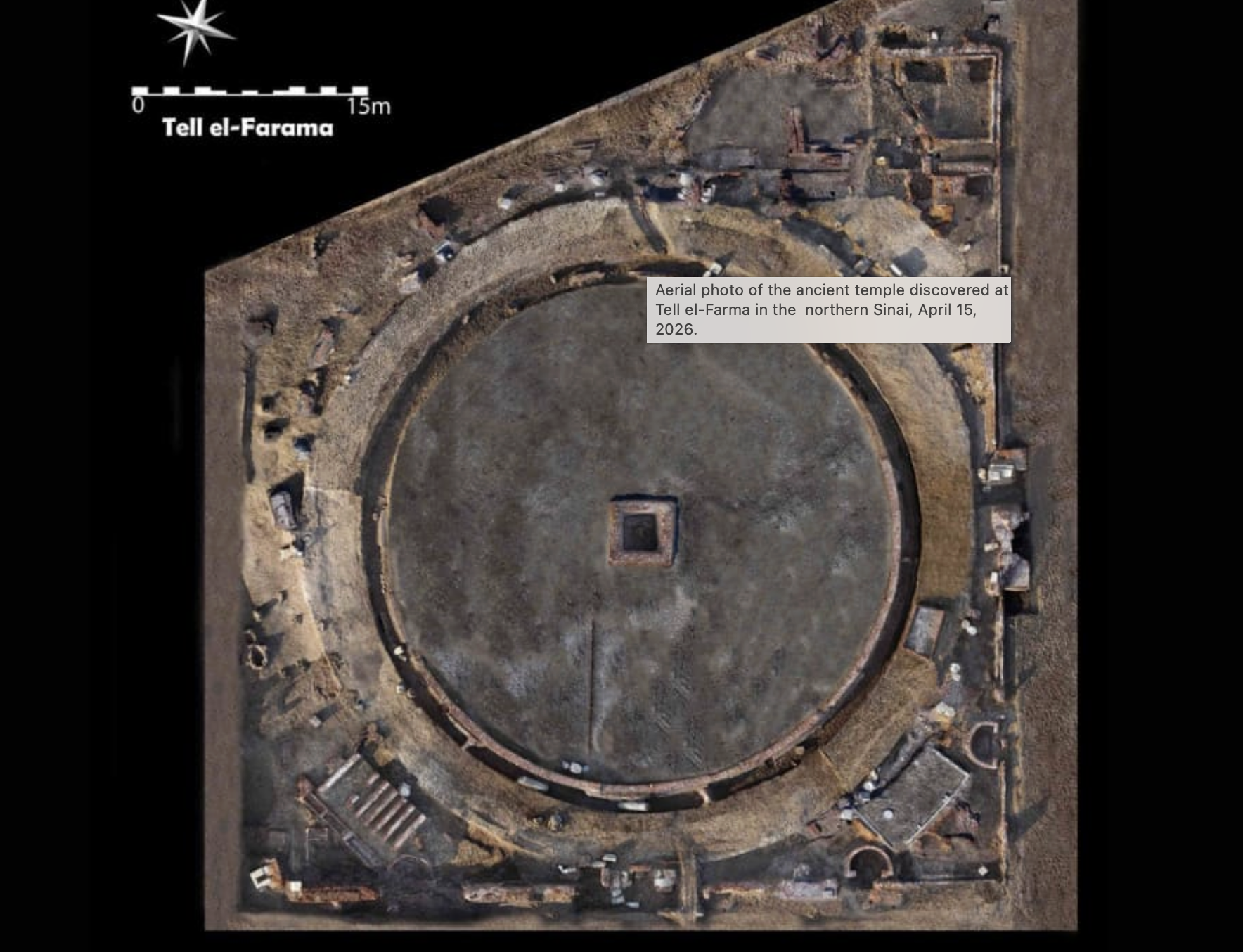
A massive circular basin, more than 100 feet across and once filled with Nile water and silt, has emerged from the sands of northern Sinai, offering a rare glimpse into an ancient ritual complex at a site long associated with a city named in the Bible.
Egyptian officials announced that the structure was uncovered at Tell el-Farama, widely identified with the ancient city of Pelusium. The site is also linked by many scholars to the biblical city of Sin, mentioned by the prophet Ezekiel as a major Egyptian stronghold.
The excavation revealed a circular basin measuring approximately 115 feet in diameter, surrounded by channels and reservoirs, with multiple access points. According to Egypt’s Ministry of Tourism and Antiquities, the basin was filled with water mixed with Nile silt, symbolizing devotion to the local deity Pelusios, whose name is derived from the Greek word for mud. Archaeologists determined that the installation was in use from the second century BCE through the sixth century CE, spanning the late Hellenistic, Roman, and Byzantine periods.
The site’s identification with the biblical Sin gives the discovery added weight. In Scripture, Sin is described as a “center of power” within Egypt’s defenses. The prophet states, “I will pour out My wrath upon Sin, the stronghold of Egypt” (Ezekiel 30:15).
The Sages understood prophetic references to Egypt not merely as geography but as a symbol of entrenched power and resistance to divine authority. Pelusium’s position on Egypt’s northeastern frontier, guarding the approaches from the Land of Israel, fits precisely with this description. It functioned as a military and economic gateway, a role that aligns with the biblical characterization of Sin as a fortified hub.
🏺 Archaeologists in North Sinai have uncovered a remarkable ancient sacred water temple at the site of Pelusium, revealing a unique glimpse into Egyptian rituals from centuries ago.
— ___ / 𓆑𓂋𓄿𓂋𓇋𓁐 ___ = Valerie (@Val_NuestraCosa) April 14, 2026
🌊 At the heart of the complex stands a massive circular basin stretching 115 feet wide,… pic.twitter.com/zhlFG9ApD9
The discovery unfolded over several years. In 2019, archaeologists first uncovered part of a red-brick circular structure. Initially believed to be a civic building, further excavation revealed a “sacred water installation” tied to ritual practices. The basin’s design, including its channels and reservoirs, points to a complex system intended for ceremonial use rather than simple storage.
Sherif Fathy, Egypt’s minister of tourism and antiquities, said the find “underscores the strategic and archaeological importance of North Sinai, which is rich in promising sites that still hold many secrets.”
Recent announcements from Egypt have highlighted additional discoveries, including a cache of papyrus scrolls dating back nearly 3,000 years and the remains of a monastery from the early centuries of Christian monasticism. These finds collectively point to the region’s long-standing religious significance across multiple eras.
For readers of the Bible, the exposure of Pelusium’s ritual infrastructure sharpens the historical backdrop of Ezekiel’s prophecy. The verse names a real city, a fortified gateway, and now, through archaeology, a place of water rituals tied to foreign worship. The physical remains uncovered at Tell el-Farama bring that reality into clear focus, grounding the prophetic words in the dust and stone of a city that once stood at the edge of Egypt’s power.