


A newly conserved ritual bath from the Second Temple period has been opened to the public at Tel Hebron, revealing a large-scale installation that connects directly to daily Jewish life in the final centuries before the destruction of the Temple in Jerusalem. The structure, a massive mikveh carved into bedrock and filled through an ancient water system, has undergone years of stabilization and restoration work by the Israel Nature and Parks Authority, turning an archaeological find into a fully accessible historical site.
The mikveh, first uncovered in 2014 during excavations led by the Staff Officer for Archaeology under Dr. Emanuel Eisenberg and Prof. David Ben-Shlomo, is among the largest of its kind discovered in the land of Israel. Its volume reaches approximately 200 cubic meters. The structure is built in two main sections: a wide stairwell descending into the ground and a deep, cave-like chamber hewn into natural stone. The scale and engineering reflect a deliberate investment in ritual infrastructure at a time when purity laws governed large areas of Jewish communal and religious life.
The conservation project, now nearing completion, included complex stabilization of the rock-cut chamber, preservation of ancient plaster layers still attached to the walls, and treatment of cracks in the bedrock to prevent further collapse. Engineers and preservation specialists also restored elements of the ancient water collection system that supplied the mikveh, ensuring that the structure could be safely accessed while maintaining its original archaeological integrity.
According to Ilia Burda, director of Tel Hebron on behalf of the Israel Nature and Parks Authority, the work is part of a broader effort to make the site accessible while preserving its historical fabric. He described the project as one designed to allow visitors to encounter the physical remains of Jewish life in the region during the Roman era, particularly the role of ritual purity in daily practice. The goal, he said, is to give visitors direct contact with the material culture of the period rather than viewing it only through reconstructed explanations.
Tel Hebron, known in Hebrew as Tel Hevron, sits on the southern slopes of the ancient city of Hebron, approximately 1.5 kilometers from Me’arat HaMachpelah (the Cave of the Patriarchs). The site is widely regarded as one of the most archaeologically significant locations in the region due to its continuous layers of settlement spanning the Canaanite, Israelite, Second Temple, Roman, and later periods.
Among its most prominent features is a massive Canaanite fortification wall dating to the Early Bronze Age, sometimes referred to as the “Cyclopean Wall,” preserved in sections reaching about four meters in height. Additional finds include Iron Age fortifications, a stepped Roman street, industrial installations such as a pottery kiln, and a large wine and oil press complex from later Roman and Byzantine periods.
The newly opened mikveh adds a direct link to the Second Temple period presence at the site. Ritual baths of this size were not standard household installations. Their dimensions suggest use by a substantial population or by groups of pilgrims traveling through the region during the Roman period, when Hebron remained a significant Jewish settlement outside the major Temple center in Jerusalem.
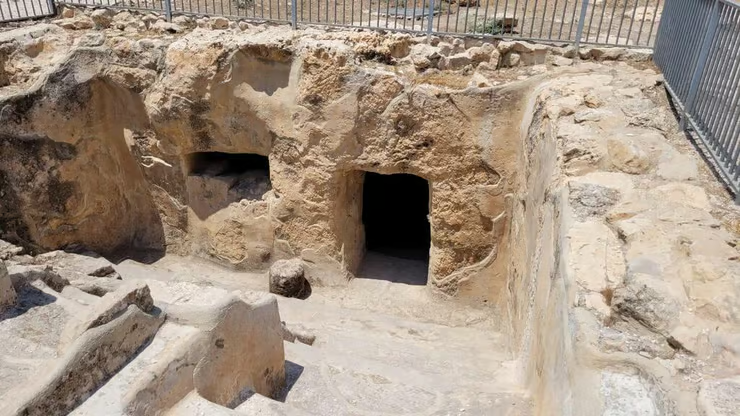
מערה שנחצבה בסלע והייתה חלק ממקווה הטהרה שהתגלה באתר הארכיאולוגי תל חברון
(צילום: איליה בורדה, רשות הטבע והגנים)
Ilan Cohen, heritage coordinator for the Judea and Samaria region of the Israel Nature and Parks Authority, described Tel Hebron as a site where multiple historical layers converge into a continuous record of settlement. He noted that findings from the site include inscriptions, administrative seals, and everyday objects that span from the Early Bronze Age through the Second Temple period and beyond. Among the discoveries are a clay tablet with an Akkadian cuneiform list of livestock, a First Temple-era seal inscribed with a personal name, and jar handles marked “lamelech” and “lamelech Hevron,” indicating royal administrative activity in the Iron Age.
Cohen also highlighted finds from the Roman period, including coins from the Bar Kokhba revolt, as well as evidence of expanded settlement beyond the ancient city walls, including industrial zones and additional ritual installations. He described Hebron as one of the earliest major urban centers in the region, with continuous occupation and strategic importance over millennia.
The archaeological record at Tel Hebron supports that continuity. Excavations have revealed that the city was established in the Early Bronze Age and functioned as a major Canaanite center. During the Iron Age, it became a fortified Israelite city. In the Second Temple period, the settlement expanded and integrated religious infrastructure such as mikvaot, reflecting the centrality of purity laws in Jewish life. Later periods saw adaptation of earlier structures for agricultural and industrial use.
A foundational textual reference to Hebron appears in the account of Abraham’s purchase of the burial site in the Cave of Machpelah:
“And the field of Ephron, which was in Machpelah, which was before Mamre, the field, and the cave which was therein, and all the trees that were in the field, that were in all the border thereof round about, were made sure unto Abraham for a possession in the presence of the children of Heth, before all that went in at the gate of his city.” (Genesis 23:19)
The biblical association of Hebron with Abraham establishes the city’s role as one of the earliest recorded centers of Hebrew presence in the land. The archaeological layers at Tel Hebron align with that long historical narrative, from early settlement through later Jewish communal life centered on Temple-era observance.
The opening of the restored mikveh marks a new stage in public access to the site. Visitors can now descend into the ancient stone-cut chamber, observe the preserved plasterwork, and view the water system that once enabled ritual immersion according to halakhic requirements. The experience provides direct exposure to the material conditions of purity observance during the final centuries of the Second Temple period.
Work at Tel Hebron is ongoing, with additional areas of the site still under conservation and excavation. The mikveh now stands as one of the most tangible remains of Second Temple life uncovered at the site, linking archaeological evidence with the historical record of Hebron as a continuously inhabited and ritually significant city across ancient periods.