




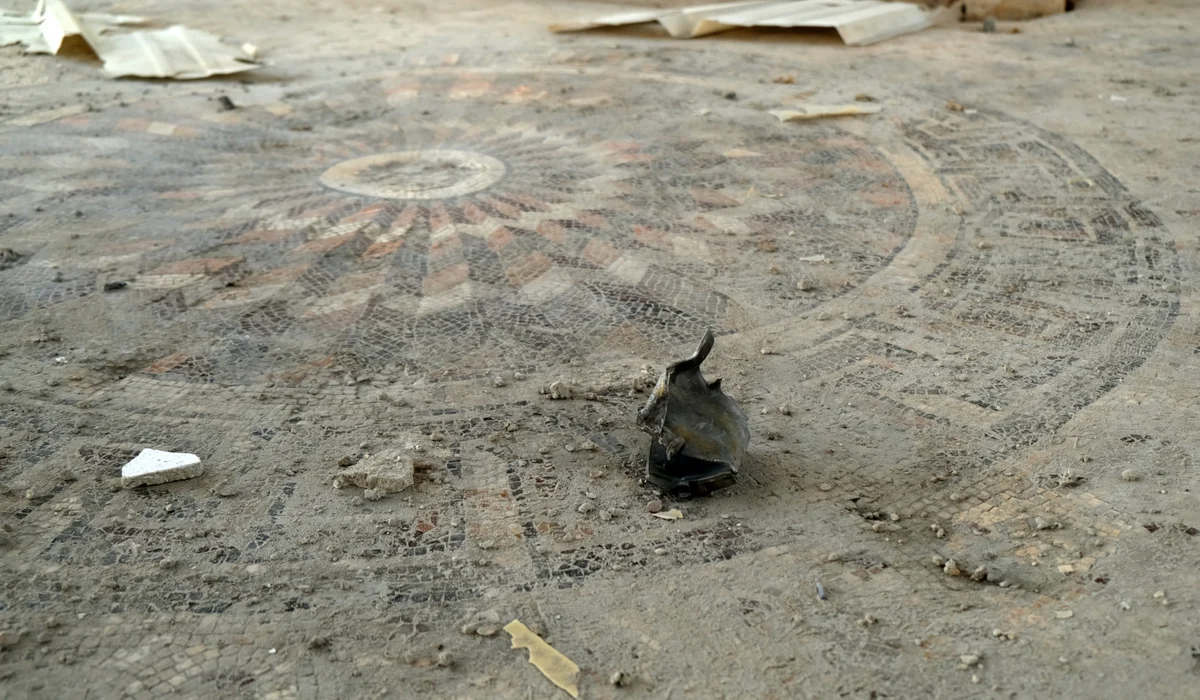
A Hezbollah rocket slammed into a 1,500-year-old Byzantine church in the northern Israeli city of Nahariya last Friday night, damaging the modern structure built to protect one of the most remarkable ancient mosaic floors ever discovered in the land of Israel.
The Israel Antiquities Authority confirmed to The Times of Israel that the rocket struck a pavilion inaugurated in 2022 to house and protect a mosaic floor spanning more than 500 square meters — nearly 5,400 square feet — in the Katznelson neighborhood of Nahariya. The church itself was first uncovered in 1964 during the construction of a local school. According to the IAA, the floor belonged to a church destroyed during the Sasanian Persian invasion of 614 CE and was completely burned down.
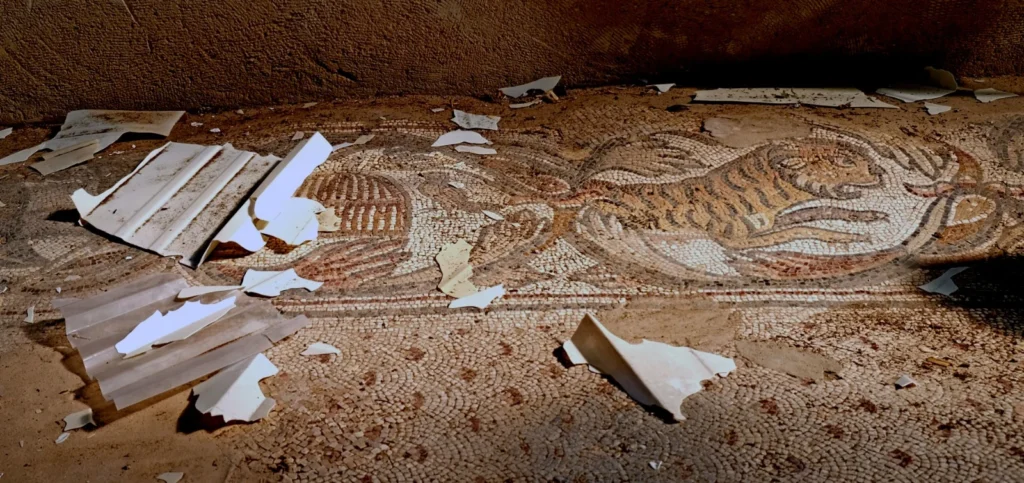
The remains of a Byzantine church dating back some 1,500 years in the northern city of Nahariya were hit by a Hezbollah rocket on April 10, 2026. (Emil Aladjem/ Israel Antiquities Authority)
The colorful mosaic features animals, plants, and human figures arranged in 100 medallions along the perimeter of the floor. Eighty-seven of those medallions survived intact into the present day. At the center of the church stood a rozetah — a rosette, a circular floral design — that anchored the entire composition. Nahariya Mayor Ronen Marelly, speaking at the 2022 inauguration, called it “a site of great archaeological value” and pledged to make it accessible to residents and tourists alike.
The IAA convened an emergency assessment on Sunday with archaeologists, conservators, and representatives of the municipality and the Property Tax Authority. Their initial conclusion: the mosaic itself was buried under debris from the collapsed modern structure but was not directly damaged. That assessment will require further verification as the rubble is cleared. IAA photographs taken after the attack show a scene of ruin — rocks, broken bricks, and a thick layer of destruction coating what was once a window into the ancient world.
It is interesting to note that the Qatari-news outlet Al Jazeera reported the incident by describing the target as an “Israeli church”.
Since the beginning of the US-Israel war with Iran on February 28, Hezbollah has fired hundreds of rockets into northern Israel. Even after a ceasefire between Iran and Israel went into effect last Thursday, Hezbollah and Israel have continued trading fire — and the ancient church in Nahariya was caught in that exchange.
Iranian ballistic missiles have also struck in the vicinity of Jerusalem’s holy sites, bringing the war’s shadow directly over the city that the Psalms call kiryat Elohim — the city of God. That Iran and its proxies are now routinely targeting the land surrounding these sites highlights the religious nature of this conflict.
The mosaic in Nahariya survived the Sasanian Persians in 614 CE. Whether it survives the enemies of Israel in 2026 CE depends on what Israel does next.

