


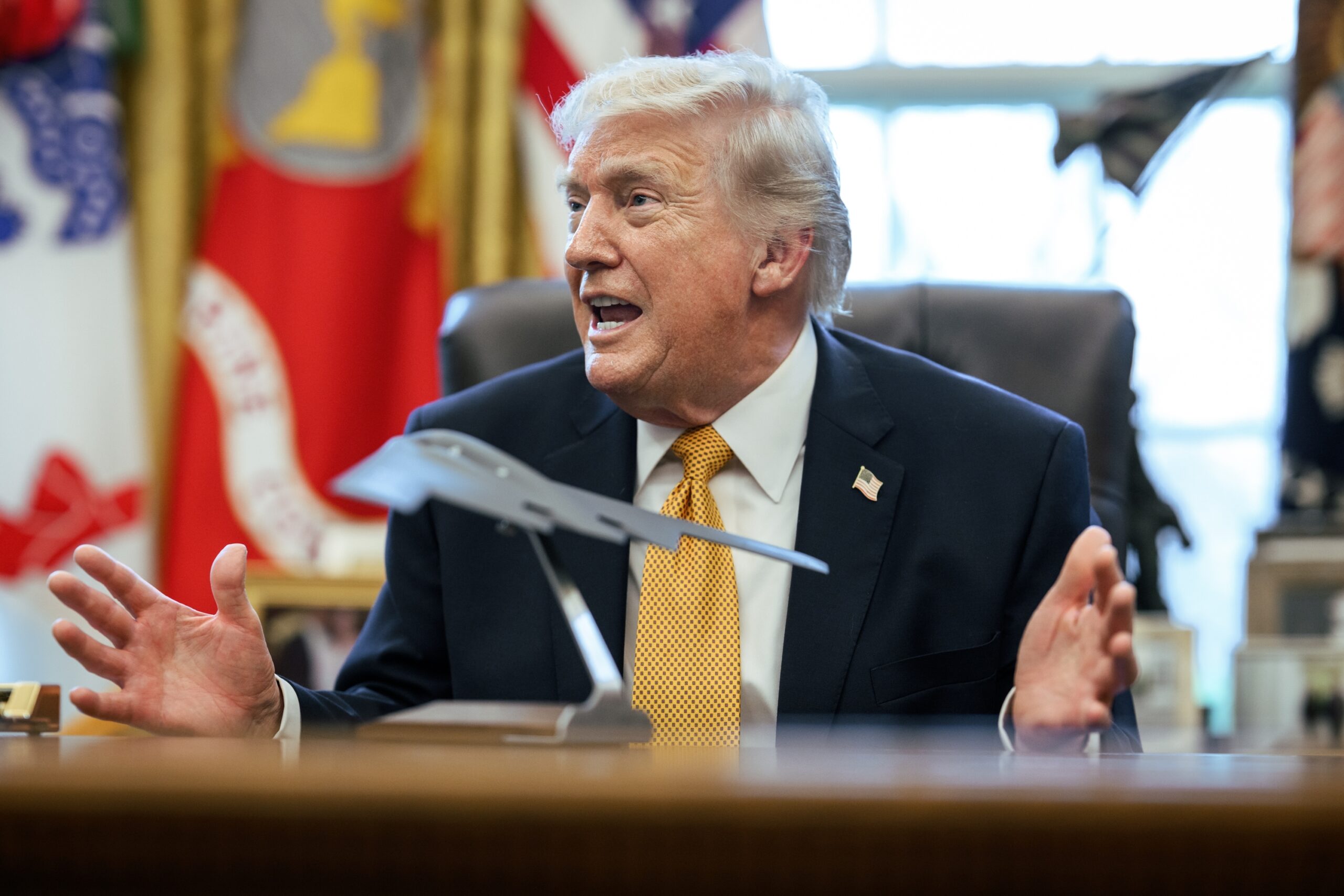
A historic public confrontation between the White House and the Vatican has erupted over the ongoing U.S.-Israel military campaign against Iran, and this week it took a jarring turn. President Donald Trump posted an AI-generated image of himself depicted as Jesus on Truth Social, drawing condemnation from his own supporters, even as his war of words with Pope Leo XIV over the Iran campaign continued to escalate. The feud now pits an American president against the first American pope in the history of the Catholic Church.
The conflict between President Donald Trump and Pope Leo XIV has escalated sharply in recent days, with the two most prominent Americans on the world stage trading blows over the military campaign against Iran, a war that has reshaped the geopolitical landscape and forced a reckoning within the Catholic Church itself.
The Pope Speaks From St. Peter’s
On the evening of April 11, Pope Leo XIV presided over a solemn prayer vigil at St. Peter’s Basilica, joined by parishes on every continent. Thousands gathered beneath the ancient dome as Leo, seated on a white throne in his red cape and liturgical stole with a rosary in hand, delivered what many observers described as his sharpest condemnation yet of the U.S.-Israel campaign.
Without naming Trump, Vice President JD Vance, or the United States directly, the pope’s words left little room for interpretation.
“Enough of the idolatry of self and money,” he declared. “Enough of the display of power. Enough of war. True strength is shown in serving life.”
He also warned that the “holy Name of God, the God of life, is being dragged into discourses of death”, a pointed reference widely interpreted as directed at U.S. Defense Secretary Pete Hegseth and other American officials who have publicly invoked their Christian faith to frame the campaign in religious terms.
The following day, speaking at the Regina Caeli, Leo pressed further. “The principle of humanity, inscribed in the conscience of every person and recognized in international law, entails the moral obligation to protect the civilian population from the atrocious effects of war,” he said. “I appeal to the parties in conflict to cease fire and urgently seek a peaceful solution.”
Leo, a Chicago-born pontiff who was initially reluctant to criticize the military action publicly, has grown increasingly outspoken since Palm Sunday. He has called Trump’s threats against Iranian civilization “truly unacceptable”, which is language rarely used by the Holy See toward an American president.
Trump Fires Back
In a furious post on Truth Social, Trump responded: “Pope Leo is WEAK on Crime, and terrible for Foreign Policy.”
He continued: “I don’t want a Pope who thinks it’s OK for Iran to have a Nuclear Weapon. I don’t want a Pope who thinks it’s terrible that America attacked Venezuela. And I don’t want a Pope who criticizes the President of the United States because I’m doing exactly what I was elected, IN A LANDSLIDE, to do.”
Trump went further still, suggesting that Leo only ascended to the papacy because he was American, and that Vatican insiders believed his nationality would give them leverage over the White House. “If I wasn’t in the White House, Leo wouldn’t be in the Vatican,” Trump wrote.
Speaking to reporters, the president was blunt: “I don’t think he’s doing a very good job. He likes crime, I guess. He’s a very liberal person.”
The Image
Late Sunday night, Trump shared an AI-generated image on Truth Social, without any written comment. In it, the president appears dressed in a white robe and red sash, laying healing hands on a sick man while surrounded by a nurse, a soldier, and other adoring figures. In the background: American flags, soaring eagles, military jets, and soldiers ascending toward a heavenly light.
The backlash came immediately, and not from his critics, but from his own camp. Former Representative Marjorie Taylor Greene, who resigned from Congress in January after clashing with the president and her own party, wrote on X: “It’s more than blasphemy. It’s an Antichrist spirit.”
On Orthodox Easter, President Trump attacked the Pope because the Pope is rightly against Trump’s war in Iran and then he posted this picture of himself as if he is replacing Jesus.
— Former Congresswoman Marjorie Taylor Greene🇺🇸 (@FmrRepMTG) April 13, 2026
This comes after last week’s post of his evil tirade on Easter and then threatening to kill an… pic.twitter.com/mq27jxJEnt
Reactions on Truth Social itself were split, with many of his supporters expressing discomfort. “There is no excuse whatsoever to put yourself in the place of Jesus Christ…Not even Trump can get away with putting something out there showing himself as Jesus. He’s not that great,” wrote one Truth Social user with the handle Key of David.
Others defended the image. Conservative commentator David J. Freeman called it “a powerful painting,” describing how “Trump stands radiant in a red robe, laying hands on a sick man while surrounded by American symbols, the flag, eagles, fighter jets, the Statue of Liberty, and everyday heroes.” Reverend Jordan Wells, a conservative pastor and self-declared Zionist, argued on X that Trump “isn’t calling himself Jesus,” but is rather “answering God’s call.”
“Trump is openly praying for the sick,” Wells wrote, “and as Protestants, we still believe in the power of prayer.”
The image arrived only days after reports surfaced of a tense January meeting between Pentagon and Vatican officials, in which Under Secretary of War for Policy Elbridge Colby summoned Cardinal Christophe Pierre, Pope Leo XIV’s then-ambassador to the U.S., to the Pentagon and told him that the Vatican should align with the Trump administration’s military tactics. A Defense Department spokesperson told Newsweek that The Free Press’s characterization of the meeting was “highly exaggerated and distorted.”
The post has now been deleted.
Trump Denies Image Was Jesus-Like
In a Q-and-A with reporters, President Trump denied the image was intended to depict him as Jesus:
“Mr. President, did you post that picture of yourself?” he was asked.
“Well, it wasn’t a depiction [of me as Jesus],” he responded. “I thought it was me as a doctor, and had to do with the Red Cross, as a Red Cross worker. which we support.”
“Only the fake news could come up with that one, so I just heard about it, and I said, ‘How do they come up with that?’ It’s supposed to be me as a doctor, making people better.”
The War That Started It All
The military campaign at the center of this dispute began on February 28, when Israel and the United States launched coordinated strikes against Iran aimed at dismantling its nuclear and ballistic missile infrastructure and destabilizing the regime. Iran responded with missile and drone attacks across the region, while Hezbollah launched intensified rocket barrages into Israel from southern Lebanon, triggering Israeli airstrikes and a ground operation in Lebanon.
Trump has pursued a dual-track strategy: military pressure combined with diplomatic outreach. He announced a two-week ceasefire contingent on Iran fully reopening the Strait of Hormuz, and face-to-face negotiations between U.S. and Iranian officials were held in Islamabad, Pakistan. The talks broke down after Iran refused to abandon its nuclear weapons program.
“We win regardless of what happens,” Trump told reporters. “Maybe they make a deal, maybe they don’t.”
A Pope Out of Step With the Conflict’s Origins?
Critics of the Vatican’s position argue that Pope Leo’s repeated calls for peace consistently omit crucial context. The campaign against Iran came after years of Iran developing a nuclear weapons program in violation of international agreements, while simultaneously funding and arming proxy militias, most notably Hezbollah, that have fired between 8,000 and 10,000 rockets, drones, and anti-tank missiles into Israeli territory since October 7, 2023. Those attacks drove mass displacement across northern Israel and represented one of the most sustained rocket campaigns against a civilian population in modern history.
A Pattern of Imbalance: Leo, Francis, and Israel
Pope Leo’s predecessor, Pope Francis, faced sustained criticism throughout the Gaza war that followed the Hamas terrorist attacks of October 7, 2023. While Francis condemned the Hamas attacks, his repeated calls for ceasefires and documented phone calls with Catholics in Gaza, without equivalent public outreach to Israeli victims, left many feeling the Vatican was applying an unequal moral standard to Israel’s right of self-defense.
Pope Leo has largely continued in that tradition. Since Hamas’s October 7 massacre, in which approximately 1,200 Israelis were killed and around 250 taken hostage, Leo has called for humanitarian protection and ceasefires in Gaza. His public statements have drawn significantly more passion when directed at American and Israeli military policy than at the actions of Hamas or Hezbollah, both internationally designated terrorist organizations whose foundational charters call for the destruction of the Jewish state.
A Reckoning in the Pews
The feud is landing at a politically perilous moment for the president. A Pew Research Center poll released in February showed that approval of Trump’s handling of his role had dropped to 52 percent among white Catholics, down from 59 percent a year earlier, and to 23 percent among Hispanic Catholics, down from 31 percent. The belief that Trump is acting ethically in office was also down across all religious groups, including white Catholics, from 39 percent to 34 percent, and Hispanic Catholics, from 22 percent to 14 percent.
A separate NBC poll found that U.S. registered voters now view the pope more favorably than the president. Some 42 percent of respondents view Leo positively, while only 8 percent view him negatively. Trump, by contrast, is viewed favorably by 41 percent and negatively by 53 percent, for a net negative of 12 points.

