

Elie Mischel
Ask any Sunday school student who led the Israelites out of Egypt, and they’ll give you the same answer: Moses. But the prophet Micah tells a different story. “For I brought you up from the land of Egypt, and redeemed you from the house of slavery, and I sent before you Moses, Aaron, and Miriam” (Micah 6:4). Three leaders, one liberation. And one of them was a woman named Miriam.
As Passover approaches, we want to introduce you to her. Not the supporting character you may have glimpsed at the riverbank — the real Miriam: bold, prophetic, complicated, and indispensable to the story of the Exodus.
Before we begin: If you want to understand the Exodus the way the Jewish people have lived it for three thousand years, Shira Schechter’s Passover from the Inside: A Jewish Guide for Christian Readers is exactly what you need. Written by a celebrated Jewish educator and Bible scholar, it takes you inside the Passover Seder — the preparation, the rituals, the ancient texts — and shows you how this story transforms the way you read Scripture. Get your copy here.
1. Miriam is Not a Supporting Character
Micah doesn’t say Moses led Israel out of Egypt with some help. He names three leaders of equal standing: Moses, Aaron, and Miriam. Jewish tradition understands the Exodus as requiring all three siblings, each contributing something irreplaceable. Moses gave Israel the Torah. Aaron gave Israel the priesthood. And Miriam? She gave Israel something equally essential — as you’re about to see.
2. Her Name Meant Bitterness — and She Refused to Accept It
Miriam was born during one of the darkest stretches of Egyptian slavery. Her very name echoed the suffering of her people — mar, the Hebrew root for bitter. And yet this is precisely when, according to the Sages, the young Miriam stepped forward and prophesied: “My mother is destined to give birth to a son who will save Israel.” In the depths of Egypt, when hope had all but died, a child refused despair. She is the first optimist in the Exodus story.
3. She is the Youngest Prophet in the Bible
Miriam is one of seven women recognized as prophetesses in the Hebrew Bible. What sets her apart from the others is when she prophesied: she was approximately six years old. No other individual in Scripture is recorded as receiving divine prophecy at such a young age — not Isaiah, not Jeremiah, not anyone. The word of God came to a child in the house of a slave.
4. She Saved Moses Before Moses Could Save Anyone
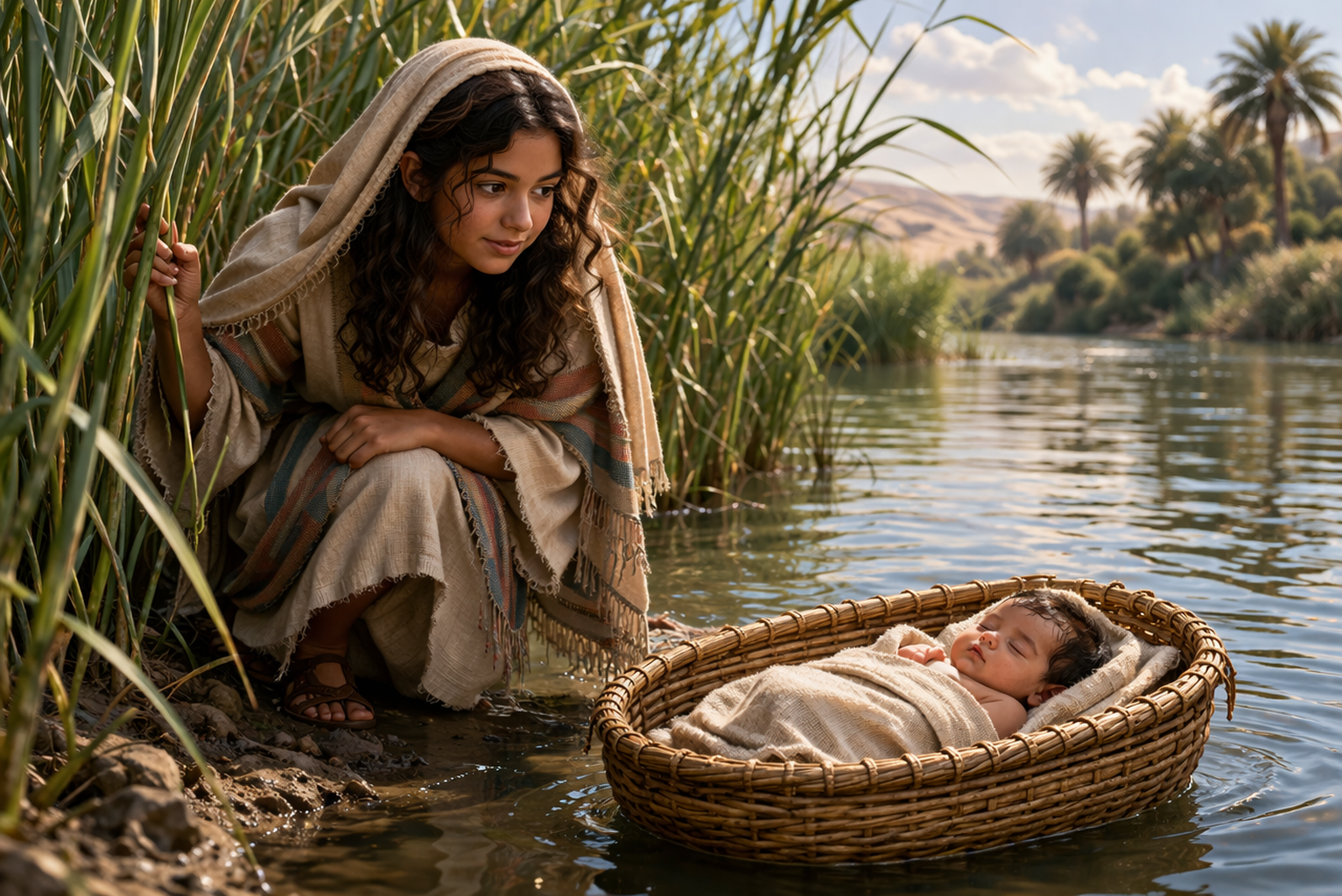
After her infant brother was placed in a basket on the Nile, Miriam did not go home and pray. She positioned herself at a distance and watched. When Pharaoh’s daughter drew the child from the water, it was Miriam who stepped forward — approaching the daughter of the most powerful man in the world — and offered to find a Hebrew nurse. That nurse was Moses’s own mother. Because of Miriam’s courage and quick thinking, Moses grew up in his parents’ home, absorbing the language, values, and identity of his people before entering the palace. The liberator of Israel was shaped by a family he almost never knew — and Miriam made it happen.
5. She Committed the First Act of Civil Disobedience in Recorded History
The Sages identify Miriam with Puah, one of the Hebrew midwives who defied Pharaoh’s decree to kill every newborn Israelite male. This was not passive resistance. It was direct, dangerous defiance of a royal command. When the Nazi defendants at Nuremberg invoked the argument that they were “just following orders,” the judges rejected it — in part because the historical and moral record already contained a counterexample: women who refused an order to commit genocide, thousands of years earlier, and paid whatever price that refusal demanded.
6. She Led the First Worship Service at the Sea
After the crossing of the Red Sea, Moses led the men of Israel in song. But Miriam did something more. She took a drum in her hand, went out to meet the other women, and led them in their own celebration — with music and dancing. The Torah records it simply: “And all the women went out after her with drums and dancing” (Exodus 15:20). The Sages ask: where did they get drums in the desert? Their answer is striking — Miriam and the women of Israel were so certain that miracles awaited them on the other side of slavery that they packed instruments before they left Egypt. Faith, in their understanding, meant preparing for the redemption before it arrived.
7. She Was Punished — and Israel Waited for Her
The most difficult chapter of Miriam’s story is also, in its way, the most revealing. After speaking ill of Moses regarding his personal life — the Sages say she did so out of concern, not malice — Miriam was struck with tzaraat (a skin condition described in Leviticus) and sent outside the camp for seven days. Moses prayed for her in what became the shortest prayer in the Torah: El na, refa na lah — “O God, please heal her” (Numbers 12:13). Five Hebrew words. But here is what the text records next: the entire nation of Israel — millions of people, with all their livestock, their families, their journey — stopped and waited seven days for Miriam to return. The Sages say this was their way of repaying the debt. Once, a young girl had stood at the riverbank and waited to see what would become of her brother. Now all of Israel stood and waited to see what would become of her.
8. Her Descendant Built the Tabernacle — and Ruled from Jerusalem
According to Jewish tradition, Miriam married Caleb, one of the two faithful spies who brought back an honest report from Canaan. Their grandson was Bezalel, the master craftsman whom God chose to build the Tabernacle in the wilderness — filling him with wisdom, understanding, and skill “to make all that I have commanded” (Exodus 31:6). And the line didn’t end there. Among Miriam’s descendants, tradition records, was King David himself.
9. She Died as She Lived — with God Close
In the final year of Israel’s journey through the desert, on the threshold of the Promised Land, Miriam died at the age of 127. The rabbinic tradition holds that she died not of illness or weakness but through what it calls the “kiss of G-d” — a soul departing the body in a moment of overwhelming cleaving to the Divine Presence. The same tradition records that on that very day, the miraculous well of water that had accompanied Israel through forty years in the desert vanished. The people understood immediately: God had provided that water in Miriam’s merit. For forty years, her righteousness had kept them from thirst. When she died, the well disappeared with her.
Miriam’s story is inseparable from the Passover story. And if you want to experience Passover the way the Jewish people have relived it for millennia — not just as history, but as living memory — the Passover From the Inside Bundle has everything you need. It includes Shira Schechter’s Passover from the Inside, The Israel Bible Passover Haggadah (featuring stunning photography and illuminating commentary), and a Passover Laminated Study Sheet to follow along at the Seder table. The bundle is now available at 27% off. Get the Passover From the Inside Bundle here.