

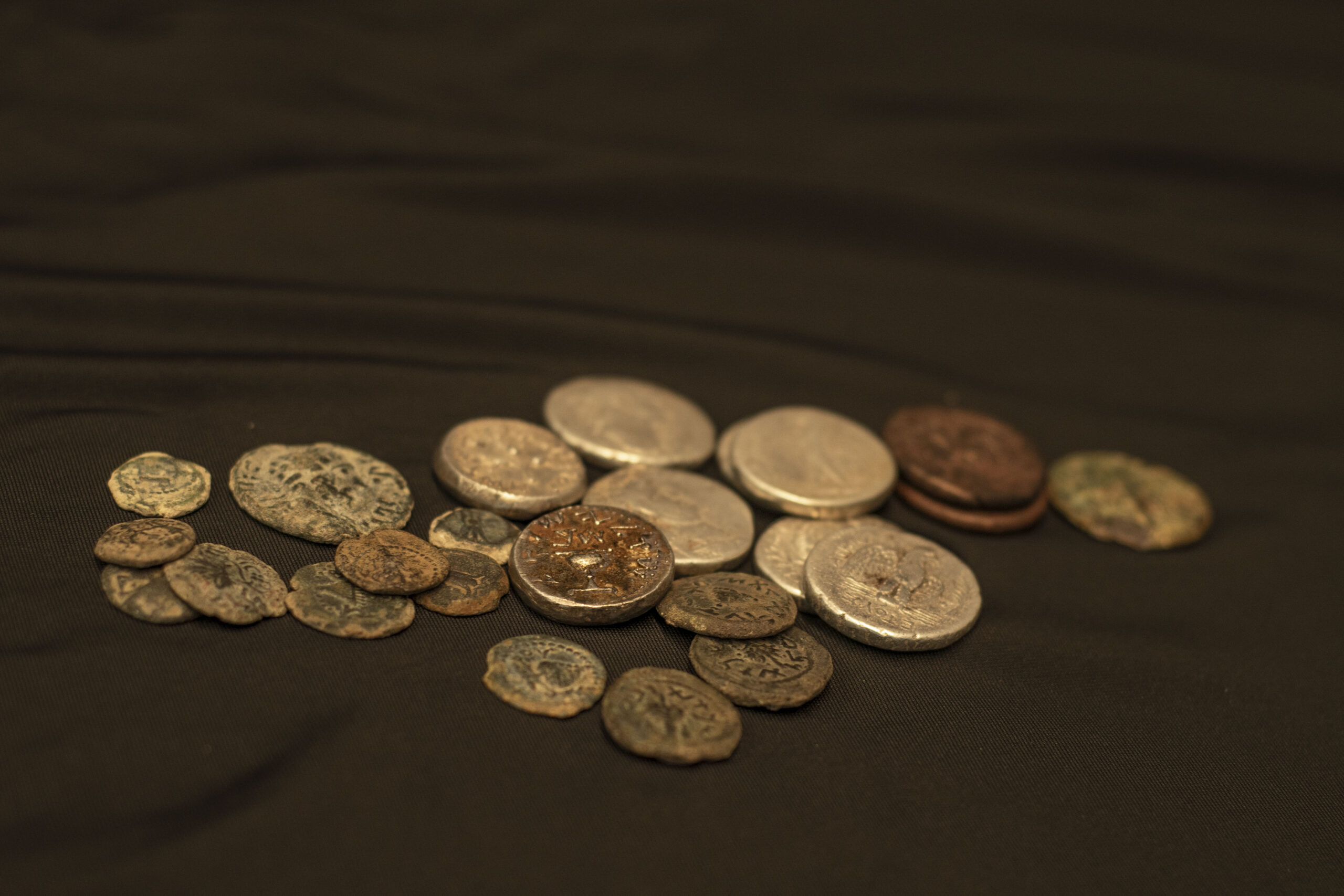
A Palestinian hospital doctor was stopped at the Hizma Checkpoint on the outskirts of Jerusalem last month on the first Friday of Ramadan, the week before the outbreak of the war with Iran, carrying a box of ancient Jewish coins hidden in his vehicle. Border Police officers and customs inspectors discovered the cache during a routine inspection. The coins documented two thousand years of Jewish sovereignty over the Land of Israel — stamped in silver, bronze, and ancient Hebrew script.
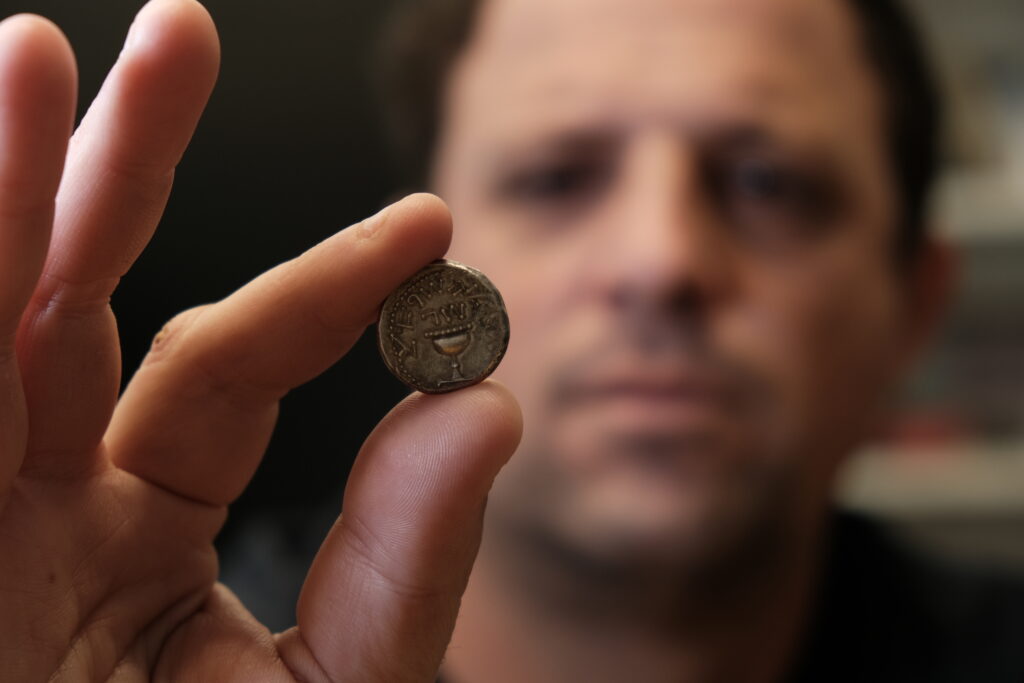
Archaeologists from the Israel Antiquities Authority confirmed the artifacts were ancient. The suspect, described by authorities as a physician, was detained by inspectors from the Authority’s Unit for the Prevention of Antiquities Theft and taken for questioning at the Shafat Police Station in Jerusalem’s Neve Yaakov neighborhood.
Among the seized coins were pure silver shekels from Years 2 and 3 of the Great Jewish Revolt against Rome, approximately 2,000 years ago. The inscriptions on them read “Shekel Yisrael” and “Yerushalayim HaKedoshah” — “Jerusalem the Holy.” Bronze coins from Year 4 of the revolt bore images of the Four Species used during the festival of Sukkot. Additional coins minted by the Hasmonean kings John Hyrcanus I and Alexander Jannaeus were found in the same box. Bar Kokhba Revolt coins were also present, stamped with the name “Shimon (Bar Kokhba)” and the inscription “Year Two of the Freedom of Israel.”
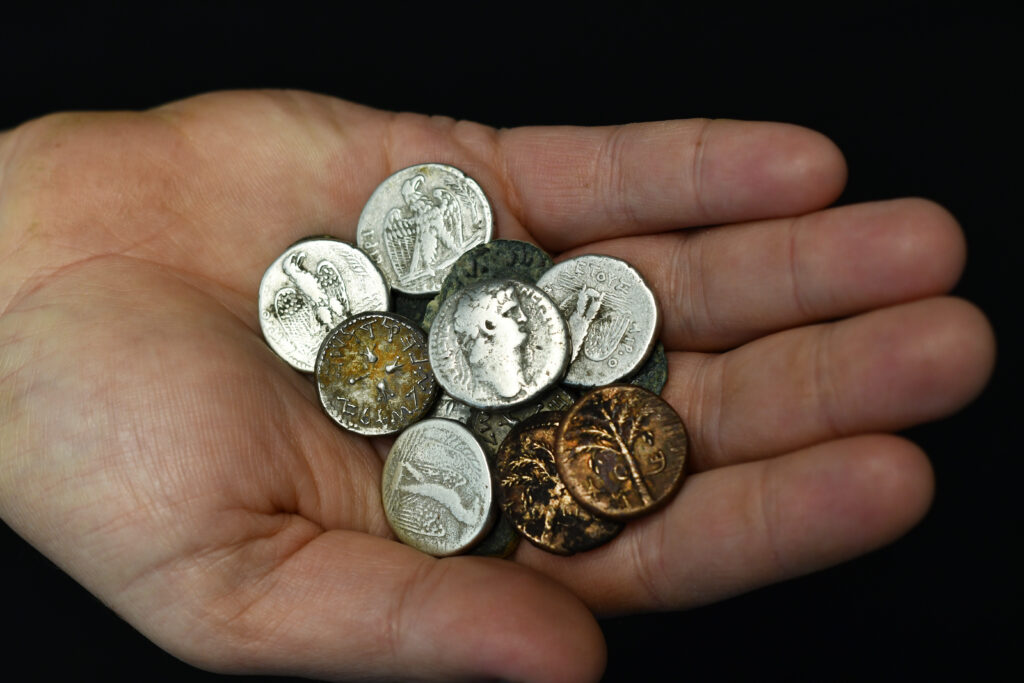
The ancient coins were the currency of Jewish national independence — struck by Jewish rulers, for a Jewish people, in a Jewish land, in a Hebrew script that predates any competing claim to this territory by centuries.
“The origin of the coins is suspected to be antiquities looting carried out using metal detectors,” said Ilan Hadad, the inspector in charge of antiquities commerce. “Some of the coins were cleaned by unskilled hands, causing irreversible damage, while others, which may have been excavated recently, have not yet been cleaned.” Hadad assessed that the coins were destined for sale to illegal collectors inside Israel or to auction houses abroad.
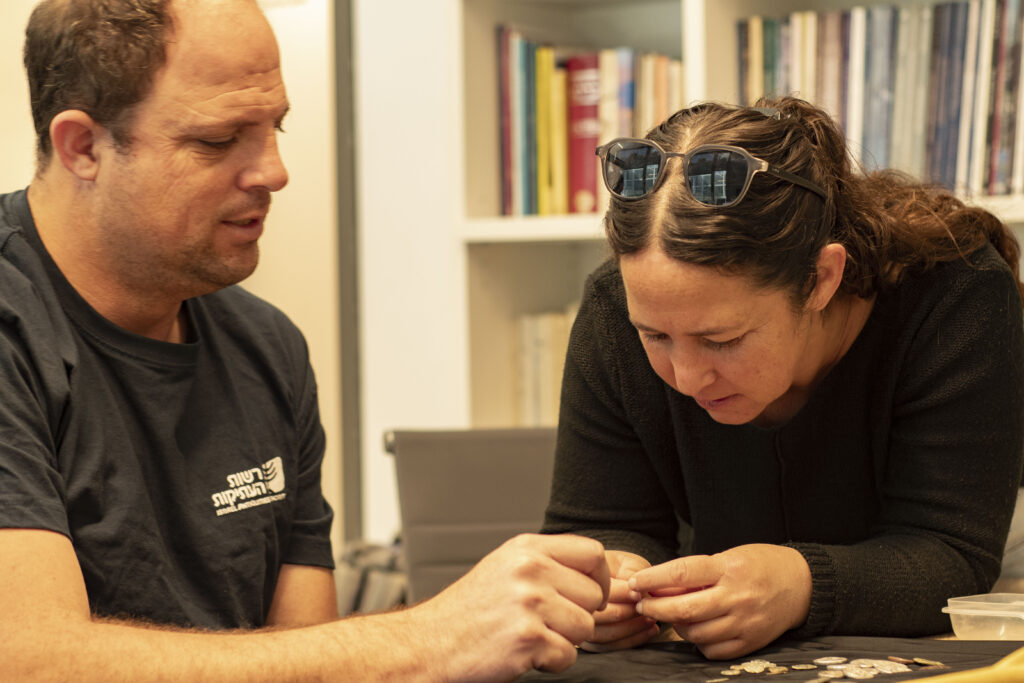
Inspectors from the Israel Antiquities Authority examine the coins that were seized. Photo: Yuli Schwartz, Israel Antiquities Authority.
Heritage Minister Rabbi Amichai Eliyahu stated directly: “Those who loot antiquities are attempting to destroy our identity and to deny our historical connection to this land.”
This attempt was carried out by a professional carrying the physical proof of Jewish nationhood across a checkpoint, under the cover of Ramadan prayers flooding the roads toward Jerusalem, raises many questions. It is a cynical abuse of Israel’s protection of Muslim religious rights in an intentional and consolidated war on Israel’s historic and Biblical connection to the land/
Dr. Amir Ganor, Director of the Antiquities Theft Prevention Unit, was unequivocal: “Every ancient coin has tremendous value for the study of the country’s past when found in situ — in place — within its archaeological context. Once a coin is looted and removed from its context, the ability to reconstruct the past through it is irreversibly lost.” Ganor added that thousands of unregulated metal detectors have flooded Israel in recent years, and that the State must restrict their sale by law. Searching for antiquities with a metal detector without a license is already a criminal offense in Israel, punishable by up to three years in prison.
Looters Nabbed as Missiles Fly
The checkpoint seizure was not an isolated case. Just weeks later, the Israel Antiquities Authority’s Northern Region Theft Prevention Unit received intelligence about illegal digging at Horvat Hermesh, an archaeological site near the Elyakim Interchange, southwest of Haifa, that contains remains from the Roman and Byzantine periods, dating from the 1st through early 7th centuries CE. Inspector Nir Distelfeld arrived with a Nature and Parks Authority inspector and a regional security officer. They found two suspects already two meters deep in an unauthorized pit they had dug adjacent to an ancient oil press installation. The suspects had already broken pottery and damaged irreplaceable archaeological layers.
As Border Police officers arrived to transport the suspects to the Zikhron Ya’akov police station, missile sirens began to wail. Distelfeld ordered everyone to the ground. “The interceptions were right over our heads,” he said. Then, during the drive to the station, sirens sounded again. The convoy pulled over, and inspectors, officers, suspects, and passing civilians crowded into a small roadside concrete shelter — approximately 30 people total. “Right above us, there was an insane interception,” Distelfeld said. “We felt the shock wave.”
In a separate operation the same week, two residents of the nearby town of Fureidis were caught using metal detectors and digging tools at the Horvat Hadarim antiquities site along the Carmel Coast.
“Surrealistically, even in such tense times, when security forces and citizens are faced with life-threatening issues, there are those who try to exploit the situation,” Distelfeld said, “searching for antiquities to enrich themselves while harming Israel’s heritage sites.”
A Workshop Two Thousand Years Buried
Also in February, a nighttime undercover operation near Mount Scopus in Jerusalem ended with the arrest of five suspects and an archaeological discovery that stopped researchers cold. Inspectors from the Theft Prevention Unit had been tracking suspicious excavation at the Ras Tamim site, documenting clandestine digging and attempts to break into an underground cavity. Officers arrested five suspects late at night — some were caught inside the cave itself, carrying a generator, quarrying tools, and a metal detector; others were serving as lookouts above ground.
When inspectors entered the cave after the arrests, they found more than 100 pieces of stone vessels from the Second Temple period. “Only Jews used those tools to observe the purity laws,” said Dr. Eitan Klein, deputy director of the Theft Prevention Unit.
The discovery was a direct window into Jewish religious life in the final decades before the Romans destroyed the Beit HaMikdash — the Holy Temple — in 70 CE. Under Jewish law, stone vessels do not contract ritual impurity, unlike clay vessels, which must be broken after becoming ritually impure. This distinction, preserved by the Sages in the Mishnah and Tosefta, drove an entire industry. Rabbinic sources describe this period with the phrase “paratzat taharah b’Yisrael” — “an outbreak of purity in Israel” (Tosefta Shabbat 1:7). Archaeology from this period shows purification mikvaot (ritual baths) installed in private homes, villages, and towns, with large public baths near the Temple and along the roads leading to Jerusalem.
Heritage Minister Eliyahu placed it plainly: “Attempts by our enemies to loot antiquities are not crimes of financial theft, but efforts to steal our identity. We will not allow this.”
The coins seized at Hizma bore the words “Shekel Yisrael” and “Yerushalayim HaKedoshah” — the same proclamations Jews make in prayer to this day. Those words were stamped in silver by Jews fighting for their land two millennia ago. They were being smuggled out by a Palestinian doctor on a Ramadan Friday, across a checkpoint separating Judea and Samaria from Jerusalem. The looting at Horvat Hermesh happened while Iranian missiles were intercepted overhead.
This emphasizes the multiple fronts of Israel’s battle for its existence: not only rockets, but also a battle for validity and recognition. Every artifact stripped from its context is a verse torn from the book of Jewish history. The Israel Antiquities Authority is fighting to keep that evidence intact. The looters, the smugglers, and those who fund and buy from them are fighting to bury it.
The artifacts seized across these three operations are now on display at the exhibition “Criminal Past — Antiquities Theft in Israel and the Fight Against It” at the Jay and Jeanie Schottenstein National Campus for the Archaeology of Israel in Jerusalem.