



Archaeologists from Ben-Gurion University excavating Nitzana National Park in the Negev have uncovered a 1,400-year-old Byzantine-era church featuring brilliantly colored mosaic floors — and they knew exactly where to look. A century-old plan sketched by none other than T.E. Lawrence — Lawrence of Arabia — and British archaeologist Leonard Woolley pointed them straight to it.
The church, dated precisely to 601 CE by a Greek dedicatory inscription found inside, is the sixth to be discovered at Nitzana, also known by its ancient name Nessana, located on Israel’s border with Egypt. It is the most visually striking of them all.
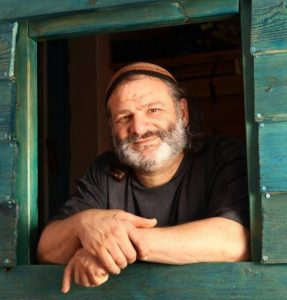
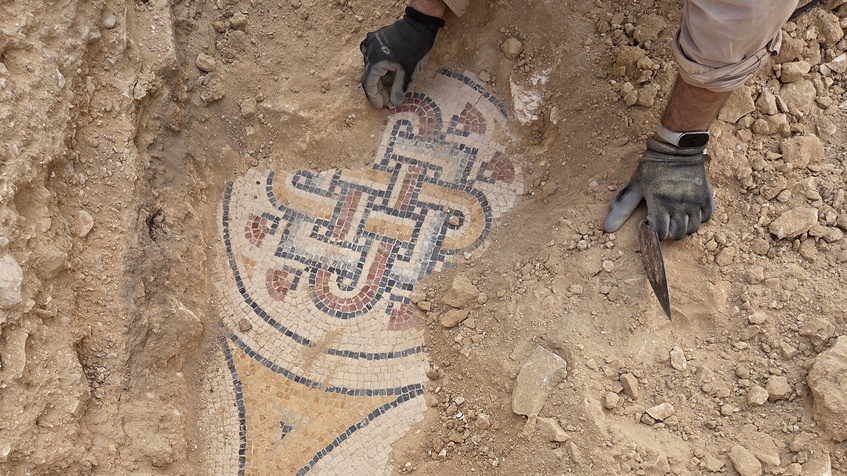
“It is the most beautiful of all six churches, because it is the only one featuring colorful mosaic floors as opposed to simple stone floors, like the others,” said Prof. Yana Tchekhanovets of BGU’s Department of Archaeology. “The mosaics present intricate geometric and floral patterns — this was a building meant to impress.”
The Negev runs through the Hebrew Bible as the land of patriarchal journeys, Israelite wanderings, and covenantal boundaries. The book of Numbers records the southern edge of the Promised Land with striking precision: “Your southern border shall be from the Wilderness of Zin alongside Edom” (Numbers 34:3). This land was hardwired into the geography of Israel’s inheritance.
The inscription inside the newly discovered church names a benefactor: Sergius, a man who traveled from Emesa — the ancient Syrian city known today as Homs — to fund the building’s construction, along with his sister and nephew. That level of biographical detail is almost unheard of in archaeological records. “In archaeological records, it is pretty rare to have a detailed dating,” Tchekhanovets told The Times of Israel. “The inscription mentioned a certain Sergius, who invested money in the building, and his sister and his nephew, who came to Nitzana from Emesa, a city in Syria that today is known as Homs.”
The name Sergius also appears in the Nessana Papyri, a massive archive of documents uncovered in the 1930s that provide an unparalleled window into daily life in the Byzantine Negev. “The name Sergius is mentioned in the papyri,” Tchekhanovets noted, “and the possibility that it refers to the church’s founder is currently under investigation.” She added a cautionary note: “At the same time, Sergius must have been a common name in the village, because the main church was also dedicated to a Sergius.”
BGU’s broader mission at the site is to bring the physical excavation findings and the Nessana Papyri into a unified, fully published record. “The BGU mission aims to connect Nessana’s physical remains with its famous historical archive,” Tchekhanovets explained. “This synergy between ancient texts and new archaeological findings allows researchers to reconstruct daily life in the Negev over a millennium ago with unprecedented detail.”
In its Byzantine heyday, Nessanat was home to 2,000 permanent residents — and far more passing through. The site occupied the primary land route connecting the Land of Israel to Saint Catherine’s Monastery and Mount Sinai, making it the last major stop before the Sinai desert road. “The site itself did not present any holy places or important relics, as far as we know, but it was the last stop before the desert road,” Tchekhanovets said. “This way it became very vibrant — people stayed there for a while, and the residents started to build all these numerous churches.”
Pilgrims came from across the known world. Graffiti discovered at the site records visitors from Georgia and Armenia. “We know from the papyri and other inscriptions found at the site that pilgrims arrived here from many places,” Tchekhanovets said. “Graffiti discovered here even records pilgrims who came from Georgia, Armenia and other regions.” The sheer number of churches relative to the town’s permanent population — six documented so far — only makes sense when you factor in the constant flow of international pilgrims. “The village had up to 2,000 residents, which could hardly explain the need for so many churches, without taking the pilgrims into account,” Tchekhanovets noted.
Previous excavation seasons had already exposed a large hostel complex in another part of the site, built to house those pilgrims. “The complex included multiple rooms, a prayer chapel and a lavish bathhouse with pools, marble-covered bathtubs and walls decorated with frescoes,” Tchekhanovets described. “The scale of the construction and the richness of the decorations point to an active and wealthy religious center. Every excavation season reveals more of the hidden wealth beneath the ruins of Nessana, which was a vital stop on the ancient pilgrimage route.”
The newly discovered church’s mosaic floors display intricate geometric and floral patterns, alongside medallions crafted from tiny, vibrant mosaic stones. Annexed rooms with additional mosaic floors have also begun to emerge, and the team plans to return next season to determine their function. “We want to understand what they are,” Tchekhanovets said. “Is it another guest house, or perhaps a monastery?”
The BGU team went looking for the site deliberately, guided by a remarkable piece of documentary evidence. “Two British explorers, Lawrence of Arabia and Leonard Woolley, had already seen the church 100 years ago,” Tchekhanovets explained. “They saw the Ottoman authorities building a military center in this abandoned place, and exposing and ruining an ancient church. They left us a plan of the ancient site, and using this plan and modern GIS technologies, we succeeded in locating it.” A 1909 photograph taken during the Ottoman construction had also documented the church’s mosaic inscription before it was covered over. “Our excavation rediscovered this church and the important inscription, which dates the construction of the church to the early seventh century,” Tchekhanovets said.
Thomas Edward Lawrence — known to history as Lawrence of Arabia — was a British Army officer, archaeologist, and writer who became legendary for his role in the Arab Revolt against the Ottoman Empire during World War I. Before the war made him famous, Lawrence had traveled extensively across the Middle East on archaeological expeditions, developing an intimate knowledge of the land and its ancient remains. It was during a 1914 survey of the Negev — conducted jointly with Leonard Woolley and partly funded by the Palestine Exploration Fund — that Lawrence documented the ruins of Nessana, leaving behind the site plan that BGU archaeologists would use more than a century later to relocate the mosaic church. The survey also served as cover for a British military intelligence operation mapping the region ahead of a potential conflict with the Ottomans — making Lawrence’s visit to Nessana equal parts archaeology and espionage.
A British-American expedition in the 1930s uncovered two churches, a Roman fort, and the papyri archive. Another BGU-led excavation in the late 1980s and early 1990s, run as part of a Jewish Agency project, brought thousands of participants to the site — students from the Nitzana Youth Village, new immigrants, soldiers, and volunteers. Tchekhanovets launched the current renewed excavation project specifically to examine Nessana‘s role in the Byzantine pilgrimage network and to bring the results of all prior digs to full publication.
The settlement’s story continued after the Islamic conquest of 638 CE when Christian pilgrims continued to pass through Nessana for roughly another 150 years. But as the Land of Israel became increasingly cut off from the wider Christian world, the pilgrim traffic dried up. “Fewer and fewer pilgrims arrived, the settlement slowly shrank, and it was completely abandoned, likely at the beginning of the 9th century,” Tchekhanovets said.
The site sustained additional damage during World War I, when Ottoman forces constructed an administrative center — Auja al-Hafir — directly atop the ancient ruins, destroying much of what had survived the preceding millennium. The ancient settlement of Nitzana was, as BGU describes it, “almost entirely destroyed” in the process. What remains is now protected within the national park.
The current excavation is supported by a research grant from the Gerda Henkel Foundation in Germany and includes Israeli and international volunteers alongside BGU students. The Israel Nature and Parks Authority has assisted with the work. “Our goal is to continue uncovering Nitzana’s fascinating secrets and to learn more about life and movement across the Negev in ancient times,” Tchekhanovets said.
