
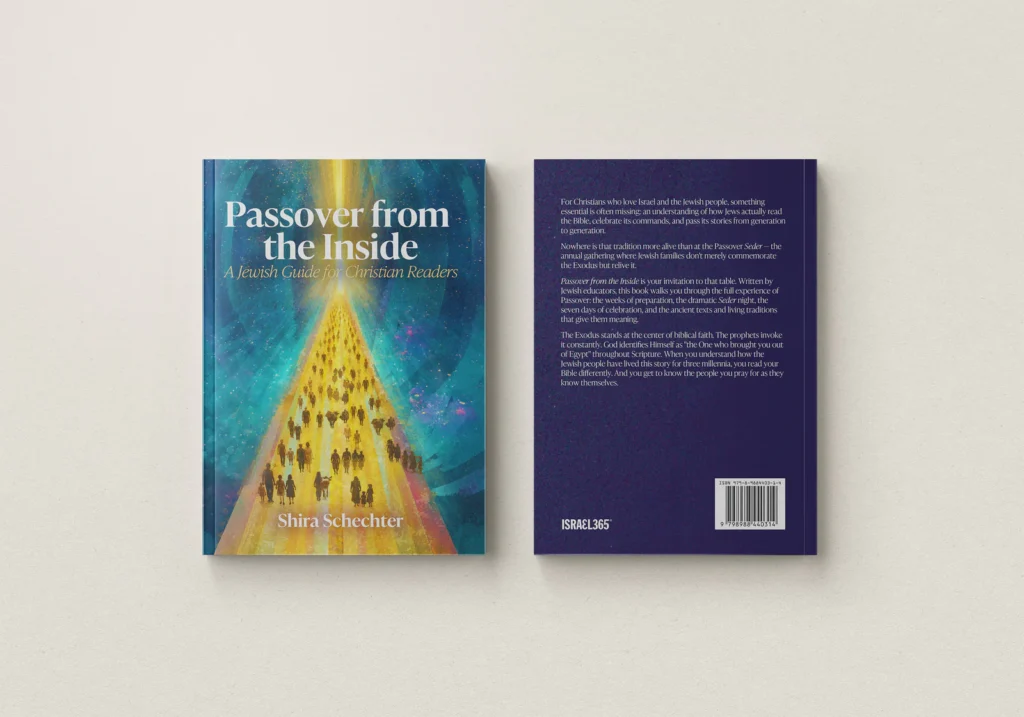
Every year, Christians ask us what Passover really means. We finally wrote the book. Passover from the Inside: A Jewish Guide for Christian Readers takes you inside the world’s most carefully preserved ritual — from the inside. But first, here’s a taste of what you’ll find.
Every spring, millions of Christians find themselves curious about Passover. They know it matters. They know it’s in their Bible. They know the Last Supper happened during it. But most of what they think they know turns out to be incomplete, filtered through centuries of distance from the living Jewish tradition that has kept this holiday alive.
That’s not a criticism — it’s an invitation. Because when you understand Passover the way Jews actually observe it, the whole thing gets more interesting, more textured, and more alive. Here are five common misconceptions, and what Jews actually believe.
1. “The Last Supper was basically a Passover-inspired meal”
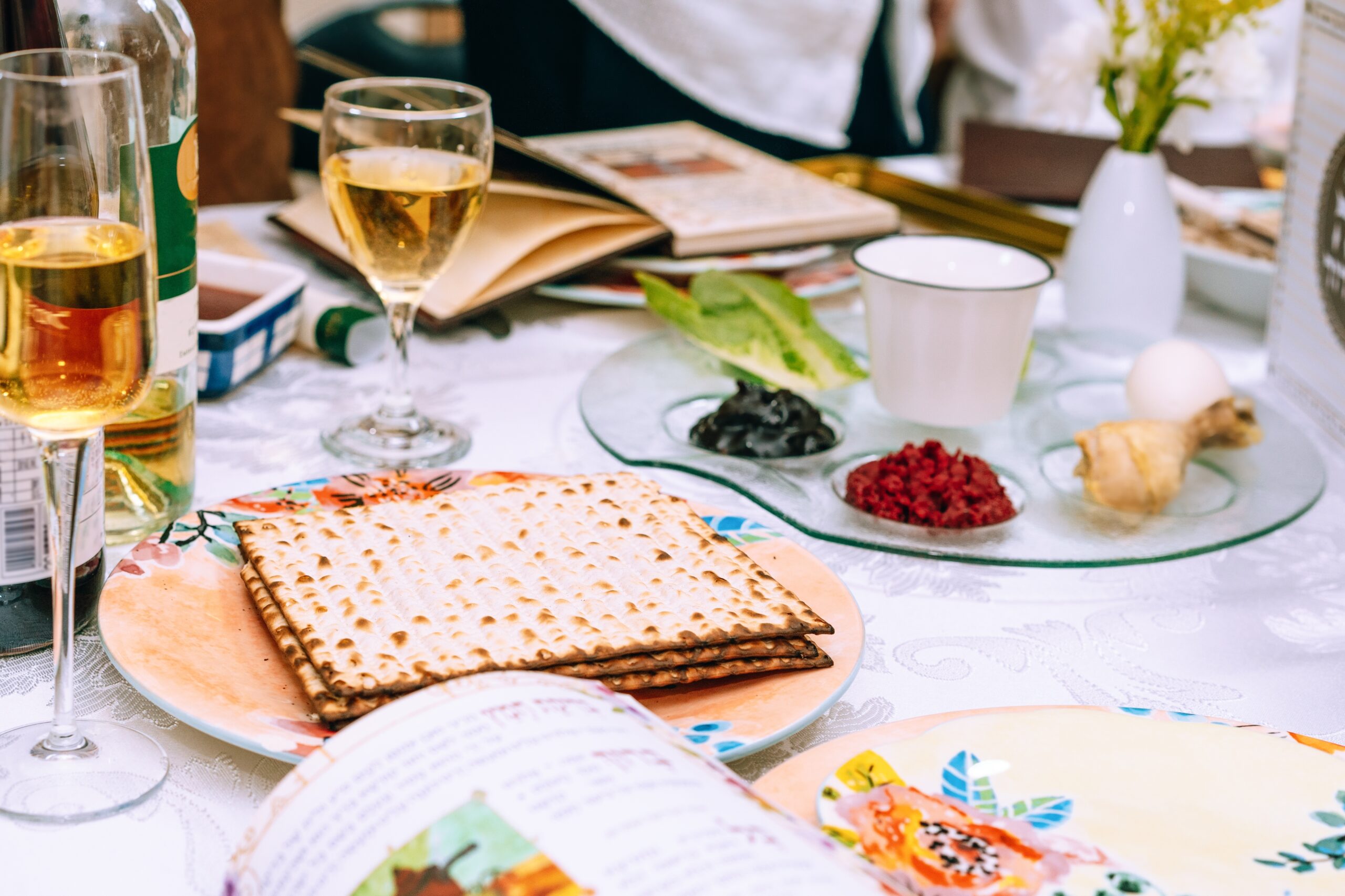
It wasn’t inspired by Passover. It was a Passover Seder — the actual ritual, conducted in full, with the same specific foods, the same 15-step sequence, the same cups of wine drunk at the same precise moments for the same specific reasons.
When the Gospels mention the broken bread, that was the Afikoman — the middle matzah that the Seder leader breaks early in the evening and sets aside to be eaten as the very last food of the night. When they mention “the cup after supper,” that was the third of four cups, each corresponding to one of God’s four promises of redemption in Exodus. When they record that the meal ended with a hymn, that was Hallel — Psalms 113 through 118, the same psalms Jews still sing at every Seder table in the world today.
None of this was improvised or symbolic in a vague sense. It was a structured, ancient ritual that every Jew at that table had performed their entire lives. Understanding the Seder doesn’t just illuminate Passover — it illuminates that entire evening in ways that reading the Gospels alone cannot.
2. “The Ten Plagues were just punishments”
Christians tend to read the plagues as divine punishment — God striking Egypt for what Pharaoh did to the Israelites. That’s not wrong, but it misses the deeper structure that Jewish tradition has always seen in them.
The medieval scholar Rabbi Isaac Abarbanel laid it out precisely. Pharaoh’s arrogance rested on three specific theological denials. First, he denied God’s existence entirely: “I do not know the Lord.” Second, he denied divine providence — even if such a God existed, Pharaoh believed He had no authority over earthly rulers. Third, he denied God’s power to alter the natural order.
The ten plagues weren’t random. They came in three groups of three, each group systematically dismantling one of those denials. The first three established that God exists. The second three demonstrated that God actively supervises human affairs. The final three proved God’s absolute mastery over nature. The tenth plague — the death of the firstborn — stood apart as direct retribution for Pharaoh’s own decree to drown Hebrew children in the Nile.
God said it explicitly: “I have hardened Pharaoh’s heart in order that I may display these My signs among them, and that you may recount in the hearing of your sons and your sons’ sons how I made a mockery of the Egyptians.” The plagues weren’t just punishment. They were a theological argument addressed to all of history.
3. “Passover ends after the Seder”
For many people, the Seder is the whole holiday. The meal happens, the Haggadah gets read, and Passover is essentially over. But the Torah commands a full seven-day celebration, and the final day carries its own distinct significance — one that most Christians, and many secular Jews, never encounter.
The seventh day of Passover commemorates the Splitting of the Sea. After seven days of flight from Egypt, Pharaoh’s army had caught up with the Israelites. The sea was before them. The chariots were behind them. And then the waters parted.
Jewish tradition teaches that the spiritual revelation at that moment surpassed anything the Israelites had experienced in Egypt. The sages say that the simplest maidservant standing at the shore witnessed a level of divine clarity greater than what the prophet Ezekiel would later see in his famous mystical visions. The first day of Passover marks leaving Egypt. The seventh day marks the moment Egypt could no longer pursue them — the moment freedom became irreversible.
And it required action first. The tradition of Nachshon ben Aminadav captures this: while everyone else stood frozen at the water’s edge, Nachshon walked in. Water to his knees. His waist. His chest. His neck. The sea didn’t split until the water reached his nostrils. The miracle came after the commitment, not before.
4. “Passover is primarily about freedom”
This is the interpretation that feels most natural to modern readers, and it’s not wrong — but it stops too soon. Freedom is the means. It isn’t the destination.
Rabbi Yehuda Henkin put it directly: “Passover is the holiday of belief in God.” When God told Moses why He was hardening Pharaoh’s heart, the reason wasn’t liberation — it was revelation: “that you may know that I am the Lord.” The Ten Commandments open not with “I created the heavens and the earth” but with “I am the Lord your God who brought you out of the land of Egypt.” The Exodus is what establishes God’s ongoing involvement in human affairs. Creation proves God made the world. The Exodus proves He didn’t walk away from it.
The Haggadah makes this explicit when it commands Jews to elaborate on the Exodus even if they already know the entire story. If the purpose were simply historical education, that would be redundant for the well-informed. But if the purpose is to strengthen living faith through the repeated, immersive experience of divine intervention — then no amount of retelling is ever enough.
Freedom from Egypt was the opening act. The destination was always Sinai.
5. “Passover is about what God did for the ancient Israelites”
This is perhaps the most fundamental misunderstanding — and correcting it changes everything about how the holiday is experienced.
The Haggadah doesn’t say that Jews gather to remember what God did for their ancestors. It says: “In every generation, each person must see himself as though he personally went out from Egypt.” Not as a symbolic ritual or an exercise in historical empathy. As a personal reality. I was a slave. I was redeemed.
The redemption of the Jewish people is ongoing. God didn’t act once in history and then step back. The same divine hand that split the sea is active today.
For Jews living in this generation, this should be clear. The Haggadah declares that “in every generation they rise against us to destroy us — and the Holy One, blessed be He, saves us from their hands.” Jews have lived through Pharaoh, Haman, the Inquisition, the pogroms, the Holocaust and over 100 years of Islamic jihad. Within three years of the worst genocide in history, the State of Israel was reborn.
Hebrew — a language of prayer for two thousand years — became the language of children playing in the streets of Jerusalem. Jews returned from Yemen, Ethiopia, Russia, and a hundred other countries of exile. The desert bloomed. Cities rose. A scattered people became a nation. The prophets had described it. For millennia it seemed impossible. And then it happened — not in a single miraculous moment, but drop by drop, year by year, in what Jewish tradition recognizes as redemption unfolding in real time.
When Jews pour Elijah’s Cup and open the door at the Seder, they are not performing an ancient ritual disconnected from the present. They are standing at the intersection of a three-thousand-year story and their own living moment in it.
Want to go deeper?
This is exactly what Passover from the Inside: A Jewish Guide for Christian Readers offers: a full walk-through of the Seder, the Haggadah, the foods, the prayers, and the rabbinic teachings that have shaped Jewish life for millennia. Written by Shira Schechter, a celebrated Jewish scholar, it doesn’t simplify or sanitize. It takes you inside the tradition as it has actually been lived.
The Exodus is the foundation of biblical faith. It’s worth understanding on its own terms.