


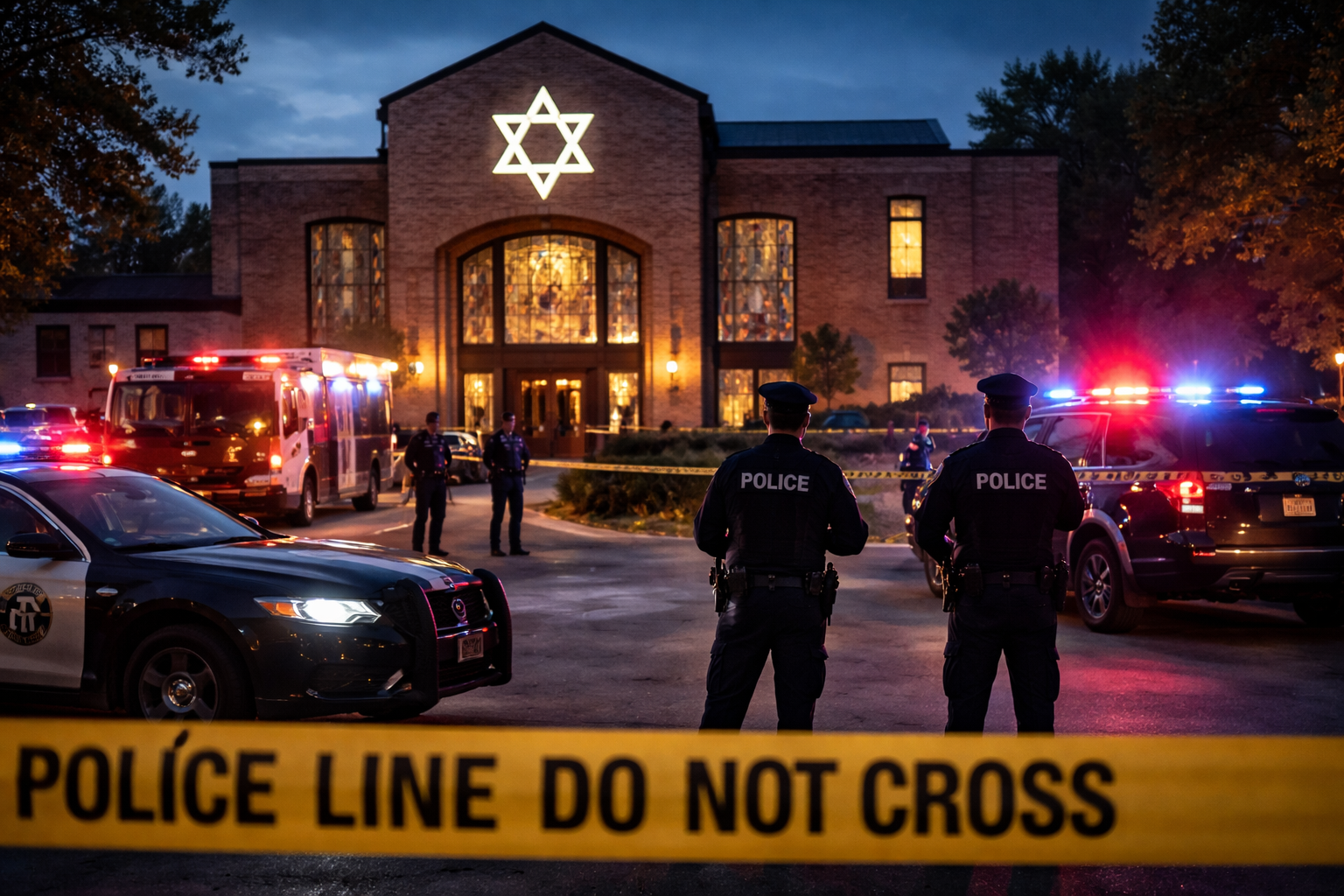
A Lebanese-born naturalized American citizen drove a truck through the hallway of one of the largest synagogues in the United States on Thursday, while 140 children were inside attending preschool. The attacker, identified as 41-year-old Ayman Mohamad Ghazali, was shot dead by security personnel at Temple Israel in West Bloomfield Township near Detroit, Michigan. One security guard was struck by the vehicle and hospitalized, but was expected to recover. None of the children were harmed in the attack.
The FBI is investigating it as a “targeted act of violence against the Jewish community.” Special Agent Jennifer Runyan, head of the FBI’s Detroit field office, made that designation clear at a Thursday press conference. Oakland County Sheriff Michael Bouchard described exactly what happened: “He breached the building, drove down the hall, and he was engaged by security.”
The synagogue made a statement labelling the attack as terrorism: “Temple Israel was the victim of a terrorist gunman who was confronted and neutralized by our security personnel who are truly heroes.”
Ghazali came to the United States in 2011 on an immediate relative visa and was granted citizenship in 2016, according to the Department of Homeland Security. Investigators have not yet determined his motive. What they have determined is that he arrived armed with a rifle at a building full of Jewish children in the middle of a weekday.
President Trump addressed the attack at a White House event Thursday: “I want to send our love to the Michigan Jewish community and all of the people in the Detroit area following the attack on the Jewish synagogue early today. I’ve been fully briefed, and it’s a terrible thing, but it goes on. We’re going to be right down to the bottom of it.”
The FBI conducted active shooter prevention training for Temple Israel’s clergy and staff just six weeks earlier, in late January. Local law enforcement, Sheriff Bouchard confirmed, had been preparing for a potential attack on Jews for weeks.
The Michigan attack was at least the seventh incident targeting a synagogue in March alone.
The week before the Michigan attack, Toronto was hit twice in a single Friday night. A shooter fired through the glass doors of Beth Avraham Yoseph of Toronto in the Thornhill neighborhood while two maintenance workers were still inside cleaning after a Shabbat dinner. Thirty minutes later, a second shooter approached the Orthodox Shaarei Shomayim congregation in North York and fired multiple rounds at its entrance. A third Toronto synagogue was struck by gunfire on March 2, less than two hours after a Purim celebration ended — while the community’s rabbi was still inside. A Toronto Jewish girls’ school has been fired upon three times in the past year. A Montreal synagogue has been firebombed twice since the Gaza war began.
In Europe, a synagogue in Liege, Belgium, was damaged in a blast on Monday in what the city’s mayor denounced as an “extremely violent act of antisemitism.” Azerbaijan announced Friday it had foiled a series of Iranian-directed terror attacks on its soil, including a planned strike on a synagogue and against Jewish community leaders. In Manchester, England, on Yom Kippur last October, an attacker killed two people and wounded four in a stabbing and shooting attack at a synagogue.
Closer to home, antisemitic graffiti was discovered this week at Congregation Shaare Tefila in Olney, Maryland. In Teaneck, New Jersey, a teenager fired a pellet gun at a Jewish man near a synagogue after asking him whether he supported Israel or Palestine. A synagogue was torched in Jackson, Mississippi in January. A Chabad synagogue was set on fire in Punta Gorda, Florida, last September. In January, a driver rammed his car repeatedly into Chabad’s world headquarters in New York City.
The pattern stretches across France, Germany, Chile, Bulgaria, California, Ukraine, Italy, Texas, and the Australian cities of Melbourne, Brisbane, and Sydney.
The Jewish Federations of North America put a price tag on all of this: “The Jewish community is forced to spend over $765 million a year just to protect itself, and there is more the government should do to ensure every vulnerable Jewish institution has the resources to keep safe.”
Antisemitism has surged since the October 7th attack on Israel, and some claim that the spike in violence targeting Jews is a response to Israel’s military campaign against Hamas in Gaza. The logic goes that Jews around the world are paying the price for Israeli and American policy decisions.
This excuse should be soundly rejected. In comparison, Vladimir Putin’s war against Ukraine has killed hundreds of thousands of people, displaced millions, and is now in its fourth year. There have been no coordinated attacks on Russian Orthodox churches in North America. Russian community centers have not been firebombed in Melbourne or Montreal. No one is shooting at Russian schools in Toronto or spray-painting threats on the walls of Russian cultural institutions in Maryland. Russians living in the Diaspora are not spending $765 million a year to protect themselves from people who oppose Putin’s war.
The distinction is not a political one. It is a clarifying one. When a war is used as a justification to attack a completely separate civilian population — Jewish preschoolers in Michigan, Shabbat dinner guests in Toronto, Yom Kippur worshipers in Manchester — the war is not the cause. It is the pretext. The target is Jews. It has always been Jews.

