

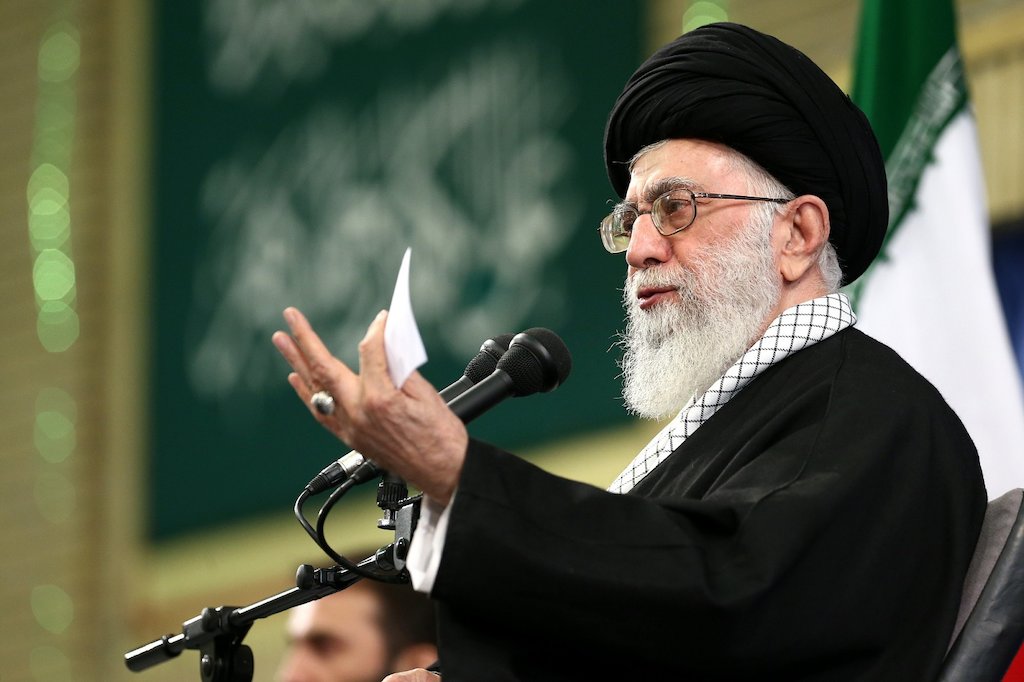
Iranian dictator Ayatollah Ali Khameini, the leader of the most notorious terrorist regime on earth, had “an easy smile” and was “fond of Persian poetry and classic Western novels,” the Washington Post wrote in its obituary of him.
Khameini rose to power under the guidance of the late Ayatollah Ruhollah Khomeini, leader of the 1979 Islamist revolution in Iran. But, the Post emphasized, Khameini “cut a more avuncular figure in public than his perpetually scowling but much more revered mentor.”
“Avuncular” is an odd word to describe someone who recently ordered the mass murder of thousands of unarmed demonstrators (tens of thousands, according to many reports) and sponsored terrorist attacks around the world that claimed the lives of countless Americans, Israelis, and others.
Technically, “avuncular” means something related to an uncle. But every dictionary defines it in a strongly positive sense. The Cambridge Dictionary, for example: “Friendly, kind, or helpful, like the expected behavior of an uncle.”
The New York Times’s obituary also called Khameini “avuncular” (adding “magnanimous” for good measure). Strange that two major newspapers would independently choose the same uncommon word.
Both newspapers have a history of describing terrorist leaders in positive terms. In 2019, the Washington Post’s obituary for ISIS leader Abu Bakr al-Baghdadi called him as an “austere religious scholar.”
A New York Times profile of the late Hezbollah terrorist leader Hassan Nasrallah, in 2025, described his “charm” and “charisma” and characterized him as a “religious leader.”
This is nothing new for the New York Times.
In July 1933, Adolf Hitler granted the Times his first interview with a foreign journalist since becoming chancellor of Germany six months earlier.
In those months, the Nazis had expelled Jews from most professions, burned down the parliament, outlawed opposition parties, and carried out sporadic violence against Jews and political dissidents. In an effort to improve his image abroad, Hitler turned to the Times. It worked like a charm.
“Hitler Seeks Jobs for All Germans,” was the headline of the article. Interviewer Anne O’Hare McCormick gave the Nazi leader paragraph after paragraph to explain that his policies were necessary to deal with Germany’s unemployment, improve its roads, and promote national unity.
Here’s how McCormick described Hitler’s appearance: “He is a rather shy and simple man, younger than one expects, more robust, taller…”
And his eyes! McCormick wrote: “His eyes are almost the color of the blue larkspur in a vase behind him, curiously childlike and candid…His voice is as quiet as his black tie and his double-breasted black suit…Herr Hitler has the sensitive hand of the artist.”
The Times interviewer eventually got around to asking him, “How about the Jews?” She then gave Hitler all the space he needed for his lies, with no rebuttal or even questioning:
“It is true we have made discriminatory laws, but they are directed not so much against the Jews as for the German people, to give equal economic opportunity to the majority…You say the Jews suffer, but so do millions of others…Our fight is not primarily against the Jews as such but against the Communists and all elements that demoralize and destroy us…”
McCormick’s final question: “What character in history do you admire most, Caesar, Napoleon, or Frederick the Great?”