




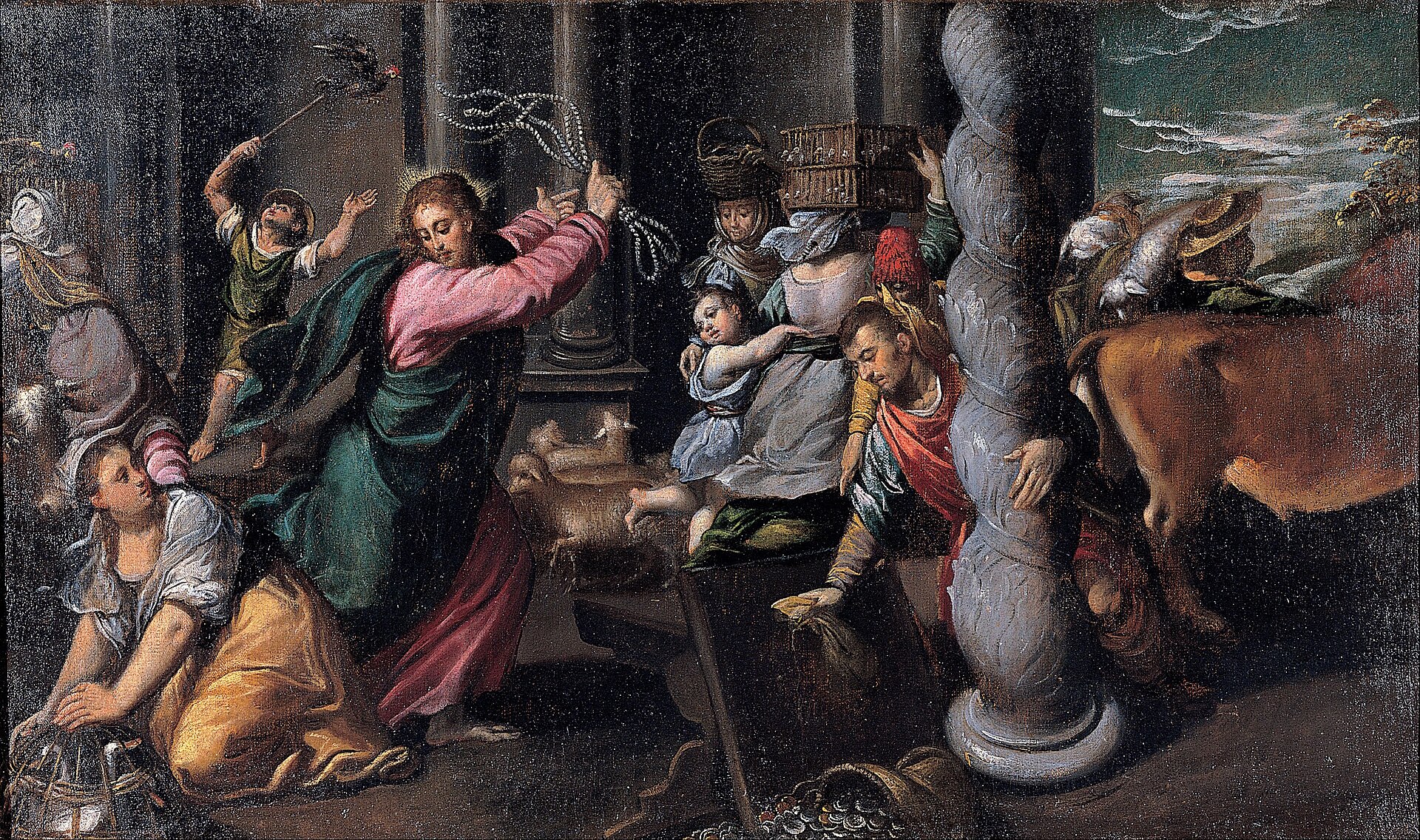
The story has been told for two thousand years: Jesus storms into the Temple, overturns the tables of the moneychangers, and drives out merchants in a blaze of divine righteousness. It became one of the foundational images of Christianity’s self-portrait — the pure against the corrupt, the sacred against the profane, the new against the old. For centuries, it was also wielded as a cudgel against Jews, framed as divine condemnation of Jewish commerce, Jewish institutions, Jewish leadership. A new peer-reviewed study says that reading is wrong — and that the real story is far more human, and far more Jewish.
The study, published in the journal Cogent Arts & Humanities, was authored by Dr. Haggai Olshanetsky of the University of Warsaw, along with Alan Silverman of Philadelphia and Lev Cosijns of Oxford. It argues that what has been called the “Temple cleansing” was not a theological statement, not an act of divine wrath, and not a protest against Jewish institutions. It was a fight over coins — specifically because a tired, hungry Galilean pilgrim discovered that the silver coins he had been carrying were worth far less than he thought.
Olshanetsky told JNS that scholars “don’t aim to persuade religious believers but rather to analyze texts, examine their historicity, and to identify the different changes which were made, and why these changes were done.” He and his colleagues say their explanation, “unlike others, is based solely on what is written in the text.”
The Gospel of Mark, the earliest written account, places a telling detail immediately before the Temple episode. Jesus arrives in Jerusalem late, surveys the Temple, and leaves without incident. The text of Mark reads: “And he entered Jerusalem and went into the Temple. And when he had looked around at everything, as it was already late, he went out to Bethany with the twelve.” The following morning, Mark states plainly: “he was hungry. And seeing in the distance a fig tree in leaf, he went to see if he could find anything on it. When he came to it, he found nothing but leaves, for it was not the season for figs. And he said to it, ‘May no one ever eat fruit from you again.'” Only then does Mark describe the confrontation with the moneychangers.
Olshanetsky reads that sequence with precision: “In the morning, we actually see that he is very hungry, because when he sees a fruitless tree, he curses it. This is very human; when you are hungry, you’re a bit short. He goes to the Temple again to look for the money changers, and something happens again.”
The night before makes the sequence even clearer. “Why is Jesus going to the Temple at night?” Olshanetsky asks. “There wouldn’t be anything to do there, except maybe he looked for the money changers, as we suggest, because he needed small change.” The group had arrived too late. The money changers had closed. They went to bed in Bethany — a cheaper village outside the city, which itself signals the group was not wealthy — hungry and without local currency.
The coin situation made everything worse the next morning. In Jerusalem around 30 CE, multiple silver currencies circulated simultaneously: the Tyrian shekel, the Antiochene tetradrachm, and the Egyptian billon tetradrachm — billon being an alloy with far less precious metal. The study explains: “The coins looked like the Antiochene tetradrachms with which they would have been acquainted, and perhaps had exchanged at prior festivals, instead of the more common Tyrian coin.” When the exchange was made, the result was devastating. “For such coins, the changer would have offered the Galileans the correct exchange value, and any other changer nearby would have concurred. This value was only around 30% of what Jesus and Judas may have believed was their value.” The scholars call it “a shocking and infuriating surprise” whose “impact on the group’s budget would have been severe.”
The Mishnah, compiled around 200 CE from much earlier oral traditions, confirms that such disputes were real and recurring. The ancient text is, in Olshanetsky’s words, “very concerned with the problems of coin authenticity and exchange, showing that the value of coins could pose real challenges.” By contrast, contemporary Jewish sources “almost do not address the question of sacrificial animal prices” — the supposed corruption that the traditional narrative invokes. The economic problem was with currency, not with the Temple’s commercial system.
This is what drove Jesus to the language he used. Mark records him quoting directly from the Hebrew prophet Yirmiyahu — Jeremiah: “Is it not written, ‘My house shall be called a house of prayer for all the nations? But you have made it a den of robbers'” (Mark 11:17). The underlying verse, from Jeremiah 7:11, reads: “Has this house, which bears My Name, become a den of robbers in your eyes?” (me’arat paritzim — מְעָרַת פָּרִצִים). Jeremiah was not condemning the Temple. He was warning those who treated it as a refuge while acting corruptly outside it. Jesus, quoting that text in the heat of a financial dispute, was reaching for scripture the way a wronged man does — not pronouncing divine judgment on the Jewish people.
Mark’s account of what followed inside the Temple is the most widely cited: “And he entered the Temple and began to drive out those who sold and those who bought in the Temple, and he overturned the tables of the moneychangers and the seats of those who sold pigeons” (Mark 11:15). But the scholars argue the actual scope was far more limited than that verse implies. Acting alone, Jesus “could only have overturned the tables of a few of the many changers needed to serve the large crowds, and, unlike what is stated in the Gospels, would have certainly been unable to drive all of them out.” The disruption “was brief and insignificant compared to the activity of tens of thousands of people daily, hundreds of thousands over the week and the extent of trade in the Temple, which was necessary to the sacrificial system.”
The study makes a structural argument that is difficult to dismiss. If Jesus had shut down the Temple’s commercial operation during Passover — the busiest week of the year — the Temple police would have responded immediately. They did not. “According to the Gospels,” Olshanetsky told the Times of Israel, “he either remained preaching in the Temple or came back the day after, and he was already famous. The authorities were looking for ways to arrest him. If he had caused all this disturbance, this could have been a good reason.” Instead, it took several more days and Judas’s betrayal for authorities to even identify him. “This action was brief and insignificant,” the scholars write — and the non-response of the Temple authorities confirms it.
Notably, priests and senior religious figures are entirely absent from the Temple scene in the Gospels. Olshanetsky is direct about what that absence means: “If he did indeed wish to protest, he would have focused his actions on the high-ranking members of the Temple institutions. According to what is known about Jesus and his teachings, he would not have expressed his anger toward the merchants and money changers who did nothing wrong other than doing their job.” Elsewhere in the Gospels, Jesus criticizes religious leadership openly. Their absence from this scene destroys the interpretation that it was a directed protest against Jewish authority.
The plain text of the Gospels also challenges the suggestion that Jesus wanted merchants out of the Temple entirely. “The suggestion that he did not want them in the Temple,” Olshanetsky says, “is problematic because it’s not really mentioned in the Gospels.” What the Gospels do record is a man who had visited the Temple before and never acted this way. “Even according to Christian belief and doctrine, he was both human and divine, and if he was partially human, we can also expect human behavior from him,” Olshanetsky told JNS. “Moreover, the entire issue of whether it was a divine or religious motivation is disproven by the fact that he went to the Temple several times before, and surprisingly and puzzlingly, he also went after the event with the money-changers. However, he never interrupted the businesses there in his visits before and after the event.”
Olshanetsky’s conclusion about who Jesus actually was cuts against centuries of Christian framing: “Jesus was Jewish. He never claimed he was starting another religion, and Judaism at the time revolved around the Temple.” He was doing, in his own words, “what every Jewish man hoped to do at the time — visit the Temple during Passover, and if possible, sacrifice an animal to God.”
The study’s most important contribution may be the clarity with which it identifies how the anti-Jewish reading entered the tradition. “This text stands better the historicity test because it is not embellished, it does not show the divine in Jesus; the divine interpretation is what people try to put in later, based on things that are not written,” Olshanetsky explained. “The story of the turning of the tables is so disconnected from anything else in the Gospels appearing before or after it, and is so human in its nature, that it can only be explained as the remnants of an older text.” That earlier text, he believes, “is probably a biography of Jesus the Jewish religious man and his philosophy, disconnected from the later attempts to portray him as the son of God.”
“This is just part of Jesus’s story and life as a normal person in Judea,” Olshanetsky said, “a normal person but also a religious figure. How it was used later is something else.”
That last sentence carries the weight of history. The Temple was not the problem. The coins were the problem. And a hungry man from the Galilee, discovering his silver was worth a third of what he thought, reacted the way people have always reacted when they feel cheated. The anti-Temple, anti-Jewish narrative layered onto that moment was never in the original text. It was constructed afterward, and it served purposes that had nothing to do with what happened in Jerusalem in 30 CE. What happened was a Jewish pilgrim, in the Beit HaMikdash — the Holy Temple — on the eve of Pesach, getting into a fight over money. The Sages would call that pashut — simple. Straightforward. And long overdue for an honest telling.