



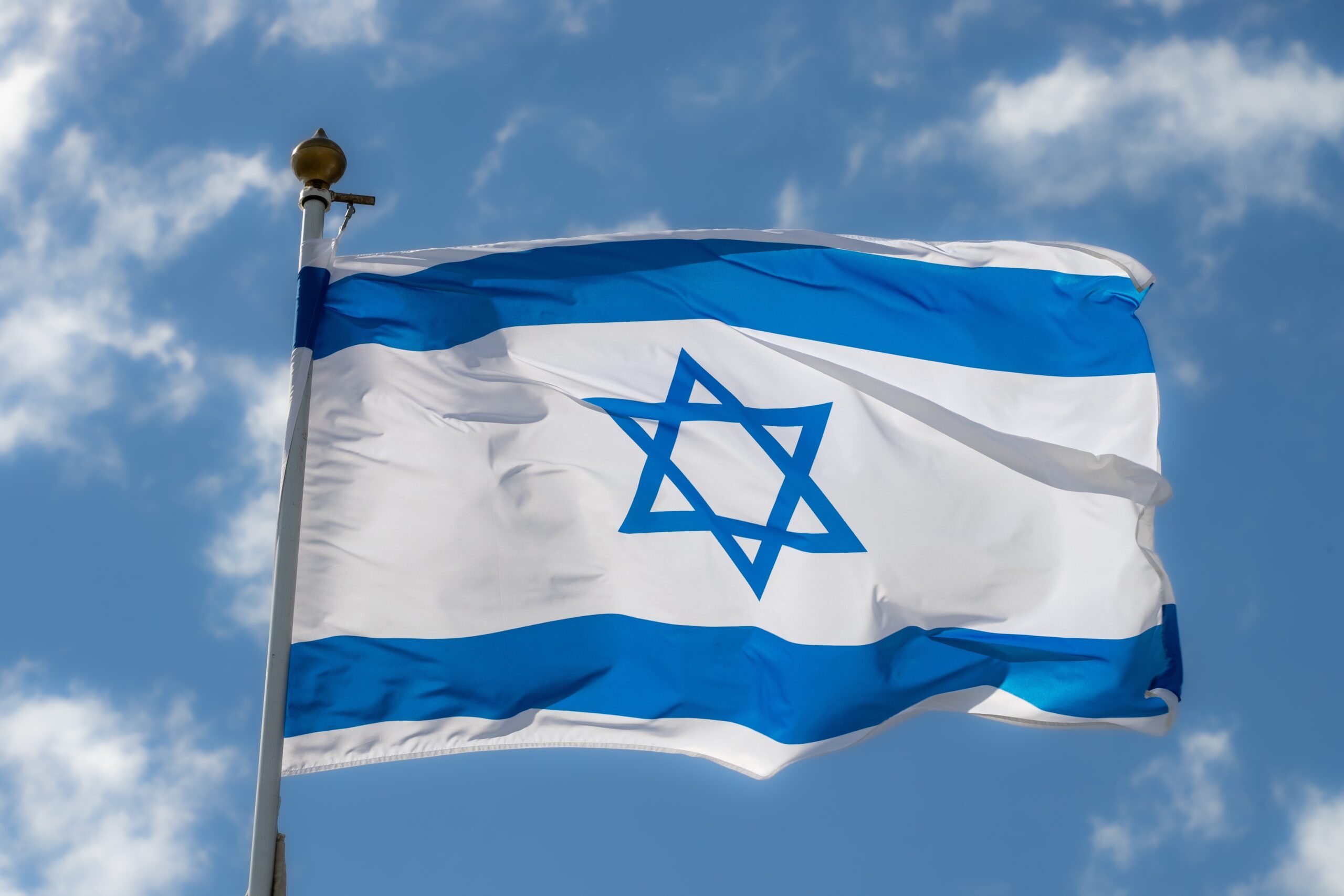
The Israeli flag now flies from the summit of Mount Sartaba in the Jordan Valley, raised there for the first time in history by Israel’s Ministry of Heritage. At 650 meters above sea level, the flag is visible from miles away — a deliberate, unmistakable statement that this land, the biblical heartland, belongs to the Jewish people.
The Sages understood fire as the original communication technology — not primitive, but ingenious. According to the Mishnah (Rosh Hashanah 2:4), once the Sanhedrin (the supreme Jewish court in Jerusalem) confirmed the new moon through eyewitness testimony, signal fires were lit atop the Mount of Olives. The flames were then relayed from peak to peak — Sartaba being the next critical station, passing the message northeast toward Gripina and ultimately to the Jewish communities of Babylonia. In an age before telegraph or telephone, a Jew in Babylon could look toward the western horizon and know: the Bet Din (rabbinical court) in Jerusalem had sanctified the new month. The sacred calendar still governed their lives. The chain was unbroken.
The prophet Isaiah described exactly this kind of connection between the Jewish people and their land: “Lift up a banner on a bare mountain, raise your voice to them, wave your hand so they may enter the gates of the nobles.” (Isaiah 13:2). A banner on a bare mountain is not a bureaucratic gesture. It is a proclamation.
Mount Sartaba was not chosen arbitrarily by the signal-fire architects of the Mishnah. Its elevation and its position commanding the entire Jordan Valley made it the essential link in the chain. From its summit, whoever controls Sartaba controls the visual corridor between Jerusalem and the east. The Hasmoneans — the Jewish warrior-kings who rededicated the Temple and drove out the Greeks — understood this perfectly. King Alexander Jannaeus (104–77 BCE) built the fortress known to the Greeks as Alexandreion precisely here, on this needle of rock above the valley, to guard the eastern approach to the biblical heartland. The ruins of that fortress still stand.
Heritage Minister Amichai Eliyahu announced that the flag-raising is the first step toward a full revival of the ancient signal-fire tradition, planned for Rosh Chodesh Nisan — the new month of Nisan. “We are reclaiming what is ours,” Minister Eliyahu said. “With God’s help, on Rosh Chodesh Nisan, we will light the fires on the summit as in the days of the Mishnah — a signal that then, as today, sends a clear message to Jews around the world: the people of Israel live, and they are walking across their historic land.”
The fortress that crowns Mount Sartaba has a name that shifts depending on who is telling the story. The Sages called it Sartaba in the Mishnah and Talmud. The Greeks called it Alexandreion. The Romans latinized it to Alexandrium. The Arabic name, Qarn Sartaba — “Horn of Sartaba” — at least has the honesty to acknowledge the mountain’s shape: a sharp, solitary spike of rock thrust above the Jordan Valley. Every empire that passed through this land left its fingerprints on the fortress, but it was the Hasmoneans who built it, and they built it for a reason.
King Alexander Jannaeus, who ruled from 104 to 77 BCE, constructed the fortress to anchor the northeastern border of the Jewish kingdom, guard the approach from Samaria, and hold political prisoners far from Jerusalem’s crowded streets. It was a garrison, a watchtower, and a dungeon — the kind of structure built by rulers who understood that sovereignty requires more than declarations. Josephus, the first-century Jewish historian, recorded the fortress in his Antiquities of the Jews, describing how the Roman general Pompey passed through the region during his conquest of Judea and encountered “a most beautiful fortress that was built on the top of a mountain called Alexandrium, whither Aristobulus had fled.” Even Rome’s most powerful general paused to note it.
Herod the Great later seized the fortress and poured resources into rebuilding it as a palatial desert stronghold, in the same mold as Masada, Herodion, and Machaerus. Herod had a particular use for remote fortresses — he filled them with people he did not trust. His second wife Mariamne and her mother Alexandra were held at Alexandrium in 30 BCE. Two of his own sons, Alexander and Aristobulus, whom he had executed at Sebaste in 7 BCE, were buried within its walls. The Romans under Vespasian or Titus finally razed it during the Great Revolt, and the stones have not been reassembled since. What remains on the summit today are ruins — but ruins that still tell the story of a Jewish kingdom that fought to hold this ground.
The fortress passed through many hands over the centuries — Pompey used it as a stronghold during his conquest of Judea, and Herod the Great rebuilt it as a palatial desert garrison, in the same style as Masada, Herodion, and Machaerus. Herod imprisoned political enemies there, including members of his own family, and buried two of his executed sons within its walls. The Romans under Vespasian or Titus razed it during the Great Revolt. For nearly two thousand years, the summit stood empty of any Jewish national symbol.
That ended Monday.
The Jordan Valley is not a peripheral strip of real estate. It is the eastern spine of the biblical land of Israel — the route through which Joshua led the Jewish people into their inheritance, the valley that separates the heartland from the desert. Whoever holds the high ground above it holds a strategic key that the Hasmoneans, the Romans, Herod, and every serious military strategist since has recognized. Today, Israel’s Ministry of Heritage is making explicit what geography has always made obvious: this mountain, this valley, this land is Jewish.
The fires planned for Rosh Chodesh Nisan will do more than re-enact an ancient ceremony. They will reassert a living continuity — the same continuity that the signal-fire system was designed to express. Two thousand years ago, a Jew in Babylon looked west and saw the message from Jerusalem. Today, the message is the same, and the mountain that carries it is flying the flag of the Jewish state.
