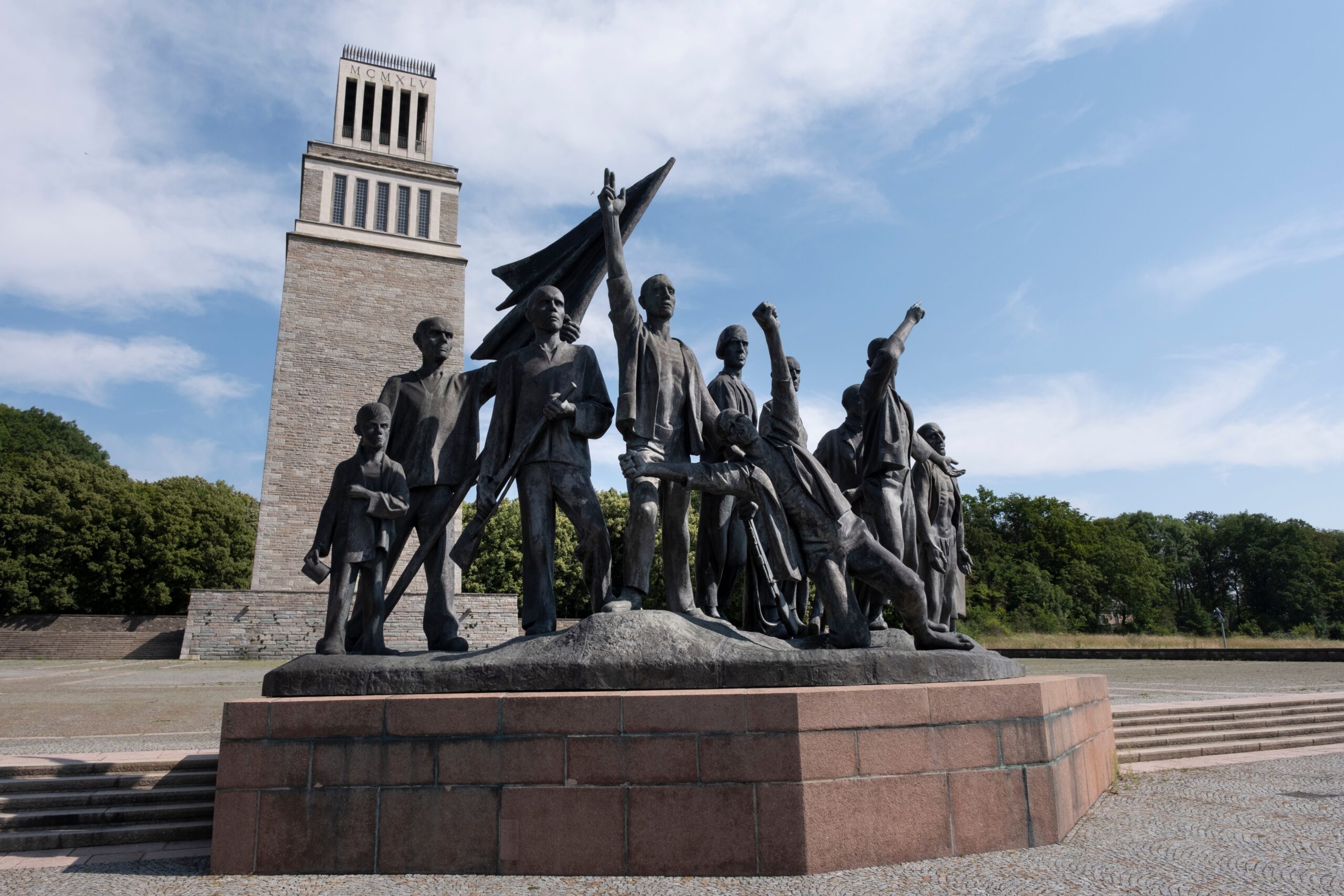
The annual commemoration of the liberation of the Buchenwald concentration camp has long stood as one of Germany’s most solemn acts of national reckoning. This year, that solemnity is set to collide with confrontation. A far-left anti-Zionist coalition calling itself “Kufiyas in Buchenwald” plans to stage a protest outside the memorial grounds on April 11, accusing the site of “historical revisionism and genocide denial” and of promoting what it calls Israeli propaganda.
The protest leads one to wonder what message the protest seeks to convey. How does a protest at a Nazi death camp help the “Palestinian cause”?
The immediate trigger is a 2025 ruling by a higher administrative court in the German state of Thuringia, which upheld the memorial’s right to deny entry to visitors wearing the Palestinian keffiyeh. The case arose after a woman was turned away from an 80th anniversary commemoration in April 2025 for wearing the scarf and later sought court permission to attend another event while displaying it. The court rejected her request, citing her stated intention of “sending a political message” against what she described as one-sided support for Israeli government policy. The judges ruled that her freedom of expression was outweighed by the memorial’s institutional purpose and stated, “It is unquestionable that this would endanger the sense of security of many Jews, especially at this site.”
Meet Anna, who has decided that because she wasn't allowed to wear her kefiyyeh into the Buchenwald concentration camp memorial last year, the site needs to become the next target of the Free Palestine movement.
— Hen Mazzig (@HenMazzig) February 23, 2026
She claims she is inspired by the members of the Buchenwald… pic.twitter.com/HjQ3zR2WNK
Germany’s federal commissioner for combating antisemitism, Felix Klein, denounced the planned demonstration as “a new low in the reversal of roles between victim and perpetrator.”
Buchenwald, established in 1937 near Weimar, was one of the largest concentration camps within Germany’s borders. Approximately 280,000 prisoners passed through the camp between 1937 and 1945. About 56,000 were murdered through execution, starvation, forced labor, medical experimentation, and disease. An estimated 55,000 to 60,000 Jews were imprisoned there, representing roughly 20–22 percent of all inmates. Between 11,000 and 15,000 Jews were murdered at Buchenwald and its subcamps, approximately 20–27 percent of the total dead. An additional 20,000 prisoners died at Mittelbau-Dora, where inmates were forced to produce the V1 and V2 rockets.
The organizers of the protest describe themselves as anti-fascists defending the legacy of the camp’s resistance. Their statement accuses the memorial of criminalizing Palestinian symbols such as the keffiyeh, olive branch, and watermelon, and of equating solidarity with Palestinians with antisemitism. They argue that remembrance at Buchenwald must address what they call “genocide in Gaza” and claim that current memorial policy betrays the 1945 Buchenwald Oath
“Jüdische Stimme für gerechten frieden in nahost,” a group established in 2003 whose name means “Jewish Voice for a Just Peace in the Middle East,” is one of the groups involved with the “Kufiyas in Buchenwald” campaign, EJJP Chairman Wieland Hoban said in an email. “Jüdische Stimme” is the German section of the European Jews for a Just Peace (EJJP) umbrella group.
Other “signatory” groups included two U.S. entities: Taxpayers Against Genocide and Richmond CA for Palestine, as well as the International Jewish Antizionist Network, the Communist Organization of Germany, and the Tunisian Youth Movement in Germany.
The campaign encourages anti-Israel activists to gather in Weimar, a city located about two miles away from the Buchenwald Memorial, on April 11, the 81st anniversary of its liberation by the United States Army.
History complicates that claim, emphasizing that it is the protesters, and not the event, that is guilty of rewriting history.
Palestinian Arab nationalism in the 20th century was shaped in part by the leadership of Hajj Amin al-Husseini, the Grand Mufti of Jerusalem. During World War II, Husseini fled to Berlin, met personally with Adolf Hitler in 1941, and aligned himself with the Nazi regime. He reportedly toured death camps and urged the Führer to expand the Final Solution to the Holy Land.
We are alarmed by reports that extremist anti-Israel groups are planning a political protest at the Buchenwald Memorial, during the official commemoration marking the 81st anniversary of the liberation of the Nazi concentration camp.
— European Jewish Congress (@eurojewcong) February 23, 2026
Buchenwald is the site where more than 56,000… pic.twitter.com/fOuNy7KSef
Al-Husseini’s request was implemented, though it was not activated. Historical evidence indicates that a special SS unit under Walther Rauff was prepared to implement mobile killing operations, including the use of gas vans, in the Middle East had Rommel’s forces succeeded in 1942. These units were formed to target Jewish populations in Palestine and Egypt, following the Nazis’ planned expansion into the region. These plans were part of the wider Nazi aim to extend the Holocaust into the Middle East, which was planned to take place behind the front lines of Rommel’s campaign. In October-November 1942, British General Bernard Montgomery’s Eighth Army defeated Rommel at the Second Battle of El Alamein, forcing a full retreat. This victory, known as a turning point in the war, stopped the planned Nazi invasion of Egypt and Palestine. With the defeat, the specialized extermination unit was repurposed and moved to Tunisia, where it implemented forced labor and anti-Jewish policies.
During the war, al-Husseini broadcast antisemitic propaganda in Arabic, recruited Muslims for Waffen-SS units in the Balkans, and urged resistance to Jewish immigration to the Land of Israel. His influence extended beyond rhetoric. He supported the Axis cause and opposed any rescue of Jews to Mandatory Palestine. His name is also associated with the 1941 Farhud pogrom in Baghdad, in which Iraqi Jews were murdered and injured during the Jewish festival of Shavuot.
The relationship between Nazi Germany and sectors of the Arab world was not incidental. Arab volunteers served with German forces, including units attached to the Afrika Korps in North Africa. Axis propaganda targeted Arab audiences, presenting the war as a joint struggle against Britain and the Jews. These documented alliances do not define every Arab or every nationalist current. They do establish that Nazi outreach to Arab leaders was real, welcomed by some, and grounded in shared antisemitism.
Germany continues to grapple with its responsibility for the murder of six million Jews. Its alliance with Israel is rooted in that history. The court in Thuringia ruled that preserving the integrity and purpose of the memorial outweighs the desire to use it as a stage for contemporary political protest.
Buchenwald is a graveyard. It is not a platform. The attempt to wrap modern anti-Zionist agitation in the language of anti-fascism at the gates of a Nazi camp forces a reckoning with history that cannot be evaded. The facts of the 20th century remain stubborn. Those who choose Buchenwald as their backdrop must contend with them.