



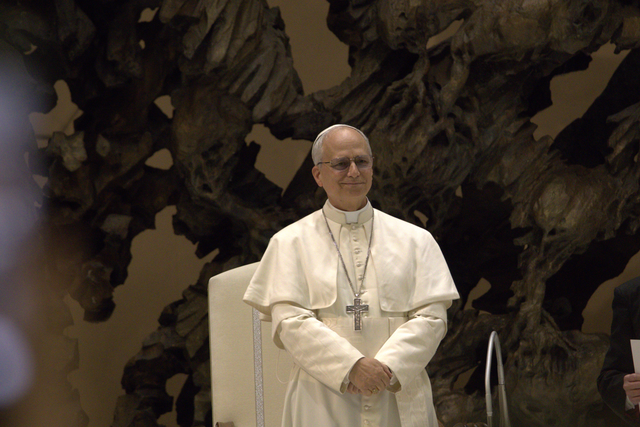
The Vatican has a long memory when it comes to blocking American-led peace initiatives — and a short one when it comes to recognizing Jewish rights in the Land of Israel. When Cardinal Pietro Parolin, the Vatican’s Secretary of State, announced Tuesday that Pope Leo would not be joining U.S. President Donald Trump’s newly formed Board of Peace, he framed the decision in procedural language about the United Nations. But for anyone who has watched the Holy See’s decades-long pattern of hostility toward Israeli sovereignty, the refusal carries a familiar echo.
Parolin made the announcement on the sidelines of a bilateral meeting with the Italian government in Rome, at the Palazzo Borromeo — the seat of the Italian Embassy to the Holy See — on the anniversary of the signing of the Lateran Pacts. “The Holy See will not participate in the Board of Peace because of its particular nature, which is evidently not that of other States,” Parolin told journalists. He elaborated that the Vatican’s core objection was jurisdictional: “One concern is that at the international level it should above all be the UN that manages these crisis situations. This is one of the points on which we have insisted.”
White House press secretary Karoline Leavitt called the decision “deeply unfortunate.”
The Board of Peace, chaired by Trump, was initially conceived to oversee Gaza’s demilitarization and reconstruction following the Hamas terrorist organization’s October 7 massacre. Its mandate has since expanded. Trump has said its work will “go far beyond Gaza.” The board’s charter names Trump as permanent chairman with no term limit, and permanent membership costs $1 billion. The executive board includes U.S. Special Envoy Steve Witkoff, former British Prime Minister Tony Blair, and World Bank President Ajay Banga. To date, board members have pledged $5 billion toward Gaza humanitarian and reconstruction efforts. More than 20 countries are expected to attend Thursday’s inaugural meeting, and key Arab states — including Saudi Arabia, Turkey, and Jordan — have signed on. Major European powers — France, Germany, Britain, and Spain — declined, as did New Zealand. The EU is sending its Mediterranean commissioner, Dubravka Šuica, to Washington as an observer without formally joining.
The Vatican’s absence is not surprising given Pope Leo’s track record. Since taking the helm of the Catholic Church last May, Leo has clashed publicly with Trump on immigration, foreign policy, and climate change. But the tension between the Holy See and pro-Israel American leadership runs far deeper than any single pope’s political instincts.
The Vatican only established full diplomatic relations with the State of Israel in 1993 — 45 years after Israel’s founding — and only after the Oslo Accords gave the Church political cover to do so without appearing to recognize Zionist legitimacy outright. For decades prior, the official position of the Holy See was that a Jewish state in the Land of Israel contradicted Catholic theological doctrine, specifically the teaching that Jewish exile was divine punishment and theological proof that the Church had replaced Israel as God’s covenant people — a doctrine known as supersessionism, or replacement theology.
The Vatican has consistently supported Palestinian statehood and the internationalization of Jerusalem. In 2015, the Holy See formally recognized “the State of Palestine” in a bilateral treaty — a move that Israel’s Foreign Ministry said was “unhelpful.” The Vatican has been a vocal opponent of Israeli sovereignty over Jerusalem, supporting a special international status for the city rather than recognizing it as Israel’s capital. These positions align far more naturally with the UN General Assembly’s perpetual anti-Israel majority than with any framework built around Israeli security and Jewish rights to the land.
The Vatican’s preference for the United Nations as the arbiter of Middle East peace is not a neutral procedural position. The UN is the body that birthed the “Zionism is racism” resolution in 1975 — a resolution so obscene it was eventually repealed — and whose agencies continue to fund, employ, and in some cases shield Hamas terrorists. UNRWA, the UN agency that has operated in Gaza for decades, had staff members who participated in the October 7 massacre. Deferring to that institution while rejecting Trump’s initiative is not a principled stand for international order. It is a political choice — one that consistently disadvantages Israel and rewards its enemies.
Pope Leo can cite procedural concerns about the Board of Peace’s structure all he wants. The Vatican’s record in the Middle East makes the real calculation clear. When an American president builds a framework that sidelines the UN — the primary institutional vehicle through which pressure on Israel has been applied for 75 years — and instead assembles a coalition that includes Arab states willing to work toward a non-Hamas Gaza, the Vatican walks away. That is not a commitment to peace. That is a commitment to a very specific, and very familiar, outcome.


