


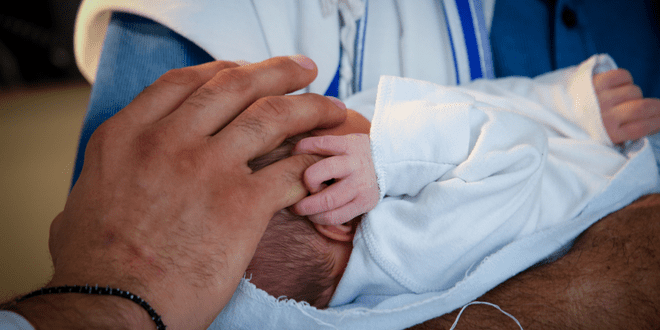
A Jewish baby boy, eight days old, lies surrounded by family as a mohel—a ritual circumciser trained in a tradition stretching back nearly four millennia—prepares to perform the same ceremony that Abraham performed on himself and his household. This is brit milah, the covenant of circumcision, the oldest continuously practiced Jewish ritual in the world. Now, in Antwerp, Belgium, three such mohels face criminal prosecution, a US Ambassador is summoning Belgium to account, and the Belgian Foreign Minister is summoning the US Ambassador—all over an eight-day-old baby boy and a knife.
The dispute crystallized in May 2025 when Belgian police conducted early morning raids on three locations in Antwerp’s Jewish Quarter, confiscating knives and demanding lists of circumcisions performed over the prior year. Three mohels now face criminal charges for performing a medical intervention without a medical license. Belgian prosecutors say they have enough evidence for a conviction. No trial date has been set.
US Ambassador to Belgium Bill White drew a hard line on Monday in a post on X. “Anti-Semitism is unacceptable in any form and it must be rooted out of our society,” he wrote, calling on Belgium to “drop the ridiculous and antisemitic ‘prosecution’ now of the three Jewish religious figures (mohels) in Antwerp. They are doing what they have been trained to do for thousands of years.” White indicated he has the backing of President Donald Trump and Vice President JD Vance, and called on Belgian Health Minister Frank Vandenbroucke to deregulate the ritual. He announced he will meet personally with the three accused mohels in Antwerp next week, and challenged Vandenbroucke to join him.
Anti Semitism is UNACCEPTABLE in any form & it must be rooted out of our society.
— Ambassador Bill White (@BillWhiteUSA) February 16, 2026
President TRUMP @POTUS @realDonaldTrump @JDVance @VP @SecRubio @StateSEAS @DeputySecState and I call upon all of Belgium to do a much better job on this subject !
TO BELGIUM,
SPECIFICALLY YOU…
Belgium’s Foreign Minister Maxime Prévot pushed back hard, summoning Ambassador White and firing back on X that “labeling Belgium as antisemitic is not just wrong, it’s dangerous disinformation that undermines the real fight against hatred.” Prévot insisted Belgian law “permits ritual circumcision when performed by a qualified physician under strict health and safety standards” and accused White of violating diplomatic norms through “personal attacks against a Belgian minister and interference in judicial matters.”
(EN) Any suggestion that Belgium is antisemitic is false, offensive, and unacceptable. Belgium condemns antisemitism with the greatest firmness. The fight against antisemitism, and all forms of hatred and discrimination, is an absolute priority for our country.
— Maxime PREVOT (@prevotmaxime) February 16, 2026
Everyone must be…
White was unmoved. “It’s not ok to simply say we ‘follow the law’ and ‘we are not antisemitic,'” he replied. “Both of those things can’t be true in this case.”
Brit milah—literally “covenant of circumcision”—is not a medical procedure. It is the physical sign of the eternal covenant between God and the Jewish people, commanded directly to Abraham: “This is My covenant which you shall keep, between Me and you and your descendants after you: every male among you shall be circumcised.” (Bereishit 17:10). The word brit means covenant. The word ot—sign—is equally critical. God explicitly calls circumcision an ot, a sign, marking the Jewish people as distinct among the nations. This is not a tribal custom or cultural habit. It is a divine commandment encoded in the first book of the Bible.
The command is so binding that brit milah overrides Shabbat, the Sabbath—one of the most sacred prohibitions in Jewish law. The Sages derived this principle directly from the text: if the eighth day after birth falls on Shabbat, the circumcision is performed anyway. The only commandment in the entire Bible that carries this weight of overriding Shabbat is brit milah. That is not a minor religious preference. That is the Jewish people’s most foundational covenant with God, enacted in flesh.
The mohel is not a rogue surgeon operating outside the medical establishment. He is a trained specialist in a procedure that takes roughly thirty seconds, has been performed successfully for thousands of years, and carries a safety record that any medical procedure would envy. Germany recognizes this, allowing mohels accepted by the Jewish community to perform the circumcision. The United Kingdom has maintained its Mohel Initiation Society for 300 years. Sweden and other European nations have found workable frameworks. Belgium alone has decided that three men fulfilling this ancient covenant are criminals.
The immediate legal trigger for the Antwerp case is a complaint filed in October 2023 by Rabbi Moshe Aryeh Friedman—himself a member of the local Jewish community—against six mohels, specifically targeting the practice of metzitzah b’peh (MbP), oral suction performed at the circumcision site. MbP is practiced in ultra-Orthodox communities and does carry documented health risks, including potential transmission of Herpes Simplex 1 to newborns. The Conference of European Rabbis has a Union of Mohels working to develop self-regulation standards that would address precisely these concerns. This intra-community dispute, however, rapidly became a vehicle for broader prosecution of brit milah itself.
Belgian MP Michael Freilich, the country’s only Orthodox Jewish lawmaker, told the Times of Israel that prosecutors now believe they have enough evidence for a conviction. “The problem is that there is no clear law regarding circumcision at the moment,” Freilich explained. “It’s not that brit milah is not allowed; it’s that there needs to be a clearer law about who can perform the procedure.” He has repeatedly called on Health Minister Vandenbroucke to accept “the outstretched hand of the Jewish community to try to find a solution and regulate the practice.”
European Commissioner of Health Olivér Várhelyi is also pressing Vandenbroucke for a resolution, without results so far. Várhelyi is scheduled to meet with the Antwerp Jewish community in the coming weeks.
Israeli Foreign Minister Gideon Sa’ar joined the condemnations, citing vandalised cemeteries, threats against synagogues, and Jews afraid to wear a kippah in public in Belgium. Israeli Diaspora Affairs Minister Amichai Chikli went further, describing “the Islamic Republic of Belgium” as “increasingly unfit for Jewish life” and thanking Ambassador White for his position.
Dear Minister Sa'ar,
— Maxime PREVOT (@prevotmaxime) February 17, 2026
Belgium is home to one of Europe's oldest Jewish communities. We are proud of that. And we will do everything to keep it that way.
When a synagogue is targeted, we are outraged. When graves are desecrated, we are disgusted. When Jewish students face… https://t.co/whjfDyJqBX
The Combat Antisemitism Movement (CAM) called the charges a “witch-hunt,” with CEO Sacha Roytman Dratwa issuing a full statement: “We join Ambassador White in his condemnation of these outrageous arrests, which constitute a witch-hunt against those merely fulfilling an ancient and long-standing Jewish tradition. These arrests are having a chilling effect on the Belgian Jewish community, because it is telling them that if their traditions are not wanted, then they are not wanted. To many, this is designed to make Jewish life impossible and is inherently anti-Semitic, because while intent can be debated, it is impact that matters, and this is having a massive impact on the Jewish community.”
Ralph Pais, vice-chair of the Jewish Information and Documentation Centre, called White’s intervention a “huge bomb” and stated that “America continues to uphold a promise that Europe also pledged to keep: safeguarding Jewish life and ensuring that Jews can live openly and securely. We expect Belgium to fully comply with the very principles and democratic values it professes to uphold.”
The broader context is impossible to ignore. Antisemitism in Belgium has surged since Hamas launched its terror war against Israel on October 7, 2023. Verbal abuse, physical violence, intimidation, and antisemitic graffiti strike Antwerp’s 30,000-strong Jewish community weekly. Belgium protests that it has antisemitism coordinators, reinforced police protection for Jewish schools and synagogues, and mandatory visits to the Kazerne Dossin memorial for antisemitism offenders. These are not nothing. But a country that deploys police at dawn to raid the homes of mohels and confiscate their knives while Hamas terrorists march freely through Brussels has a credibility problem that no diplomatic response can paper over.
The brit has outlasted every empire that tried to abolish it—the Greeks, the Romans, the Soviets. The covenant cut into the flesh of Jewish boys for four thousand years was not stopped by Antiochus Epiphanes, who made it a capital crime, and it was not stopped by Hadrian. Belgium’s prosecutors will not stop it either. But the willingness to try—in 2026, in the heart of Europe, eighty years after the Holocaust—tells the Jewish world everything it needs to know about the continent’s real commitment to Jewish life.

