





At the entrance to the Temple Mount, the holiest site in Judaism, shoes once lay in tangled heaps on the ground. Jews ascending in accordance with halacha—Jewish law—removed their footwear, as required when entering a sacred place. The result was disorder, a tripping hazard, and a scene unbefitting the site where the Beit HaMikdash, the Holy Temple, once stood.
For years, the problem went unaddressed. Each day, as Jewish visitors ascended barefoot in keeping with established halachic practice, shoes accumulated at the entrance. The clutter created both a safety risk and an unnecessary flashpoint at a site already burdened with tension and restrictions.
The requirement to ascend barefoot is not symbolic theater. In the Temple itself, the Kohanim, the priests, served without shoes. The Sages taught that there was no separation between their feet and the sacred floor of the Azarah, the Temple courtyard. The flooring was engineered with a double-layered design, creating air space beneath the stone to prevent moisture buildup and to moderate the cold of Jerusalem winters. The service demanded physical endurance and ritual precision. Before ascending the Mount today, Jews immerse in a mikveh, a ritual bath, in accordance with halacha, just as those entering the Temple precincts prepared themselves in purity. The removal of shoes and immersion in a mikveh are not innovations. They are acts rooted in the Temple service itself.
Earlier this month, an anonymous donor quietly stepped forward and installed a simple shoe rack at the entry point. The rack brought immediate order to the area. Shoes were placed neatly, the pathway was cleared, and police had an unobstructed view of the entrance.
The rack was promptly seized by police, returning the entrance to chaos.
BeYadenu – Returning to the Temple Mount did not accept the reversal. In a formal letter to Jerusalem District Commander Avshalom Peled, acting CEO Akiva Ariel outlined the practical and operational advantages of the rack.
“Every day a situation of ‘shoe piles’ is created that constitutes a safety hazard and offends public sensitivities,” Ariel wrote. “A dedicated and aesthetic shoe rack will allow the police better control of the public space and an easier visual scan of the area.”
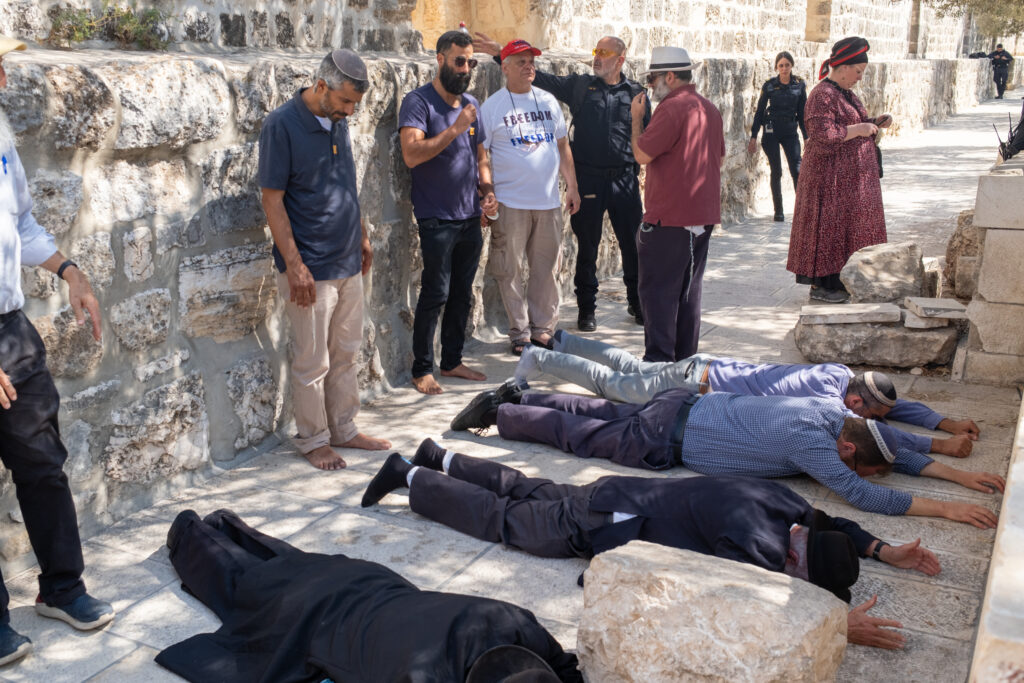
The argument was direct. The rack did not alter prayer arrangements. It did not change established procedures. It did not affect other public groups visiting the Mount. It addressed a clear safety and logistical concern.
After reviewing the request, the police approved the installation, clarifying that the rack does not alter the status quo and does not harm other public groups. The shoe rack, donated privately, was installed in coordination with enforcement authorities.
Ariel welcomed the decision. “The Temple Mount is the most sacred place for the Jewish people, and there is no reason that those who ascend to it must deal with deficient infrastructure that demeans its stature. Installing the rack is a small but significant step toward making the Temple Mount accessible, orderly, and respectful for every Jew. We will continue to work to improve conditions on the Mount in all areas.”
The development follows another shift on the Mount. After years in which Jews were denied the ability to pray from printed texts, police have now officially permitted visitors to bring prayer sheets. The change marks a departure from prior enforcement, in which even silent prayer from a written page could result in removal.
Restrictions remain severe. Only one approved version of a prayer sheet is permitted.
That limitation was recently enforced against Ariel himself. He was detained and removed from the Mount for praying from his own prayer sheet rather than the single version authorized by police. The content was Jewish prayer. The act was silent. The location was the holiest site in Judaism. The removal constituted a direct infringement on his right to freedom of religious expression at a Jewish holy site.
The Mount remains governed by tight limitations on Jewish prayer and expression. Yet the installation of a shoe rack and the limited approval of printed prayer sheets demonstrate that determined, focused advocacy produces results.
The Bible commands, “My house shall be called a house of prayer for all peoples” (Isaiah 56:7). The verse speaks of dignity and order in the service of God. A cleared entrance. Shoes placed properly. Jews being permitted to hold a page of prayer in their hands. These are basic matters.
The Temple Mount is not a museum exhibit or a political bargaining chip. It is the heart of Jewish faith and identity. Order, safety, and the right to pray are obligations grounded in the sanctity of the place itself.
BeYadenu has made clear that its work continues. The goal is simple: that no Jew ascending the Temple Mount will hesitate before bringing a siddur, a prayer book, to a Jewish holy site.
