




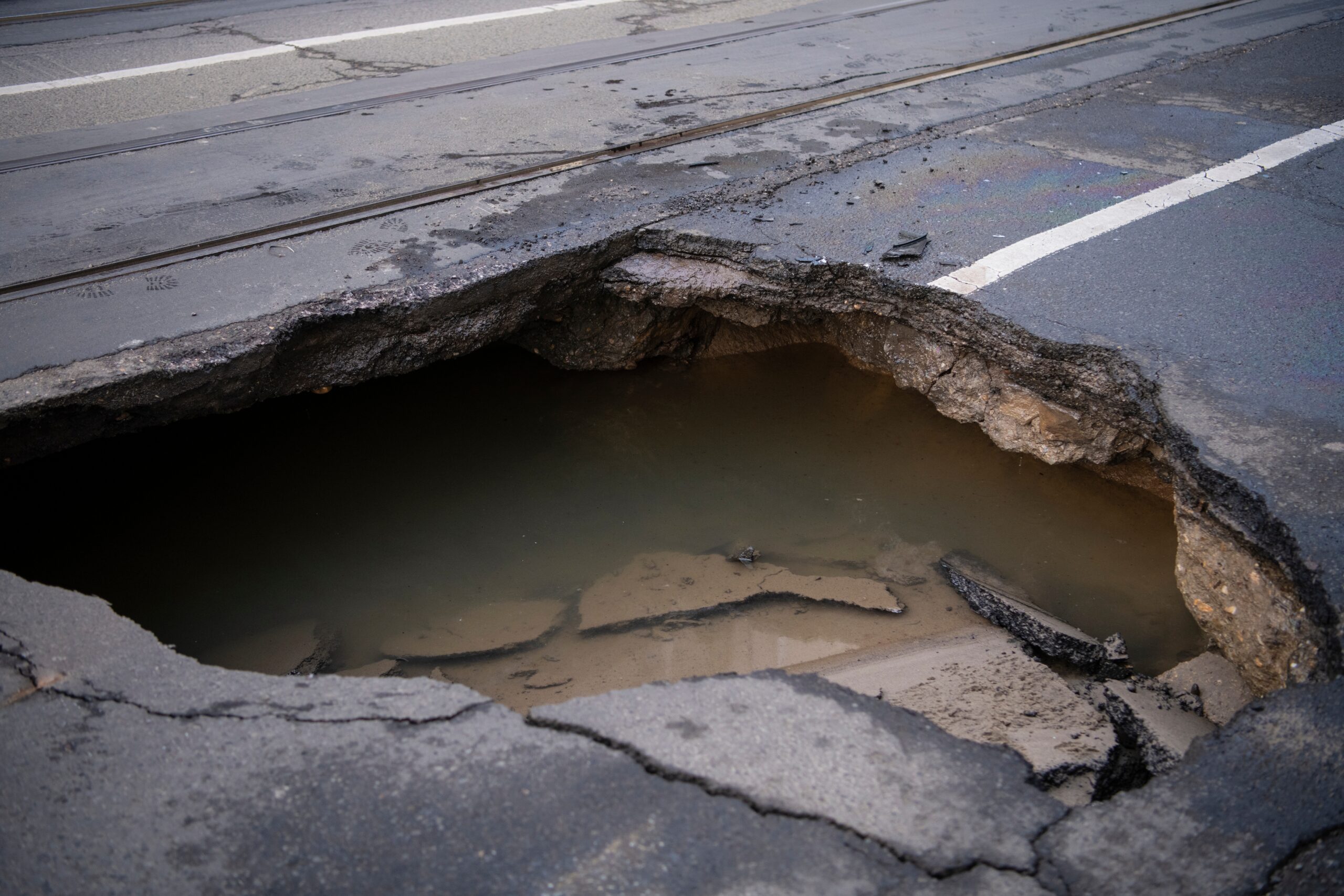
A gaping sinkhole tore open a busy intersection in Shanghai this week, swallowing a stretch of asphalt in seconds as stunned workers ran for safety. The dramatic collapse, captured on CCTV and widely shared online, showed the road splitting apart before caving into a massive crater, sending up clouds of dust in the heart of the city’s Minhang District.
According to Gulf News and local reports, the incident occurred near the intersection of Qixin Road and Li’an Road, close to an active metro construction site. Tunneling work by the China Railway Tunnel Group was underway when groundwater breached the excavation area, destabilizing the soil beneath the roadway. Within moments, the pavement gave way.
Authorities said the collapse took place at approximately 10:30 a.m. Municipal crews quickly cordoned off the area, diverted traffic, and began pouring concrete to stabilize the ground. Nearby offices and residential buildings were temporarily evacuated as a precaution. No injuries or fatalities were reported.
Video from the scene shows cracks racing across the asphalt before the surface collapses into a wide cavity. Workers are seen sprinting away as the ground drops out beneath them. On social media, reactions ranged from technical assessments to political commentary. “Lucky everyone stayed safe, railings worked. Looks like water flow in the area caused underground holes, not uncommon,” one user wrote. Another commented, “China about to fix this in 12 hours and reopen the road like nothing happened.”
Shanghai has long faced subsidence risks due to its soft, water-saturated alluvial soil, heavy groundwater extraction, and rapid urban development. In January 2024, part of a road in the same district collapsed after a sewage pipe failure. In August 2023, a 10-square-meter sinkhole opened elsewhere in the city. Engineers are now investigating the precise sequence of failures that led to this latest incident.
Security cameras have captured a massive sinkhole opening in Shanghai, China, swallowing a large section of a busy road and nearby structures. Evacuations have been underway since last several hours in the area. pic.twitter.com/FD6gvFKGHQ
— Aditya Raj Kaul (@AdityaRajKaul) February 12, 2026
The ground opened without warning. In the Bible, when the earth opens suddenly, it is not merely a matter of geology. It is judgment. The most famous biblical precedent is the rebellion of Korach. Challenging the leadership of Moses and Aaron, Korach framed his uprising as a populist demand for equality. Moses responded by declaring that the outcome would demonstrate divine authority. The Torah records:
“But if the LORD brings about something unheard-of, and the earth opens its mouth and swallows them up with all that belongs to them, and they go down alive into Sheol (the netherworld), you shall know that these men have spurned the LORD.” (Numbers 16:30)
The text continues that “the earth opened its mouth and swallowed them and their households” (Numbers 16:32). The rebellion was not answered with argument. It was answered with the ground giving way beneath the rebels’ feet.
The Sages teach that Korach’s punishment was measure for measure. He sought to undermine divinely ordained order; the earth itself rejected him. Midrash describes the opening in the ground as a rupture in the natural order, a reminder that stability is not guaranteed when authority rooted in heaven is mocked on earth.
When Korach gathered his followers against Moses and Aaron, the punishment came not from plague or sword but from the ground beneath them. The Bible describes the moment with stark clarity: “And the earth opened her mouth and swallowed them up, and their households, and all the men that appertained unto Korach, and all their goods” (Numbers 16:32). The Sages taught that Korach and his congregation did not perish in the usual sense. They remain alive beneath the earth, awaiting the end of days.
A Midrash cited in the Tosafot (Kiddushin 31b) links Korach’s fate to the future redemption. The commentary asks why Psalm 82 is called a mizmor—a song—despite its lament over the destruction of the Temple. The Tosafot offers a remarkable explanation. Asaf, a descendant of Korach, perceived salvation hidden within devastation. The Midrash compares it to a maidservant who dropped her clay pitcher into a well. She despaired until the king’s maidservant approached with a golden pitcher, which also fell in. The first maidservant then rejoiced: if the king’s servants retrieve the golden vessel, her simple one will come out too. In the same way, when the sons of Korach saw the gates of the Temple sink into the earth, they proclaimed that whoever rescues the gates will also rescue them. That, the Midrash teaches, is why Asaf called it a song.
Korach was extraordinarily righteous before his rebellion. His argument that all Israel possesses inherent holiness was not false; it was premature. The sages teach that his vision belonged to the messianic era, which is why he wasn’t killed. According to the Midrash, he was swallowed by the earth and will reemerge in the days preceding the Messiah, when his vision of all of Israel being equal in their clear vision of God will come to be.
In recent years, clusters of sinkholes have appeared in Turkey’s Konya Plain, in Russia, and elsewhere. In each case, secular explanations point to groundwater depletion, erosion, and industrial activity. Those factors are real. The Bible does not deny natural mechanisms. It reveals their meaning.
The Hebrew word for earth, aretz, is the same word used for land in the covenant with Abraham. Land is never neutral in the Bible. It responds. When Korach rebelled, the earth became an active participant in enforcing divine justice.
The footage from Shanghai shows workers running as the pavement cracks and disappears. It is a modern scene with ancient resonance. The earth can open in an instant. Stability can vanish in seconds. Korach believed he was standing on firm ground. He was not.
Shanghai’s engineers will repair the damage. Concrete will be poured. Traffic will resume. But the image remains: the earth opening its mouth. The Bible recorded it once in the wilderness. The lesson has not changed.

