




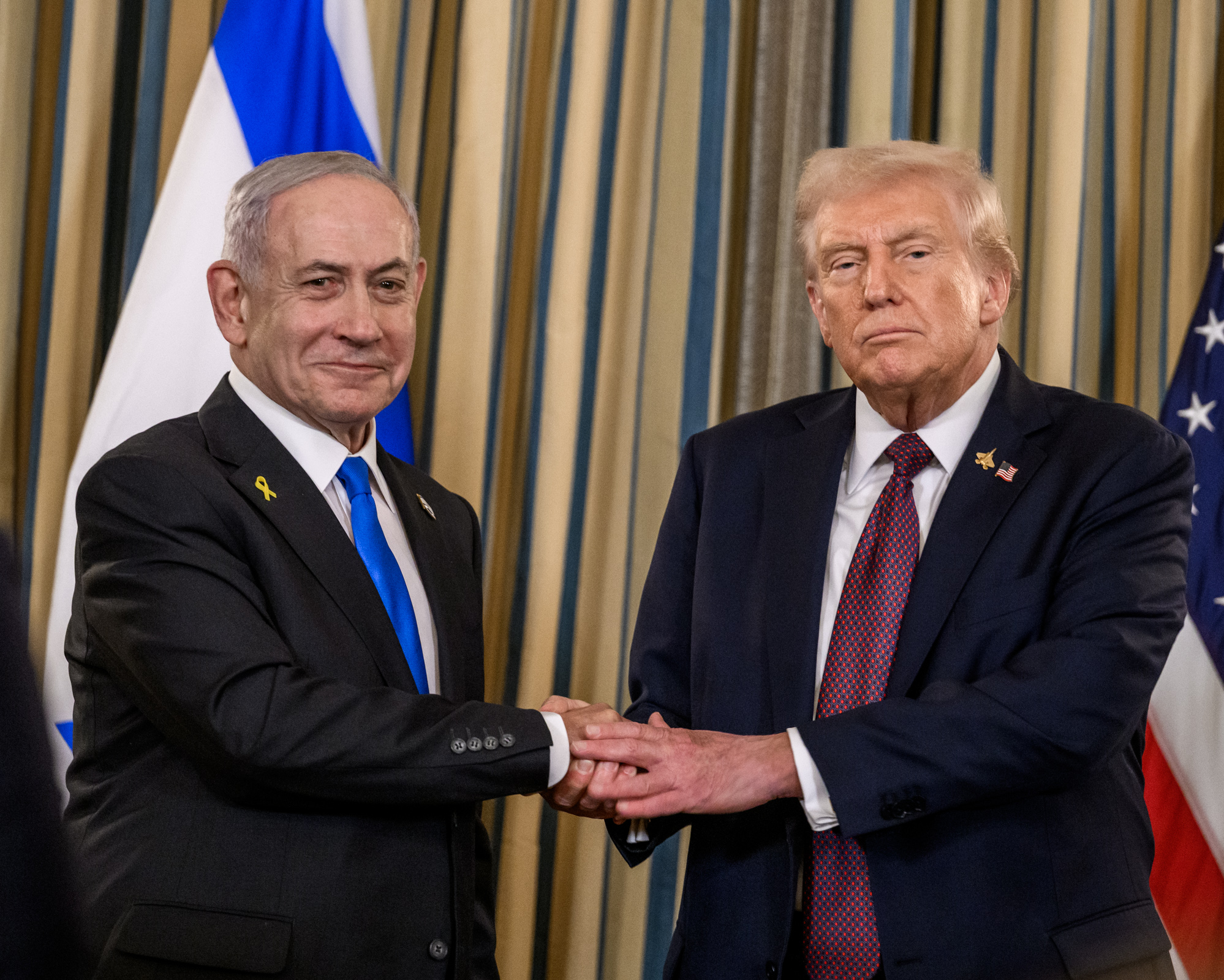
Nearly three-quarters of Israelis view President Donald Trump as a better-than-average U.S. president for Israel’s interests, with almost half describing him as one of the best presidents in American history from an Israeli perspective, according to a new survey released by the Jewish People Policy Institute.
The February 2026 Israeli Society Index shows an exceptionally high level of public approval of Trump’s performance regarding Israel. Among the Israeli public, 73% rate Trump as better than average, with 49% calling him one of the best presidents in U.S. history for Israel, and another 24% describing him as above average.
The numbers climb even higher among Jewish Israelis specifically. 54% say Trump is one of the best presidents in U.S. history in the Israeli context, with an additional 25% describing him as above average, bringing the total to 79%.
How Does Israeli Right-Wing Support Compare to the Left?
Support for Trump on the Israeli right is nearly unanimous. 73% view him as one of the best presidents, and another 19% see him as above average from an Israeli perspective, totaling 92%. On the Israeli left, by contrast, only 34 % hold a positive view of Trump.
The survey also asked Israelis to assess Trump’s performance from an American perspective. The findings reveal a striking gap between Israeli and American perceptions. From an American perspective, as assessed by Israelis, 28% believe Trump will be remembered as one of the best presidents in U.S. history, while an additional 20% describe him as an above-average president. In total, nearly half of Israelis believe that, even from the viewpoint of American voters, Trump’s presidency will ultimately be regarded as positive.
However, Israeli opinion remains divided. 20% believe Trump will be remembered as one of the worst presidents in U.S. history, while another 20% think he will be judged as average or below average. 12% said they did not know or did not respond.
Clear differences emerge between population groups. Among Jewish Israelis, assessments are more favorable, with 31% viewing Trump as one of the best presidents in U.S. history. Among Arab Israelis, attitudes are more negative, with 38% describing him as one of the worst presidents in U.S. history.
A comparison with American public opinion highlights a notable gap. A Siena College and New York Times poll of American voters conducted last month found that only 19% of Americans believe Trump will be remembered as one of the best presidents in U.S. history, compared to 28% of Israelis who hold that view. Conversely, 42% of Americans believe Trump will be remembered as one of the worst presidents, more than double the share of Israelis who think so.
Ideological divisions within Israel further shape these assessments. On the right, belief in Trump’s positive historical legacy is especially strong, with more than half of respondents viewing him as one of the best U.S. presidents. Among center-right Israelis, a majority rate Trump as an above-average president. In contrast, most center-left and left-wing Israelis view Trump negatively, describing him as a below-average president or one of the worst presidents in U.S. history.
These findings come ahead of Trump’s meeting with Prime Minister Benjamin Netanyahu this Wednesday.
Trump’s Record on Israel
The high Israeli approval ratings reflect Trump’s extensive record of pro-Israel actions during both his first and current terms. The president has implemented policies that previous administrations either avoided or actively opposed.
In December 2017, Trump recognized Jerusalem as Israel’s capital and relocated the U.S. embassy from Tel Aviv to Jerusalem in May 2018, fulfilling a promise that multiple presidents had made but failed to keep. The move acknowledged the reality that Jerusalem has served as Israel’s capital since the state’s founding.
Trump recognized Israeli sovereignty over the Golan Heights in March 2019, making the United States the first country to acknowledge Israel’s control over the strategic plateau captured from Syria in 1967. The proclamation declared that the region “is part of the State of Israel” and has been critical for Israeli security.
The Trump administration reversed decades of U.S. policy by declaring in November 2019 that Israeli communities in Judea and Samaria are not illegal under international law. Secretary of State Mike Pompeo announced that the establishment of Israeli civilian communities in these areas “is not, per se, inconsistent with international law.”
Trump brokered the Abraham Accords in 2020, normalizing relations between Israel and the United Arab Emirates, Bahrain, Sudan, and Morocco. The agreements opened diplomatic, economic, and security cooperation between Israel and Arab nations without requiring Israeli concessions to the Palestinians.
The Trump administration cut funding to the Palestinian Authority and the United Nations Relief and Works Agency, citing the PA’s payments to terrorists and their families and UNRWA’s perpetuation of Palestinian refugee status across generations.
Trump withdrew the United States from the Iran nuclear deal in May 2018, reimposing sanctions on Tehran. He ordered the killing of Iranian General Qasem Soleimani in January 2020, eliminating the architect of Iran’s proxy network across the Middle East.
The president unveiled his “Peace to Prosperity” plan in January 2020, which proposed allowing Israel to apply sovereignty to thirty percent of Judea and Samaria, including the Jordan Valley and all Israeli communities. While the plan included provisions for a Palestinian state, it represented the most pro-Israel peace proposal ever put forward by a U.S. administration.
Trump appointed David Friedman as U.S. Ambassador to Israel, selecting a committed supporter of Israeli communities in Judea and Samaria who had served as president of American Friends of Bet El Yeshiva. Friedman’s tenure marked a departure from previous ambassadors who maintained distance from Israeli positions on territorial issues.
The administration closed the Palestine Liberation Organization office in Washington in 2018, citing the PA’s refusal to engage in peace negotiations and its support for the International Criminal Court’s investigation of Israel.
Trump recognized the Golan Heights as Israeli territory through a presidential proclamation, providing legal and diplomatic backing for Israel’s sovereignty over the strategically vital region bordering Syria.
During the current Gaza conflict, Trump has supported Israel’s right to defend itself against Hamas terrorism. His administration has maintained military aid and diplomatic backing as Israel prosecutes its war against the terrorist organization.
Trump signed the Taylor Force Act in 2018, cutting U.S. aid to the Palestinian Authority until it ends payments to terrorists and their families. The legislation was named after an American veteran killed in a Palestinian terrorist attack in Tel Aviv.
The president moved to designate the Muslim Brotherhood as a terrorist organization, targeting the ideological foundation of Hamas and other Islamist groups. While the formal designation faced bureaucratic delays, Trump’s position marked a clear stance against political Islam.
Trump has challenged the International Criminal Court’s authority to investigate Israel for alleged war crimes, defending Israeli sovereignty against international legal bodies.
Perceptions of the War: Victory, with Reservations
Against the backdrop of relative calm on the ground and uncertainty surrounding the implementation of the second phase of the agreement, which includes Hamas’s disarmament and the reconstruction of Gaza, 54% of Israelis believe that Israel won the war. Among them, 36% say the victory was insufficient, while 18 percent believe it was a full victory.
By contrast, 20% of the public believes that Israel neither won nor lost the war, while 23% assess that Israel lost the war or came close to losing it. Among Jewish respondents, 60 percent believe Israel won the war. Among Arab respondents, only 25% share that view.
The ideological divide sharpens the picture. The further right respondents place themselves politically, the stronger the perception that Israel defeated Hamas, with 83% on the right expressing this view. On the left and center-left, there is a clear tendency to see the war’s outcome as a failure or, at best, an incomplete achievement, a view held by 63 percent of those on the left.
A notable finding emerges among coalition voters. Even there, a sense of unfinished business prevails. A majority of Likud voters, 51%, and an even larger majority of Religious Zionism voters, 69%, believe that although a victory was achieved, it was not sufficient. The only party whose voters mostly believe that Israel lost the war or came close to losing it is the Democrats Party, where 52% hold that view.
Data for JPPI’s February 2026 Israeli Society Index was collected February 1–4, 2026. Data collection was conducted via the Madad website panel (588 Jewish respondents) and Afkar Research (207 Arab respondents), with roughly half online and half by telephone. The data were analyzed and weighted by voting patterns and religiosity to reflect the views of the adult population in Israel. The JPPI Israeli Society Index is compiled by Shmuel Rosner and Noah Slepkov with research, production, and writing assistance by Yael Levinovsky. Prof. David Steinberg serves as a statistical consultant.