



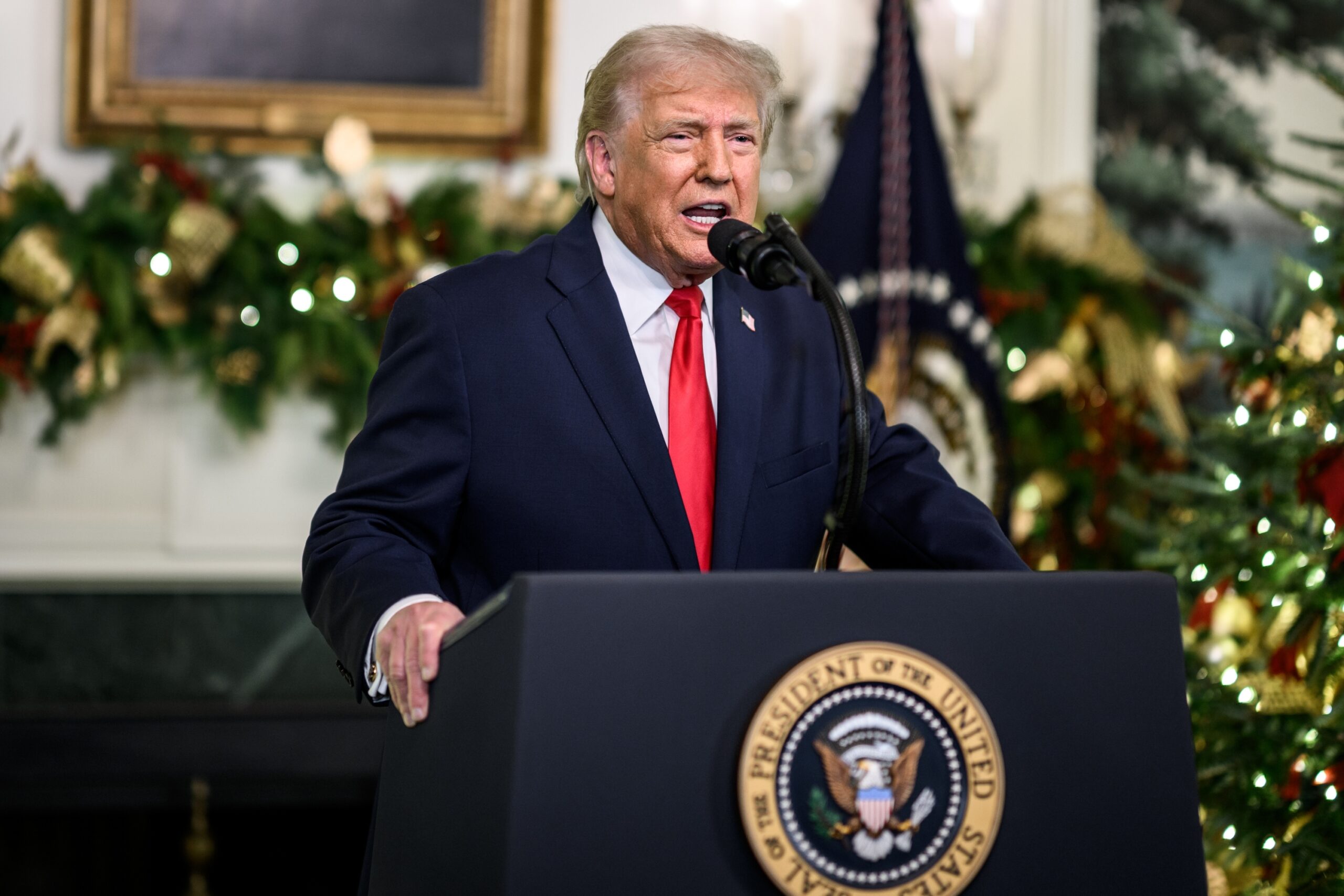
President Donald Trump spent nearly 80 minutes at the 74th National Prayer Breakfast on February 5 doing what he does best—talking about himself. But this time, the subject was his eternal soul. Standing before a crowd at the Washington Hilton hotel, Trump mused on his chances of making it through the pearly gates, declaring ironically, “I really think I probably should make it. I mean, I’m not a perfect candidate, but I did a hell of a lot of good for perfect people.”
Trump’s remarks at the nonpartisan event were characteristically bold. He boasted that he has “done more for religion than any other president,” accusing his predecessors of having “bailed out” on religion. He mocked Democrats, saying, “I don’t know how a person of faith can vote for a Democrat. I really don’t.” The president announced plans for a May 17 event at the National Mall to “rededicate America as one nation under God,” and claimed that churches are filling up under his watch, unlike two years ago.
“Some major politicians refuse to say the word God. They don’t want to say it. I say it,” Trump declared. He credited his administration with bringing prayer back to schools, creating a White House faith office, and implementing policies targeting transgender people—all measures he framed as victories for religious America.
The president’s relationship with Christian evangelicals has been a defining feature of both his terms in office. He emerged as a champion of the Christian right despite not attending church regularly and being known for his ruthless attacks on adversaries. Trump recounted remarks from Robert Jeffress, senior pastor of First Baptist Church in Dallas, who said of Trump in 2016, “He may not have ever read the Bible, but he will be a much stronger messenger for us.”
During his speech, Trump portrayed himself as a defender of religious liberty against government persecution. “They always like to say, ‘Trump is a dictator!'” he said. “They love that. I’m not a dictator. But they were like dictators. They were like the Gestapo. They were arresting people for going to church.”
When addressing his past comments about the afterlife, Trump blamed the media for failing to capture his sense of irony. “I was just having fun,” he said, before adding, “I really think I probably should make it. I mean, I’m not a perfect candidate, but I did a hell of a lot of good for perfect people.”
Trump closed his remarks with a quote from the New Testament—Matthew 5:8—”Blessed are the pure in heart, for they shall see God,” then immediately undercut it: “I don’t know if that applies to me necessarily. I’m not so sure… I try.”
This was not the first time Trump has speculated publicly about his eternal fate. In July 2025, the Trump campaign sent fundraising emails reading, “I want to try and get to Heaven.” The message referenced the July 2024 assassination attempt in Butler, Pennsylvania: “Last year, I came millimeters from death when that bullet pierced through my skin. My triumphant return to the White House was never supposed to happen! But I believe that God saved me for one reason: TO MAKE AMERICA GREAT AGAIN!”
The following month, during a phone interview with Fox & Friends, Trump suggested that mediating between Russian President Vladimir Putin and Ukrainian President Volodymyr Zelenskyy might earn him divine favor. “If I can save 7,000 people a week from being killed, I think that’s pretty—I want to try to get to heaven if possible,” he said. “I’m hearing that I’m not doing well. I am really at the bottom of the totem pole. But if I can get to heaven, this will be one of the reasons.”
White House press secretary Karoline Leavitt clarified at the time that Trump was serious. “I think the president wants to get to heaven—as I hope we all do in this room as well,” she said.
But by October 12, with the Russia-Ukraine conflict continuing to escalate, Trump seemed less optimistic. When asked about his August statement, he admitted he was “being a little cute” and said, “I don’t think there’s anything going to get me in heaven. I really don’t. I think I’m not maybe heaven-bound.” He added, “I may be in heaven right now as we fly on Air Force One. I’m not sure I’m going to be able to make heaven, but I’ve made life a lot better for a lot of people.”
Trump’s claim that he has done “a hell of a lot of good for perfect people” may be brash, but it reflects a real belief that actions in this world have consequences in the next. Whether those actions are sufficient—and whether heaven is a destination earned or a gift bestowed—remains a question the president continues to wrestle with, in public and on his own terms.

