




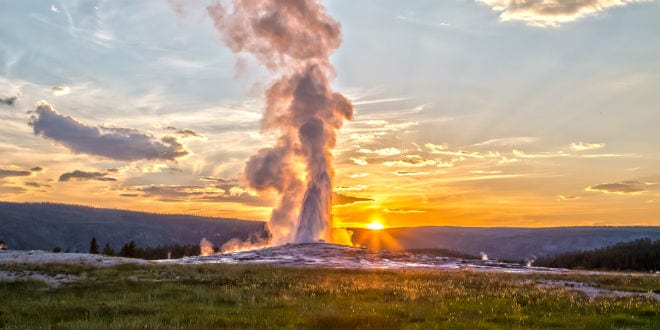
An eruption at Yellowstone would not merely be a geological event. It would be a convulsion of the earth on a scale the Bible explicitly associates with divine judgment. Scientists warn that a full caldera eruption could blanket much of North America in ash, collapse infrastructure, poison water supplies, and plunge the world into years of climatic disruption. Tens of thousands could be killed immediately, with global food systems breaking down in the aftermath. New scientific studies now suggest that much of what researchers thought they knew about Yellowstone’s past eruptions may be incomplete. That realization has direct consequences for how scientists assess the likelihood and potential scale of a future catastrophe.
An eruption at Yellowstone would not resemble a regional natural disaster. It would be a continental and potentially global event. Scientists estimate that a full-scale caldera eruption would eject thousands of cubic kilometers of ash and volcanic material into the atmosphere, burying large portions of the United States under thick layers of caustic ash. Roofs would collapse under the weight, water systems would be contaminated, electronics would fail, and air travel across North America would cease. Immediate fatalities are estimated in the tens of thousands, with long-term deaths potentially reaching far higher as food systems collapse.
The greatest danger would not come from lava but from ash. Fine volcanic particles inhaled into the lungs are lethal. Ash clouds lofted high into the stratosphere would block sunlight, triggering a prolonged volcanic winter. Climate models indicate global temperature drops of several degrees Celsius, enough to devastate agriculture worldwide for years. A sustained eruption could render large portions of the central United States uninhabitable and push the global economy into collapse.
If the geological record is incomplete, then predictions about the future rest on assumptions that may need revision.
The latest findings, presented by scientists at the Yellowstone Volcano Observatory, Montana State University, and published in peer-reviewed journals, point to a troubling reality. Yellowstone’s eruptive history is not fully written in stone. Portions of it are buried, obscured, or erased by time, and that missing history matters.
When geologists assess volcanic risk, they begin with one core principle: past behavior is the best guide to future behavior. At Yellowstone, scientists have long identified three massive, caldera-forming eruptions over the past 2.1 million years, with the most recent occurring 631,000 years ago. That eruption formed the present Yellowstone Caldera and spread ash across much of North America.
Since that event, Yellowstone has not been dormant. Researchers have identified at least 28 post-caldera eruptions in the form of rhyolite lava flows and domes within the caldera itself. Importantly, this figure is not presented as a final count. It is explicitly described by the US Geological Survey as a minimum estimate.
The reason is simple. Older eruptions are often buried beneath younger lava flows, altered by erosion, or masked by glaciation. In many cases, only small outcrops remain, offering fragmentary clues that are difficult to date or distinguish from nearby flows.
Recent field work underscores how much may still be missing. Lava exposed in Hayden Valley was long believed to be about 102,000 years old. New argon dating suggests it may be closer to 160,000 years old, potentially identifying an entirely separate eruption that had gone unrecognized. USGS scientists collected new samples in 2025, with final results expected soon.
Similarly, along the Gibbon River near Nez Perce Creek, geologists identified a small exposure of lava lying beneath a known flow. If confirmed through geochemistry and argon dating, this would add yet another eruption to Yellowstone’s record.
Researchers from Montana State University have also identified volcanic deposits northwest of the caldera near Madison Junction that appear to predate the caldera-forming eruption itself. These findings help bridge a long-standing gap between Yellowstone’s pre-caldera and post-caldera activity.
At the same time, offshore mud cores recovered near Santa Barbara, California, contain thin layers of Yellowstone ash, or tephra, deposited at the outermost reach of the eruption. These cores suggest the caldera-forming event 631,000 years ago may not have been a single eruption but two major eruptions separated by only 270 years. Both ash layers coincide with a documented global temperature drop of approximately three degrees Celsius lasting a century or more.
If confirmed, this challenges the prevailing assumption that Yellowstone requires hundreds of thousands of years to recharge between large eruptions.
New imaging of Yellowstone’s magma system adds another layer to the picture. Using seismic tomography and magnetotellurics, scientists have mapped a much larger and more complex magma reservoir than previously recognized. Rather than a single massive chamber, Yellowstone’s magma resembles a “snow cone,” with solid rock interspersed with pockets of molten material.
Ross Maguire of the University of Illinois reported that up to 20 percent melt exists at shallow depths beneath parts of the caldera, higher than earlier estimates of 5 to 15 percent. Michael Manga of the University of California, Berkeley, noted that Yellowstone’s caldera was formed by thick, explosive rhyolitic magma, the same type now identified in shallow reservoirs beneath the northeastern part of the park.
Scientists stress that these findings do not indicate an imminent eruption. Monitoring shows no signs of escalating unrest. But the hazard assessment rests on probabilities, not certainties. A system with more magma, more complexity, and a less complete eruption history is harder to model with confidence.
The scientific conclusion is measured but sobering. Yellowstone is not “overdue,” but it is not fully understood either. And incomplete knowledge always carries risk.
The Bible does not treat such earth-altering events as anomalies. It treats them as instruments.
“But Hashem God is the true God, He is the living God, and the everlasting King; at His wrath the earth trembleth, and the nations are not able to abide His indignation” (Jeremiah 10:10).
The prophets describe seismic upheaval as a defining feature of the End-of-Days process, not as random destruction but as judgment and purification. The earth itself becomes an actor, responding to divine will.
Zechariah frames this period with striking clarity. “And I will bring the third part through the fire and will refine them as silver is refined and will try them as gold is tried; they shall call on My name and I will answer them; I will say: ‘It is My people’ and they shall say: ‘Hashem is my God’” (Zechariah 13:9).
Psalms captures this reality without sentimentality. “Therefore we are not afraid though the earth reels, though mountains topple into the sea. Its waters rage and foam; in its swell mountains quake. Selah” (Psalms 46:3–4).
Rabbi Yekutiel Fish, author of the Hebrew Torah blog, Sod HaChashmal, emphasized that forces of nature, such as earthquakes and volcanoes, are manifestations of God’s judgement, denoted in the Bible by His name ‘elohim.’ The rabbi noted that the seismic aspect of God’s influence in the world was explicitly described in this verse in Psalms.
“The entire world will be judged before the Moshiach (Messiah),” Rabbi Fish told Breaking Israel News. “Nature will change, be less normal, because God will be guiding it in a more direct manner.”
“This will be especially true during the War of Gog and Magog,” he said. “The war will be unique in that it won’t be simply a war between countries. God will play a major role via nature, through natural disasters.”
“The verse in Psalms is clearly referring to tsunamis which will increase in the days preceding Messiah,” Rabbi Fish said. But we also see that earthquakes will increase around the world.”
Rabbi David Altschuler of Prague (1687-1769) , in his Bible commentary Metsudat David, explains that during the war of Gog and Magog, half of the casualties will result from warfare between nations, and half from natural disasters unleashed during that same period. Earthquakes and volcanoes are not side effects. They are central mechanisms.
A Yellowstone-scale eruption would darken skies, collapse agriculture, and destabilize nations. Science describes it in terms of ash, magma, and climate forcing. The prophets describe it as refinement by fire.
These are not competing explanations. They are layered descriptions of the same reality.
Modern instruments are now revealing that Yellowstone’s past is less tidy and its subsurface more volatile than once believed. The Bible has long warned that the ground beneath human civilization is not as stable as it appears.
When the earth itself begins to convulse, the prophets say, it is not the end of history. It is the beginning of accountability.
