




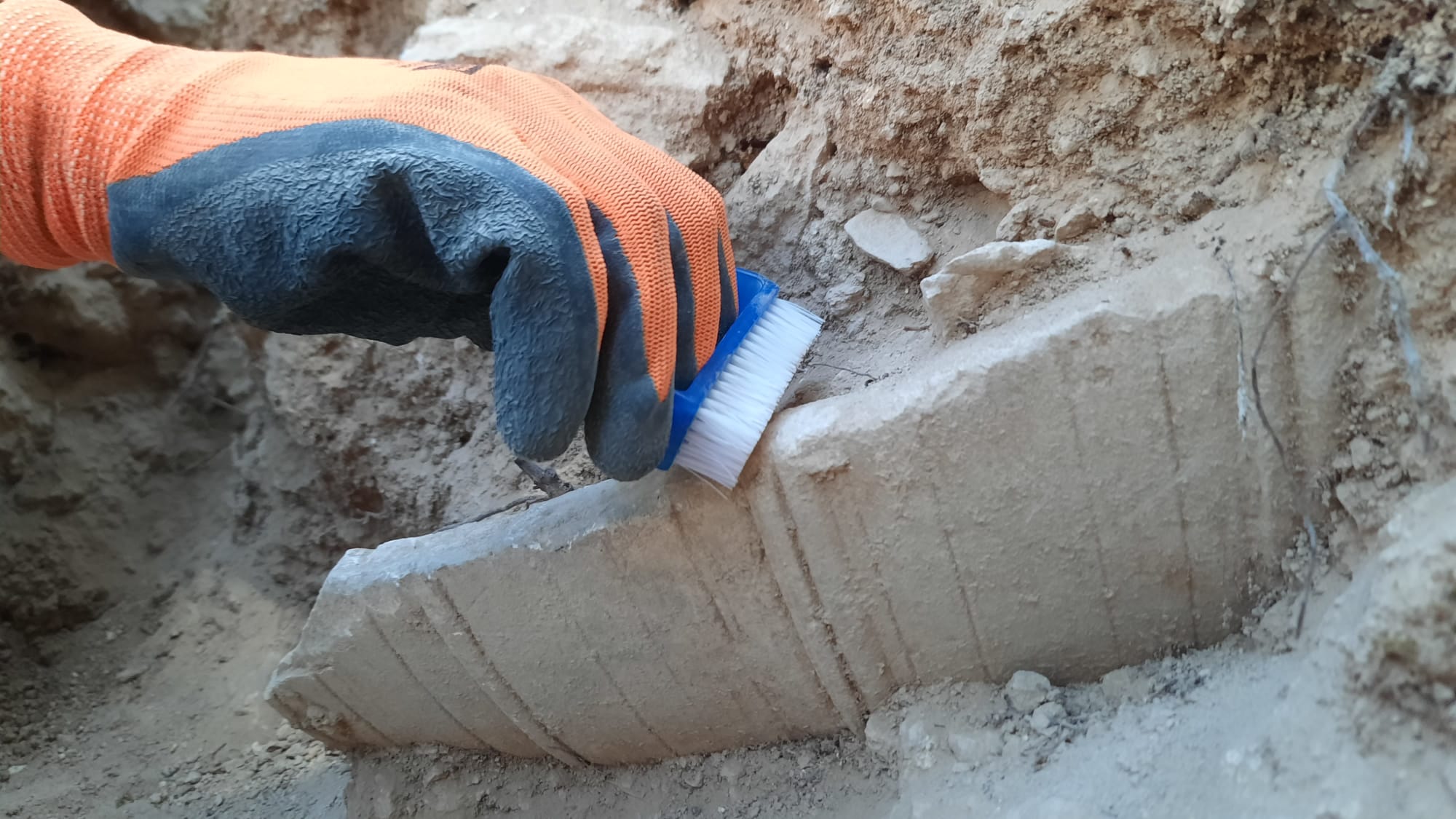
A massive stone vessel, carved 1,800 years ago and used by Jews in the Galilee to maintain ritual purity, now sits in the halls of Israel’s Knesset. The timing is deliberate. As the Parliament building marks its 60th anniversary on Tu B’Shevat, this archaeological treasure forces an unavoidable question: Can the Knesset truly claim to be the heir of the Sanhedrin while ignoring the institution that made the ancient court legitimate—the Temple in Jerusalem?
The new exhibition, established by the Israel Antiquities Authority in cooperation with the Knesset and the Ministry of Heritage, opens today as part of the Knesset’s birthday celebrations in its home in Jerusalem’s Givat Ram neighborhood. Stone vessels, ancient inscriptions, and coins from Sepphoris and Tiberias tell the story of a supreme court that functioned in the shadow of Roman occupation, maintaining Jewish law even as the Temple lay in ruins. Yet something is missing from this historical narrative. The exhibition celebrates continuity but avoids the uncomfortable truth: the original Sanhedrin derived its authority from the Temple, and without actively pursuing the Temple’s restoration, the modern Knesset remains an incomplete successor.
The Sanhedrin’s biblical foundation is explicit. Moses established the first judicial council of seventy elders, as recorded in Numbers: “And the LORD said unto Moses: ‘Gather unto Me seventy men of the elders of Israel, whom thou knowest to be the elders of the people, and officers over them; and bring them unto the tent of meeting, that they may stand there with thee'” (Numbers 11:16). This was not merely an administrative body. The Sanhedrin functioned as the supreme court and legislature of the Jewish people, interpreting Torah law and making binding decisions for the entire nation.
The Sages teach that the Sanhedrin sat in the Chamber of Hewn Stone, the Lishkat HaGazit, located on the Temple Mount itself. This was not coincidental. The court’s proximity to the Temple signified that its authority flowed from the Divine presence that dwelt in the sanctuary. When the Second Temple was destroyed in 70 CE, the Sanhedrin relocated to Yavneh, beginning a centuries-long exile that took the court from city to city across the Galilee—Usha, Shfaram, Beit She’arim, Sepphoris, and finally Tiberias, where it disbanded around 425 CE under Roman persecution.
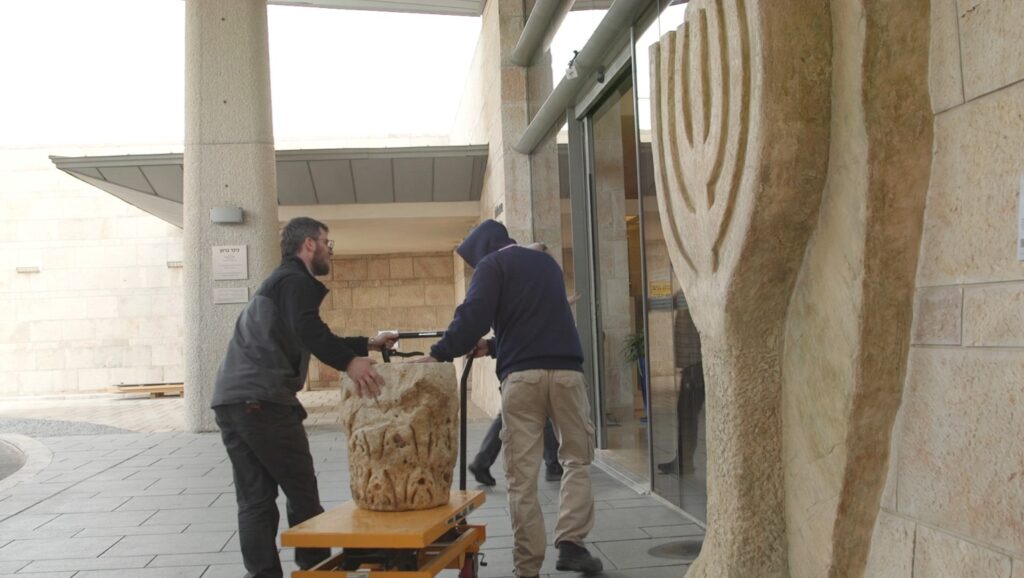
The centerpiece of the exhibition embodies this period of exile. The large stone storage vessel, which some identify as the qalal vessel mentioned in Jewish sources, was uncovered in recent months by volunteers in an educational-community excavation by the Israel Antiquities Authority and the KKL-JNF at the Pundaka de Lavi site in the Lower Galilee. This is the first time the vessel has been displayed publicly.
At approximately 80 centimeters high and 50 centimeters in diameter, the vessel stands out for its unusual dimensions and where it was found: a Jewish settlement from the Roman and Byzantine periods mentioned in Talmudic sources.
Stone vessels cannot become ritually impure according to Jewish law, unlike pottery. This made them essential for maintaining taharah, ritual purity, particularly in connection with Temple service and the consumption of terumah, the priestly portions.
“Stone vessels made of chalk limestone earned special importance in Jewish society, since according to Halacha, Jewish law—unlike pottery vessels—they do not become impure,” explains Noam Zilberberg, excavation director on behalf of the Israel Antiquities Authority. “While small stone vessels, such as cups and bowls, are known in the Galilee, large vessels of this type are quite rare.”
Dr. Einat Ambar-Armon, director of the Israel Antiquities Authority’s Northern Region Community-Educational Center, emphasizes the significance: “This find reflects a high level of strict halachic adherence and a cohesive and well-defined Jewish lifestyle, and illuminates the character of the Galilee as an active and vibrant living space during the Mishnah and Talmud periods, the very region within which the leadership of the Jewish people also flourished and functioned.”
This was the world of the Sanhedrin in exile—a court maintaining Jewish law in anticipation of restoration, not resignation to permanent displacement. Even in exile, even without a functioning Temple, Jews in the Galilee maintained the stringent purity standards that would be necessary when the Temple was rebuilt.
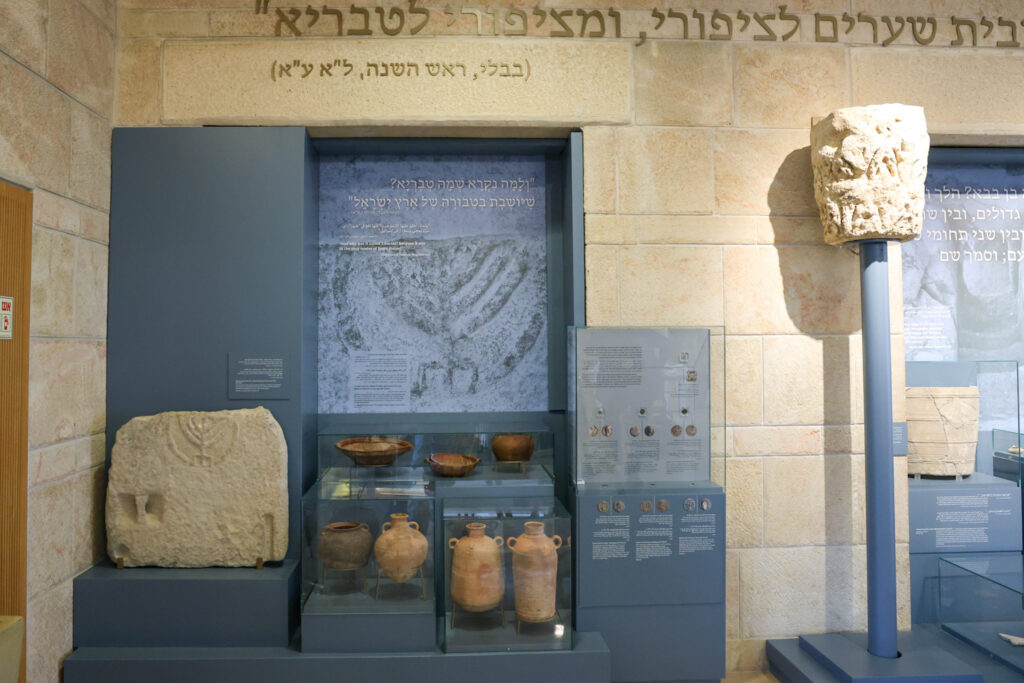
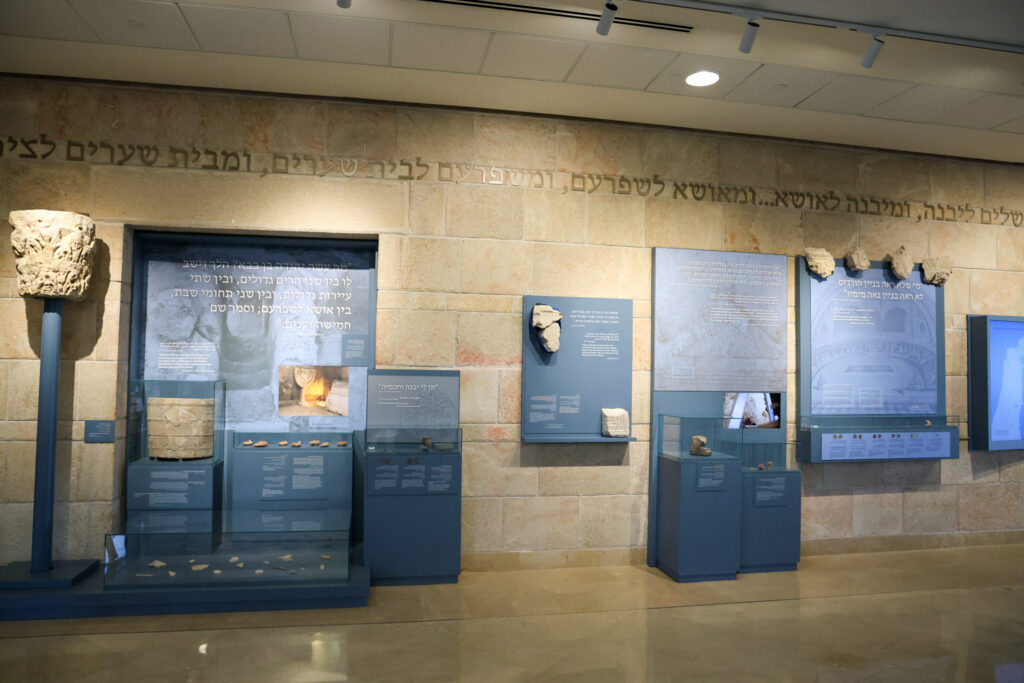
The exhibition presents archaeological finds from Jerusalem and Galilee sites that trace what the curators call “a historical continuum of Jewish leadership institutions over thousands of years, from the Knesset HaGedolah and the Sanhedrin to the Knesset of the State of Israel, which today constitutes the center of the democratic and sovereign life of the Jewish people in Israel.”
Among the most striking exhibits is a rare Hebrew inscription, consisting of two segments now joined for the first time to be read together. The lower part was discovered in 1863 in the south of the Temple Mount by French archaeologist De Soucy, bearing the word “prison” or “imprisoned.” The upper part was uncovered about a century later in the excavations of Prof. Benjamin Mazar, where the last letters of the word “elders” are visible. According to researchers, the inscription alludes to the legal role of the Sanhedrin’s sages. The original fragment from Mazar’s excavations and a replica of the inscription, preserved in the Louvre Museum in Paris, are being displayed together in the Knesset for the first time.
The exhibition also displays coins from the Jewish city of Sepphoris, which attest to coin minting in Jewish cities with official Roman approval, and a basalt door decorated with a seven-branched menorah from Tiberias, approximately 1,800 years old. It is a testament to Jewish life in the city where the Jerusalem Talmud was compiled. This door was discovered during excavations directed by Dr. Katia Cytryn-Silverman of the Hebrew University in Jerusalem.
“We invite the public on a journey in the footsteps of the Sanhedrin sages,” say Exhibition Curators Adi Ziv-Esudri, Alegre Savariego, Navit Popovich-Geller, and Deborah Ben-Ami of the Israel Antiquities Authority. “The archaeological findings presented in the exhibition illuminate the activities of Jewish leadership institutions throughout the generations, and the continuous connection between Jewish history and the Knesset, the House of Representatives of the State of Israel.”
Knesset Speaker Amir Ohana framed the exhibition in terms of continuity: “The Knesset building marking 60 years is another link in a long chain of sovereign Jewish leadership, which was severed in exile and renewed with the establishment of the State of Israel. Two thousand years of Jewish life in exile did not extinguish the dream, which was realized with the establishment of the State of Israel. The exhibition displayed at the Nation’s House connects the roots of Jewish democracy in antiquity to the modern Knesset, and reminds us that the characteristics of the Knesset are deeply rooted in the history of the Jewish people.”
Heritage Minister Rabbi Amichai Eliyahu added: “The new exhibition in the Knesset building bridges in a deeply moving manner our ancient past and our present of regained sovereignty. The unique archaeological findings testify to the depth of the Jewish people’s roots in their land and to the continuity of our heritage. I encourage all citizens of Israel to visit this fascinating exhibition and experience firsthand the deep connection between our glorious past and the living heritage that we continue to build in the State of Israel.”
KKL-JNF Chairman Eyal Ostrinsky offered his own perspective on the discovery: “Where Keren Kayemeth LeIsrael—the Jewish National Fund plants the trees of the future, the soil reveals to us the roots of the past. The stone vessel discovered in the Lavi Forest is a living greeting from the Jewish leadership in the Galilee, straight to the heart of the Israeli leadership in Jerusalem. The cooperation between KKL-JNF and the Israel Antiquities Authority makes it possible to uncover these significant chapters in the historical story, which constitute our identity card in this country. We are proud to connect the clods of earth to the Hall of Democracy, because there is no more worthy gift than this for the birthday of the Knesset, a reminder that our roots here are the guarantee of our future here.”
But sovereignty over what? The Knesset sits in Givat Ram, not on the Temple Mount. It legislates for a state that treats the holiest site in Judaism as an archaeological park where Jewish prayer is restricted. The stone vessels in the exhibition were used to maintain ritual purity standards connected to Temple service. The Sanhedrin derived its authority from sitting adjacent to the Divine presence in the Temple. If the modern Knesset wants to claim this heritage, it must confront the obvious gap: the Temple itself.
Modern attempts to revive the Sanhedrin have met with limited success. In 2004, a group of rabbis in Tiberias attempted to reconvene the court through a process of rabbinic ordination tracing back to Moses. The effort generated controversy within the Orthodox community, with critics arguing that authentic semicha, the unbroken chain of ordination, ended with the original Sanhedrin’s dissolution. Others contend that only the establishment of a functioning Temple and the appointment of judges within the Temple precincts can legitimize a renewed Sanhedrin.
The Bible is explicit about the centrality of the Temple to Jewish national life. “But unto the place which the LORD your God shall choose out of all your tribes to put His name there, even unto His habitation shall ye seek, and thither thou shalt come” (Deuteronomy 12:5). The Sages understood this as a positive commandment incumbent on each generation—to build and maintain the Temple when circumstances permit. Israel today has sovereignty over Jerusalem. It has the political and military capability to control the Temple Mount. The technological and architectural expertise to construct the Third Temple exists. What is missing is not ability but will, particularly the Knesset’s will to assert Jewish rights at the site.
The archaeological finds in this exhibition make the case inadvertently. Jews in Roman-occupied Galilee, living under persecution, maintained meticulous standards of ritual purity. They carved enormous stone vessels to ensure compliance with Temple-related laws, even though the Temple no longer stood. They established rabbinic courts that continued to function as the highest legal authority for the Jewish people. They never accepted the Temple’s destruction as permanent. The modern State of Israel, with actual sovereignty and military control, does less. The Knesset passes laws about the Supreme Court and the economy, but avoids legislation addressing Jewish worship rights on the Temple Mount or advancing plans for the Temple’s reconstruction.
This exhibition should serve as a rebuke, not a celebration. The stone vessel from Lavi is a reminder that our ancestors lived in expectation of restoration. The Sanhedrin moved from city to city in the Galilee but never relinquished its ultimate claim to authority derived from the Temple. The modern Knesset, if it genuinely sees itself as heir to these institutions, must take concrete steps toward enabling the Third Temple. This means passing legislation affirming Jewish sovereignty over the Temple Mount, allocating resources for preparation of Temple service, and supporting the training of kohanim, priests, for eventual Temple duties.
Sharon Soffer, the Knesset’s art curator, calls on the public to come to the Parliament building and view treasures from the past. The exhibition will be open to the public as part of the overall open house events and guided tours during the 60th anniversary celebrations of the Knesset building. But visitors should see more than historical artifacts. They should see a challenge to the current leadership to complete what the Sanhedrin in exile could only dream of—the restoration of full Jewish sovereignty over the Temple Mount and the rebuilding of the House that gives the Knesset its true legitimacy as heir to Israel’s ancient institutions of governance.
