




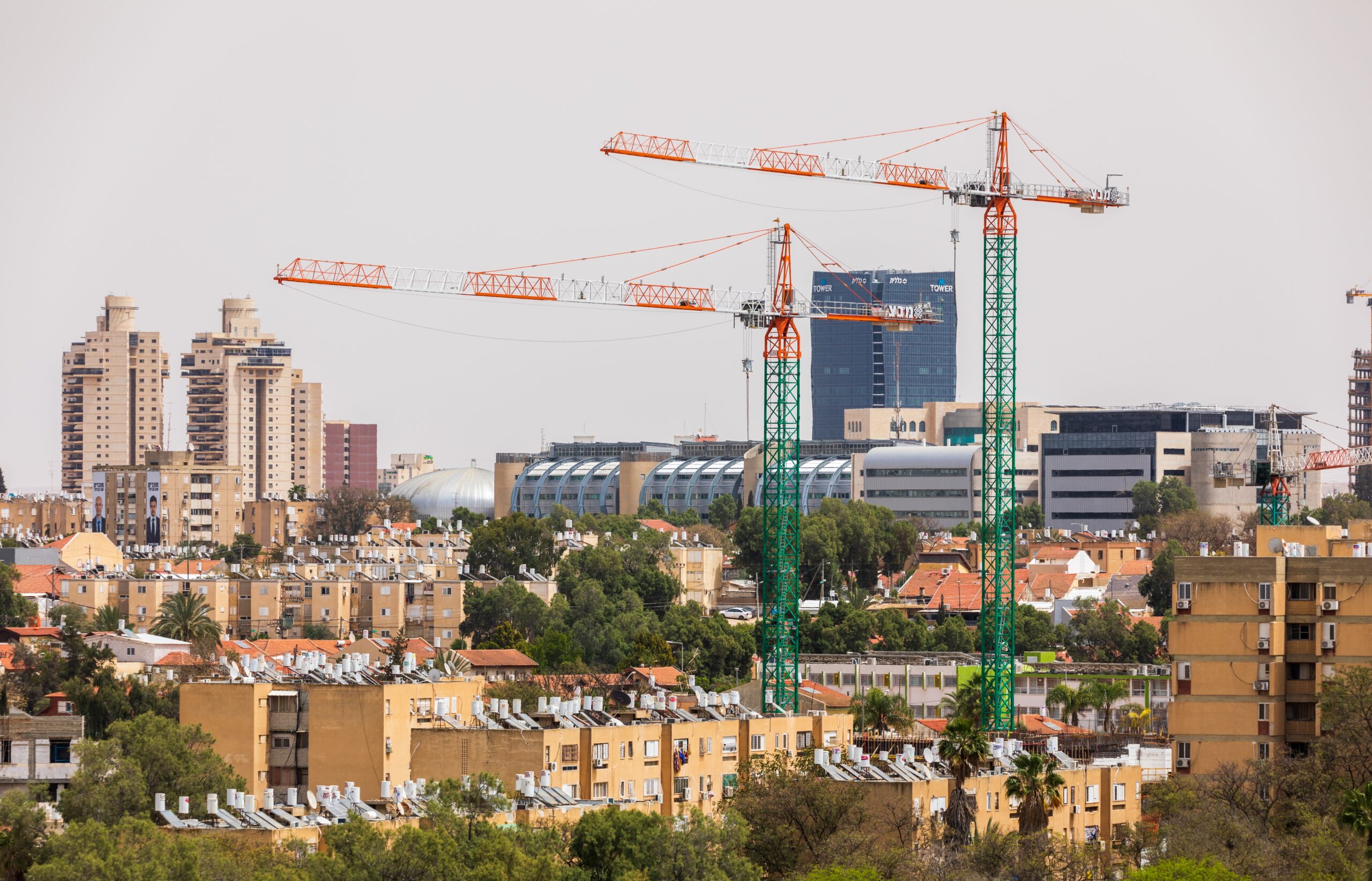
The Israeli government’s decision on Sunday to establish five new community towns east of Be’er Sheva marks a decisive moment for the future of the Negev. Approved during the weekly cabinet meeting and announced by the Prime Minister’s Office, the move signals a clear assertion of sovereignty, reversing decades of neglect in a region that has become a focal point of demographic, security, and national challenges. Far from a technical planning decision, the approval reframes the Negev as a central arena of Israel’s national revival.
The initiative, advanced by Construction and Housing Minister Haim Katz and Settlement Minister Orit Strook, is intended to create a continuous Jewish settlement corridor between Be’er Sheva and Dimona along the Route 25–80 axis. According to the official statement, the goal is to expand housing supply, disperse population, deepen civilian and security presence, and entrench the Negev as a strategic region of the State of Israel. The five new communities are planned as community towns, designed to attract families committed to long-term settlement and civic engagement.
Prime Minister Benjamin Netanyahu described the decision as part of a broader momentum reshaping the south. Speaking during the cabinet session, he said, “During my visit to the Negev about two weeks ago, I declared: We will advance the Negev along several paths, one of which is Jewish settlement. This Government is doing much in this regard.” Netanyahu emphasized that attitudes toward southern cities have shifted, noting that pride in places like Dimona, Kiryat Gat, and Ashkelon has replaced the stigma once associated with them. “This is a monumental settlement announcement: five community settlements in the eastern area of the Be’er Sheva metropolitan area,” he said.
Prime Minister Benjamin Netanyahu also announced that one of the new communities would be named Renanim, meaning “rejoicing,” in memory of Police Master Sgt. Ran Gvili, whom he described as a hero of Israel. Gvili, the final slain hostage held in Gaza, was brought home yesterday. “I have decided that one of the communities in the Negev will be called ‘Renanim’ in memory of an Israeli hero, the late Ran Gvili,” Netanyahu said.

The decision comes amid intensified efforts to restore law and order in the Negev. Earlier this month, Netanyahu warned that the region was “running wild” and pledged to rein it in. In late December, Israel Police launched a large-scale, open-ended operation in the Bedouin town of Tarabin, arresting 16 suspects on weapons charges and seizing military-grade firearms allegedly stolen from Israel Defense Forces bases. The operation followed repeated incidents of stone-throwing and arson near Jewish communities such as Giv’ot Bar, where residents reported feeling abandoned and forced to arm themselves for protection.
Settlement Minister Orit Strook praised the cabinet decision, calling it a turning point. “The settlement revolution is reaching the Negev as well,” she said. “Establishing new communities in the northern Negev is a strategic goal that for years advanced too slowly, resulting in a lawless, shameful, and dangerous southern region.”
The Regavim Movement, which has spent years documenting illegal construction and lack of governance in the south, welcomed the decision enthusiastically. “This is an exciting development and a significant step forward for the Negev,” a Regavim spokesperson said. “Five new communities have been approved in an area that has been neglected and almost entirely overtaken by illegal Arab squatter camps—in the corridor formed by Route 80 and Route 25 between Be’er Sheva and Dimona.” Regavim described the move as a clear statement of basic Zionist, value-driven goals and a first step toward transforming reality in southern Israel.
The Bible consistently frames the South as the place where national destiny is clarified through settlement and perseverance. The Sages expand on this theme, teaching that the geula, the final redemption, unfolds through the physical return of the Jewish people to neglected and desolate parts of the Land of Israel and their transformation into thriving centers of life. A lesser-known tradition preserved in rabbinic sources links the arrival of Sepharad—identified by the Sages with Spain and later Western Europe, including France—to settlement in the south of Israel as a precursor to redemption. This is explicitly stated by the Prophet Obadiah: “And this exiled host of the children of Israel who are (with) the Canaanites as far as Zarepath (France) and the exile of Jerusalem which is in Sepharad (Spain) shall inherit the cities of the south (Negev). And saviors shall ascend Mt Zion to judge the mountain of Esau, and the Lord shall have the kingdom.” (Obadiah 1:20-21). The ingathering from Sepharad does not culminate in Jerusalem first, but in the Negev, where barren land is reclaimed through Jewish labor and permanence.
This vision was articulated in modern terms by David Ben-Gurion, who saw the Negev as the key to Israel’s future. Ben-Gurion insisted that without Jewish settlement in the south, the state would remain geographically and strategically fragile. For him, making the desert bloom was not poetic language but a hard national imperative rooted in history and destiny.
The government’s approval of five new communities east of Be’er Sheva aligns state policy with both biblical vision and Zionist strategy. It asserts that sovereignty is not enforced by declarations alone but by families, schools, roads, and daily Jewish life anchored to the land. The Negev is no longer treated as Israel’s periphery. It is being restored to its rightful place at the heart of the Jewish national project, where redemption advances not through abstraction, but through settlement on the ground.
