


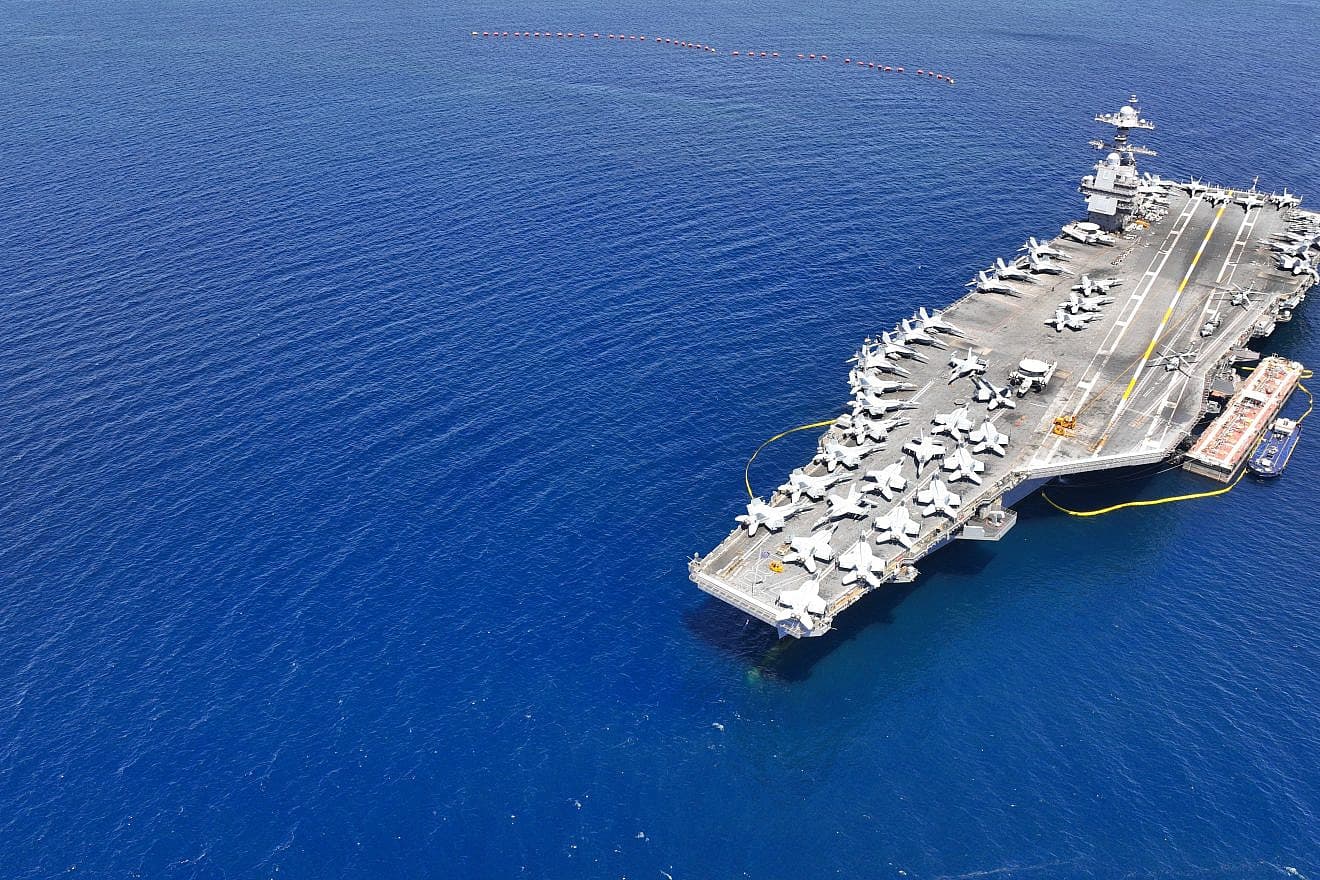
President Donald Trump placed Iran on notice in language that was backed by steel in the water. As the Islamic regime faces its most sustained internal unrest since 1979, the president confirmed that a large U.S. naval force is moving toward Iran, making clear that American warnings are no longer abstract. The deployment comes as the Iranian government accelerates executions, suppresses information, and continues to posture defiantly on its nuclear program.
Speaking to reporters aboard Air Force One on Thursday, Trump confirmed that the U.S. Navy is moving a significant flotilla toward Iran. “We have a big force going toward Iran. I’d rather not see anything happen, but we’re watching them very closely,” he said. The president linked the deployment directly to Iranian plans to execute hundreds of protesters, warning Tehran that mass killings would trigger a devastating American response. “If you hang those people, you’re going to be hit harder than you’ve ever been hit,” Trump said, adding that Iran canceled nearly 840 planned executions after his warning.
Satellite imagery and ship-tracking data indicate that the Abraham Lincoln Carrier Strike Group has entered the Malacca Strait and is heading west toward the Indian Ocean. A U.S. Navy official confirmed that the aircraft carrier and three guided-missile destroyers are moving toward the Middle East. The USS George H.W. Bush has also departed Norfolk and is currently at sea in the Atlantic, conducting live-fire exercises as it transits toward Europe. U.S. officials, speaking on condition of anonymity, said additional air defense systems are under consideration to protect American bases in the region.
Since protests erupted across Iran on Dec. 28, nearly 5,000 people have been confirmed killed, according to Human Rights Activists in Iran. The group said it is still reviewing more than 9,000 additional death cases and reported at least 7,398 severe injuries. More than 26,000 people have been arrested. Internet access remains heavily restricted, more than two weeks after nationwide shutdowns began, according to NetBlocks.
Trump has repeatedly stated that the United States will not tolerate mass executions. “I stopped 837 hangings on Thursday. They would have been dead. Everyone would have been hung. This is like from 1,000 years ago,” he said. “An hour before this horrible thing was going to take place, they canceled it. They didn’t postpone it. They canceled it.” He added, “We have an armada. We have a massive fleet heading in that direction. And maybe we won’t have to use it.”
At the same time, the president has reaffirmed that Iran’s nuclear ambitions remain a red line. In an interview with CNBC, Trump said Iran “cannot pursue a nuclear program” and warned that any attempt to restart enrichment would be met with additional U.S. strikes. “If they do it, it’s going to happen again,” he said. “They have got to stop with the nuclear. Can’t let them have it.”
The International Atomic Energy Agency last verified Iran’s stockpile of highly enriched uranium roughly seven months ago, despite recommending monthly inspections. Iran is estimated to possess 440.9 kilograms of uranium enriched to 60 percent purity, close to weapons-grade. According to IAEA benchmarks, further enrichment could yield material sufficient for approximately 10 nuclear warheads. The agency has yet to receive a full report from Tehran on the status of nuclear sites struck by the United States last year.
Earlier this month, Trump imposed a 25 percent tariff on any nation trading with Iran, including China and the United Arab Emirates. Iranian officials responded by warning that any aggression against Supreme Leader Ayatollah Ali Khamenei would amount to “all-out war.” Trump, for his part, said he has issued strict orders that if Iran attempts to assassinate him, the regime would be “completely destroyed.” In a NewsNation interview, he said the United States would “wipe them off the face of the Earth” if such a plot were carried out.
While maintaining maximum pressure, Trump has also left the door open to talks. Speaking at the World Economic Forum in Davos, Switzerland, he said, “Iran does want to talk, and we’ll talk,” even as he refused to publicly commit to specific military actions if executions resume, calling such declarations “foolish.”
Trump’s warnings, backed by carriers and destroyers, function as a final demand from the Islamist regime for restraint, not a diplomatic flourish. His language is deliberate, and the movement of U.S. naval power removes any doubt that these statements are meant to be taken literally.
