

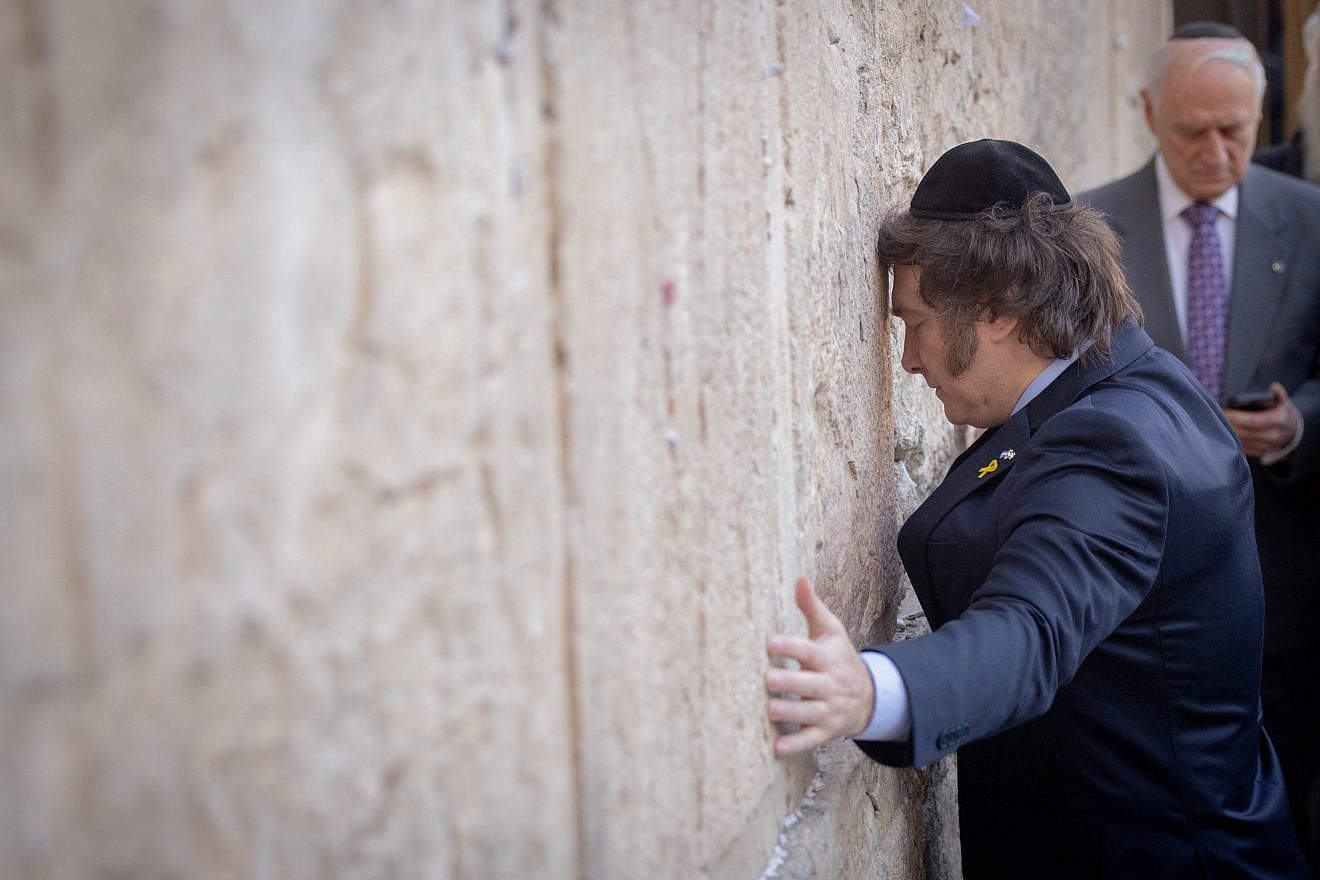
Argentine President Javier Milei stood before the World Economic Forum in Davos, Switzerland, on Thursday and did something unprecedented at the globalist gathering: he invoked the weekly Torah portion to warn Western nations that their trajectory mirrors that of ancient Egypt under Pharaoh. Speaking shortly after President Donald Trump’s address, Milei used Parashat Bo to draw a direct line between the oppressive Egyptian state and what he sees as creeping socialism across the West.
“Parashat Bo describes the moment when Moses confronts Pharaoh, a symbol of the oppressive power of the state,” Milei told the assembled political leaders, multinational executives, and international bureaucrats. The Argentine leader, who earlier that day joined Trump’s newly formed Board of Peace to oversee postwar Gaza, chose to conclude his remarks with Jewish Scripture rather than the economic platitudes typical of Davos.
The speech marks another step in Argentina’s transformation from a nation that cursed Israel to one that blesses it. For eight decades, Argentina blocked Jewish immigration in the 1930s, harbored Nazi war criminals, served as a base for Iranian terror, and covered up terrorist attacks against Jewish targets. The consequences were devastating—a country that once had a glorious past spiraled toward destruction. But Milei has rewritten this trajectory. His identification with Israel and Jewish values represents a national teshuvah, a return that mirrors the Exodus story he cited at Davos.
.@JMilei shared some words on this week’s Torah portion at Davos pic.twitter.com/f9fqxJ6gWS
— Lahav Harkov 🎗️ (@LahavHarkov) January 22, 2026
The Sages teach that the plagues were not random acts of divine punishment. Each plague targeted a specific aspect of Egyptian society and power, dismantling Pharaoh’s claim to absolute authority piece by piece. Milei grasped this structure and applied it to contemporary politics with precision.
His understanding comes from deep engagement with Jewish sources. Milei visited the Ohel—the gravesite of Rabbi Menachem Mendel Schneerson, the Lubavitcher Rebbe—for the fourth time just weeks before his Davos speech. He keeps a kippah in his office. When Israeli Foreign Minister Gideon Sa’ar recited the Shehecheyanu blessing during their meeting in Buenos Aires, Milei immediately placed his own kippah on his head in response. This is not political theater. Milei studies Torah “from the point of view of economic analysis” and has spoken about converting to Judaism, though he acknowledges that observing Shabbat while serving as president poses challenges.
The connection to the Rebbe matters because it connects Milei to Trump. President Trump visited the Ohel on the first anniversary of the October 7 terrorist massacre, donning a kippah, reading Psalms, lighting a yahrzeit candle, and placing a note at the gravesite. In a letter to Chabad rabbis, Trump wrote: “When I visited the grave on the anniversary of the terrible attacks of October 7th, I drew strength and inspiration from the Rebbe’s legacy.” Both leaders draw from the same spiritual well. Both understand that fighting statism and standing with Israel are inseparable commitments.
Argentina’s alignment with Israel under Milei fulfills Genesis 12:3: “I will bless those who bless you, and whoever curses you I will curse” (Genesis 12:3). The Hebrew reveals deeper meaning than English translations suggest. The root of barach (to bless) is the same as the root for “knee”—blessing Israel means bending the knee in active solidarity, not mere words. The word for cursing comes from a root meaning “to destroy completely.” Argentina cursed Israel for decades and faced near-complete destruction. Milei’s administration reversed this. He has positioned Israel and the United States as Argentina’s two key strategic allies, launched direct flights between Tel Aviv and Buenos Aires for the first time since Nazi war criminal Adolf Eichmann was captured in Argentina in 1960, and announced plans to move Argentina’s embassy to Jerusalem.
“When Pharaoh did not free the Hebrew people, the plague of locusts arrived, which signifies famine. Then came the plague of darkness, which signifies the loss of clarity in decision-making. Finally, the plague of the death of the firstborn, which lays bare the fate of a society that denies freedom,” Milei said. “The analogy to what is happening today in the West is strikingly clear.”
Milei’s spent much of his speech defending free-market capitalism and attacking socialism, citing what he called “13,500 structural reforms” implemented since he took office in December 2023. He praised his Deregulation and State Transformation Ministry and condemned socialism as a system that “always ends badly, horrifically badly,” pointing to Venezuela as a contemporary example.
Milei described the United States under Trump as “the beacon of light that reignites the whole of the West” and positioned Argentina’s reforms as part of a larger ideological shift. He declared that “the Americas will be the beacon of light that will once again illuminate the entire West, thereby repaying the civilizational debt with expressions of gratitude toward the foundations in Greek philosophy, Roman law and Judeo-Christian values.”
The Argentine president, who has spoken publicly about his spiritual connection to Judaism and the Torah, closed with his signature phrase: “Machiavelli is dead and it is time to bury him. Long live freedom, damn it.”
That a head of state would cite the Torah portion at Davos reveals something about the changing political landscape. Milei was elected in 2023 on a platform opposing globalist orthodoxy and left-wing policies. He has identified Israel and the United States as Argentina’s key allies. His appointment to Trump’s Board of Peace signals a coordinated approach between the two administrations.
The irony of delivering an anti-globalist message at the World Economic Forum while quoting from the Hebrew Bible was not lost on observers. Davos represents the concentration of international power that Milei spent his speech warning against. The annual gathering brings together precisely the kind of political leaders and multinational institutions that promote what Milei called “a whole set of socialist policies elegantly packaged to deceive people of noble spirit.”
Milei’s speech worked because he understood the structure of the biblical narrative. The plagues escalated in severity and meaning. They moved from inconvenience to economic disaster to existential threat. Societies that deny freedom follow this same pattern. First comes economic stagnation, then confusion and loss of direction, then the death of the future itself as the next generation inherits a broken system.
Milei’s commitment extends beyond rhetoric. He launched the Isaac Accords—modeled on the Abraham Accords—to strengthen cooperation between Israel and Latin American nations. The initiative targets Uruguay, Panama, and Costa Rica for joint projects in technology, security, and economic development. Argentine Foreign Minister Gideon Sa’ar described Milei as “a double miracle, for Argentina and for the Jewish people,” noting that his connection to Judaism and Israel is “sincere, powerful, and moving.” When they concluded their meeting, Milei told Sa’ar with a smile: “See you soon in Jerusalem.”
The timing of Argentina’s rescue of two hostages born in Argentina just days after Milei’s first visit to Israel suggested divine providence. Of 136 hostages held by Hamas terrorists at that time, the two rescued were both Argentine citizens.
While most of the region—Bolivia and Colombia severed ties with Israel, others recalled their ambassadors—maintains its anti-Israel consensus, Milei declared: “While the vast majority of the free world decided to turn its back on the Jewish state, we extended a hand to it. While the vast majority turned a deaf ear to the growth of antisemitism in their lands, we denounced it with even greater fervor, because evil cannot be met with indifference.”
The Davos speech brought together these threads. Milei’s reading of Parashat Bo connected ancient Egypt’s oppression to modern statism, Argentina’s past to its future, and the West’s decline to its potential redemption. He understands what the Torah teaches: freedom requires both economic liberty and moral clarity. The plagues fall on societies that deny both. Argentina endured those plagues for eight decades. Under Milei, the nation has chosen a different path—the path of Moses, not Pharaoh. The question is whether the rest of the West will follow.