

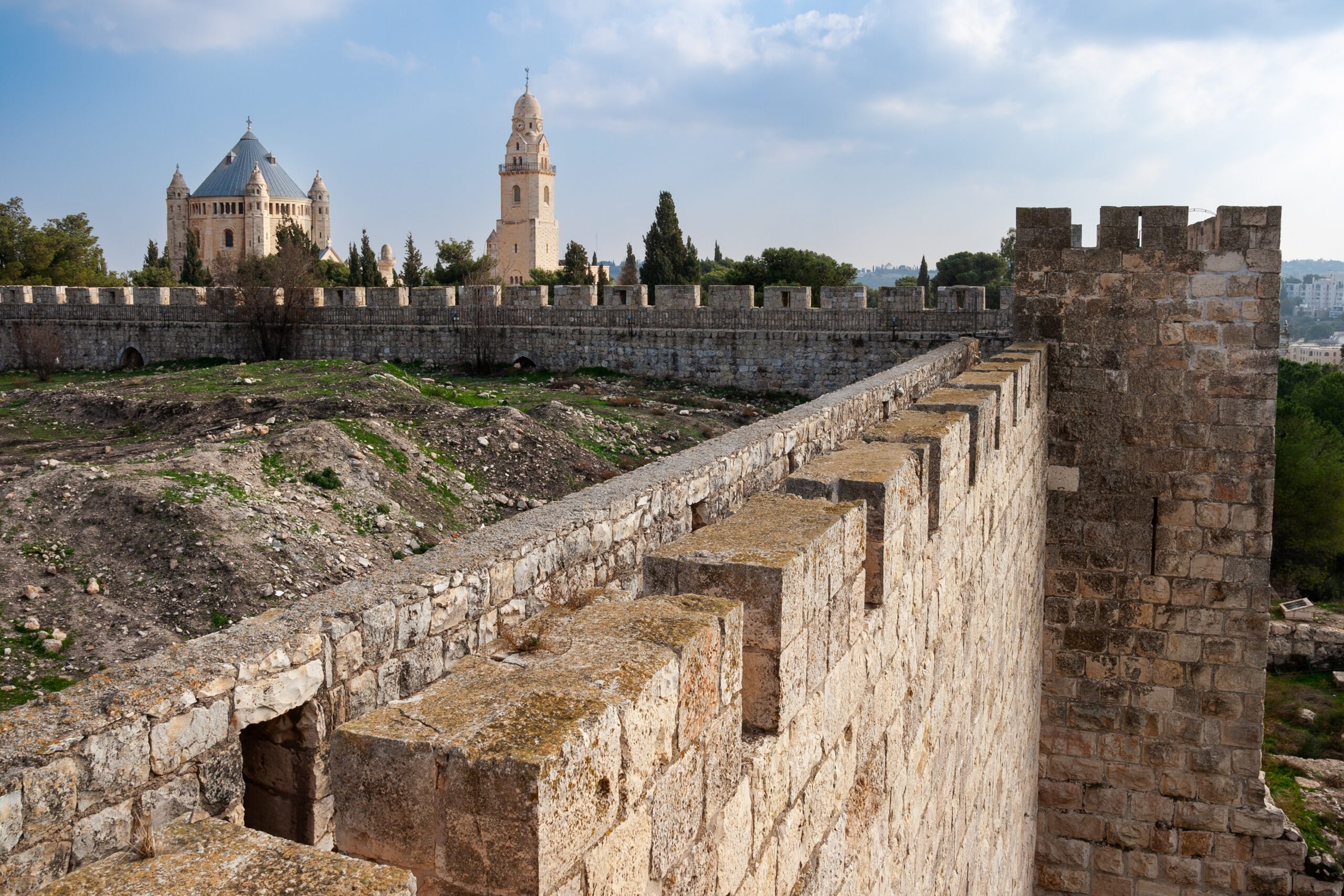
Jerusalem doesn’t reveal itself from a distance. You can read about it, argue about it, or study it for years and still miss what matters. The city only starts to make sense when you move through it on foot, when the elevation shifts under you, when ancient stones sit beside modern life, and when the Bible stops feeling like a text and starts feeling like a place.
This isn’t just a city on a map. It’s a place where history is still alive. Its walls and streets don’t just tell a story. They pull you into it. Judaism, Christianity, and Islam all took shape here, bound together by shared history, prophecy, and memory that shaped the course of the world. And within Jerusalem, four places make that reality impossible to ignore: the City of David, the Mount of Olives, Mount Zion, and the Church of All Nations.
City of David: Jerusalem’s heartbeat
If you want to understand Jerusalem, you don’t start with the skyline. You start below it.
The City of David sits on a narrow ridge just south of the Old City walls. It’s easy to miss if you’re looking for something dramatic. No grand gates. No sweeping plaza. And that’s the point. This is where Jerusalem begins, before it becomes important, famous, or argued over.
This is the place the Bible associates with King David’s rule. Not a mythic version of Jerusalem, but a working city. One with walls, water problems, enemies, and real decisions. The kind of place a king had to defend, not admire.
What’s striking about the City of David is how practical everything is. The famous water systems were built because water meant survival. Hezekiah’s Tunnel wasn’t an architectural statement. It was dug in a hurry, in secret, through solid rock, because an Assyrian army was on the way. You walk through it today and realize how little room there was for error.
That practicality matters. It explains a lot about the Bible’s relationship to Jerusalem. This was never a symbolic city first. It was a lived city. People argued here. They made mistakes here. They adapted.
Standing in the City of David, the scale feels smaller than people expect. And that’s revealing. Jerusalem didn’t start as an empire. It started as a decision. Someone chose this ridge, defended it, and built something that lasted far longer than anyone at the time could have imagined.
You leave understanding that Jerusalem’s importance wasn’t inevitable. It was earned.
Mount of Olives: prophecy, prayer, and waiting
The Mount of Olives is not subtle. It rises directly across from Jerusalem’s eastern wall, close enough that the city feels within reach, but just far enough to force perspective.
In the Bible, this hill shows up again and again at moments of tension. King David crosses it barefoot and weeping as he flees Jerusalem during Absalom’s rebellion. The book of Samuel describes him ascending the Mount of Olives in grief, surrounded by loyal followers, uncertain whether he will ever return. It is one of the most human scenes in the Bible. A king in retreat, not in triumph.
The prophets pick up the thread. Zechariah places the Mount of Olives at the center of future reckoning and restoration, describing it as a stage for events that reshape Jerusalem’s fate. Jewish tradition, drawing from these texts, ties the mountain to redemption and resurrection. That belief is not theoretical. It is why the slopes of the Mount of Olives are covered in ancient graves, thousands of years’ worth, all facing the city.
This is not a coincidence. The Mount of Olives has always been a place of watching and waiting. It is where Jerusalem is seen clearly, without the noise of its streets. From here, the Temple Mount dominates the view. You understand why prophets stood here. It is the one place where the whole story of Jerusalem feels visible at once.
What makes the Mount of Olives different from other biblical sites is that it has never been sealed off in the past. People still come here to pray, to bury their dead, to look toward the city and ask difficult questions about what comes next. The meaning has accumulated, not faded.
Standing on the Mount of Olives today, Jerusalem looks exposed. Vulnerable. Central. It does not feel mythic from here. It feels real. And that may be the point. The Bible places moments of crisis and hope on this hill because it strips away illusion. From the Mount of Olives, Jerusalem has always been something you must choose, not something you simply inherit.
Mount Zion: the legacy of kings and prophets
Mount Zion shows up in the Bible in a way few places do. Not just as a location, but as a recurring idea. It is where kings ruled, where worship was centered, and where Scripture keeps returning when it speaks about permanence in a fragile world.
This is the ground associated with King David’s rule over Jerusalem, the city he chose as his capital. From there, Zion became shorthand for God’s dwelling place and the moral center of the nation. The Psalms return to it again and again, calling Zion beloved, chosen, and unshakable. “The Lord loves the gates of Zion more than all the dwellings of Jacob” is not poetic exaggeration. It is a statement about priority.
What is striking is how Zion keeps its role even when everything else falls apart. When Jerusalem is destroyed and the people are exiled, the prophets do not replace Zion. They double down on it. “Those who trust in the Lord are like Mount Zion, which cannot be moved.” Zion becomes the symbol of what survives loss. It represents the idea that covenant outlasts catastrophe.
Standing on Mount Zion today, that stubborn continuity is easy to feel. Jewish tradition has long identified this area with King David’s burial place, and generations have come here not to admire ruins, but to connect themselves to an unbroken story. Zion was never meant to be a monument. It was meant to be a promise that history does not get the final word.
Mount Zion insists that Jerusalem is not just ancient, but ongoing. It pushes back against the idea that the Bible belongs safely in the past. This is a place that refuses to be finished.
Church of All Nations: when Jerusalem stops belonging to just one people
The Church of All Nations sits at the foot of the Mount of Olives, built on land that drew prayer long before there were buildings to mark it. By the time you reach it, one thing becomes obvious. Jerusalem does not stay contained.
From a Jewish perspective, this site matters not because of doctrine, but because of what it represents. This is ground that began as part of Jerusalem’s biblical landscape and became sacred far beyond the Jewish world. That transition tells you something essential about the city itself.
The church was built in the early twentieth century with support from multiple nations, which is where its name comes from. Its architecture reflects that. Different styles. Different symbols. Different languages carved into the same space. It is a physical reminder that Jerusalem’s story did not end with the Bible. It expanded.
For Jews, Jerusalem is the center of covenant and peoplehood. For others, it became the center of spiritual memory and longing. The Church of All Nations stands at that intersection. It does not erase Jerusalem’s Jewish roots. It rests on them.
What makes the site compelling is not what it claims, but where it stands. At the edge of the city. At the base of a hill loaded with prophecy and grief. On ground that has absorbed centuries of prayer, argument, hope, and expectation.
Standing there, it becomes harder to pretend Jerusalem belongs neatly to anyone. This is a city that spills outward, shaping the faith and imagination of people far removed from its streets. The Church of All Nations is one expression of that reality. Not a contradiction of Jerusalem’s story, but evidence of how far that story traveled.
Jerusalem does not dilute when others draw meaning from it. It intensifies. And places like this make that clear.
The timelessness of Jerusalem: a city of living history
Jerusalem isn’t just a city you visit. It’s a city you experience. Its sacred sites are more than tourist stops. They are living reminders of promises, arguments, and choices made thousands of years ago. Whether you’re standing on the Mount of Olives, looking out over the City of David, walking Mount Zion, or lingering at the Church of All Nations, you’re not just seeing history. You’re moving through it.
The beauty of Jerusalem is that it never lets its story close. It keeps unfolding. The prophets spoke here. Kings ruled here. And today, the city still asks hard questions of anyone willing to pay attention.
For those who want to not just witness this history but immerse themselves in it, the Israel365 Heartland Tour of the Holy Land is your chance to walk in the footsteps of kings, prophets, and pilgrims. From April 15-23, 2026, you’ll experience these sacred sites firsthand, connect with the stories they hold, and see how Jerusalem’s ancient past still shapes the future.
If you can’t make it this spring, don’t worry. We’re also offering trips from July 29-August 6, 2026, and September 24-October 2, 2026. Each journey offers a chance to explore the timeless beauty of Israel and discover how the sacred and the present come together in this powerful land.
When you sign up, a member of our team will personally reach out to answer your questions, walk you through the details, and help you decide if this trip is right for you. There’s no pressure, just a conversation and a chance to take the next step.
Sign up today, and get ready for an unforgettable experience in the heart of Jerusalem.