


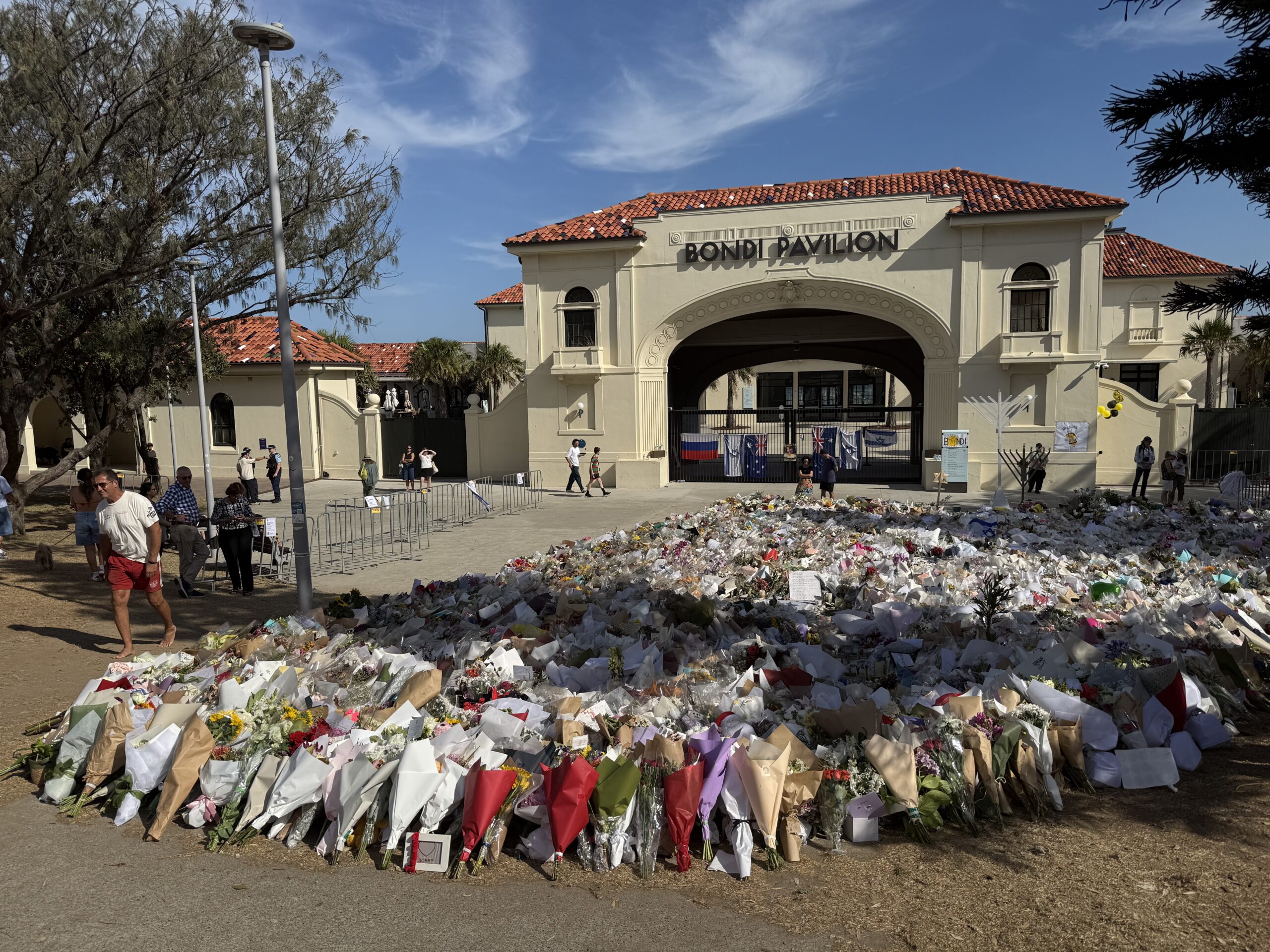
The Australian Parliament stood in silence this week as Hebrew words normally whispered in synagogues and cemeteries were spoken from the floor of a national legislature. In the aftermath of the Hanukkah massacre on Sydney’s Bondi Beach, a Jewish lawmaker did not offer a generic moment of silence or a carefully neutral statement. He recited the Jewish Mourner’s Kaddish and read aloud the names of the murdered, forcing the nation to confront the human cost of antisemitic terror.
The address was delivered on Monday by Mark Dreyfus, a Jewish member of Parliament and former attorney general. Wearing a kippah, Dreyfus honored the fifteen people murdered when two terrorists, motivated by what authorities described as “Islamic State ideology,” opened fire on a Hanukkah celebration at Bondi Beach. Dozens more were wounded. Most of the victims were Jewish. Dreyfus read every name aloud, refusing to let the dead dissolve into statistics.
He also praised what he called “acts of extraordinary courage” by bystanders and first responders, singling out Ahmed al-Ahmed, the Muslim man who was shot while disarming one of the terrorists and who later received public support from the Jewish community. Dreyfus told the House of Representatives that Australia’s “response cannot be confined to grief,” urging lawmakers to act decisively to uphold laws against hate. He then asked the chamber to rise and recited the Mourner’s Kaddish.
“You don’t have to be Jewish to feel this in your chest, an attack like this hurts all of us,” Dreyfus said, describing the prayer as “a prayer about life, dignity, and the hope for peace at times of profound loss.”
The moment was striking not only for its setting, but for what the Kaddish actually is. The Mourner’s Kaddish, known in Hebrew as Kaddish Yatom—the Orphan’s Kaddish—is not a lament and does not mention death. Its central line is a public sanctification of God’s Name: Yitgadal v’yitkadash sh’mei rabbah, “May His great Name be magnified and sanctified.” The Sages shaped the prayer as an act of defiance. When death tries to reduce the world to chaos, the mourner stands and proclaims that God’s sovereignty remains intact.
That insistence is rooted in the Bible itself. King David declares, “The Lord gave, and the Lord has taken; may the Name of the Lord be blessed” (Job 1:21). Judaism does not deny pain, but it refuses to let pain have the final word. By magnifying God’s Name in public, the mourner affirms that evil does not get to define reality.
The public recitation in Canberra echoed an earlier moment of American history. After eleven Jews were murdered in their synagogue in Pittsburgh in 2018, the Pittsburgh Post-Gazette published the Hebrew text of the Kaddish on its front page. In both cases, a Jewish response to terror was not hidden or softened. It was placed squarely before the broader society.
Australia’s lawmakers did not leave the moment at symbolism. Late Tuesday, Parliament passed anti-hate speech and gun reform legislation introduced in the wake of the Bondi Beach attack. The gun reform law added new checks to firearm license applications and launched a national gun buy-back program. The anti-hate law banned designated hate groups and imposed penalties on preachers who promote hatred. The hate-speech provisions were passed after being narrowed, winning support from some liberal lawmakers who had raised free-speech concerns about earlier drafts.
“The terrorists at Bondi Beach had hatred in their hearts and guns in their hands,” Prime Minister Anthony Albanese wrote on X. “Today we passed new laws that deal with both. Combatting antisemitism and cracking down on guns.”
The Kaddish in Parliament came as Australia faced yet another antisemitic attack. Late Monday, five Jewish teenagers in Melbourne were chased by a car whose occupants shouted “Heil Hitler” and performed Nazi salutes. The boys, aged fifteen and sixteen, were visibly Orthodox Jews walking home from Adass High School near Adass Israel Synagogue, which had been firebombed in December 2024. No arrests were immediately announced. Albanese condemned the incident, calling it “beyond disgusting” to see Nazi slogans hurled at Jewish children during a moment of national mourning.
The power of the Mourner’s Kaddish lies in its refusal to bow. The Sages understood that when Jews sanctify God’s Name after bloodshed, they deny victory to the killers. Hearing that prayer in the Australian Parliament sent a clear message. Jewish grief will not be silenced, Jewish faith will not be privatized, and Jewish life will not be erased by terror. Standing to say Kaddish in a house of government was not a gesture of weakness. It was an assertion of moral clarity.
The Mourner’s Kaddish was said in memory of:
Rabbi Eli Schlanger z”l
Alexander Kleytman z”l
Rabbi Yaakov Levitan z”l
Dan Elkayam z”l
Reuben Morrison z”l
Marika Pogany z”l
Matilda z”l
Tibor Weitzen z”l
Peter Meagher z”l
Edith Brutman z”l
Boris Gurman z”l
Sofia Gurman z”l
Boris Tetleroyd z”l
Adam Smyth z”l
Tania Tretiak z”l
