




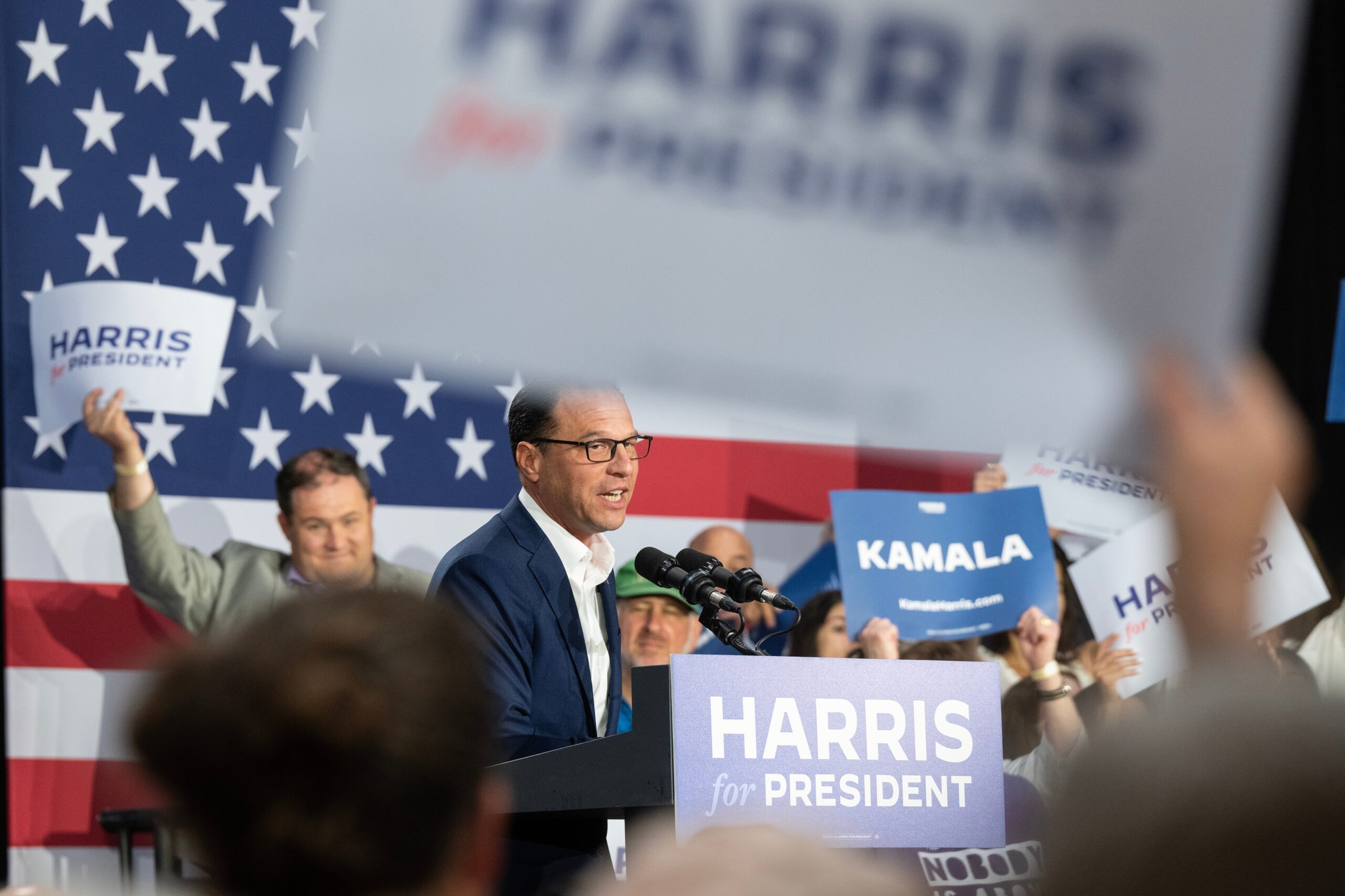
Pennsylvania Governor Josh Shapiro, one of the most prominent Jewish politicians in America, revealed that during the 2024 presidential campaign, members of Vice President Kamala Harris’ vetting team asked him whether he had been a double agent for Israel. The question was all the more shocking because it came from inside a Democratic presidential campaign, during a serious discussion about national leadership, loyalty, and power.
According to Shapiro’s account in Where We Keep the Light, the question stunned him. “Had I been a double agent for Israel?” he wrote, describing the moment when Harris’ team raised the issue. When he pushed back, the response he received was blunt. “Well, we have to ask.” Shapiro further alleged that the vetting team wanted to know whether he had communicated with an undercover Israeli agent. His response was equally blunt. “If they were undercover, how the hell would I know?” He later identified the questioner as Dana Remus, a former White House counsel, and noted that while she was “just doing her job,” the episode “said a lot about some of the people around the VP.”
This accusation did not emerge in a vacuum. Claims of Jewish “dual loyalty” are among the most durable antisemitic tropes in Western history. The Anti-Defamation League defines dual loyalty accusations as antisemitic when Jews are portrayed as more loyal to Israel or to Jews worldwide than to their own country. The International Holocaust Remembrance Alliance’s working definition of antisemitism likewise includes charging Jews with being disloyal citizens as a classic manifestation of antisemitic hatred. These are conclusions drawn from blood-soaked history.
Shapiro’s suspicions were bolstered on Monday when Deborah Lipstadt, the United States Special Envoy for Monitoring and Combating Anti-Semitism from 2022 to 2025, posted on social media that the incident was “extremely distressing.”
“When vetted by the White House for my position as Special Envoy, I was not asked anything akin to this. Had I been, I would have responded that the question is an example of why an Envoy is necessary. It is classic antisemitism,” Lipstadt wrote.
“The more I read about Josh Shapiro’s treatment in the vetting process, the more disturbed I become. The questions to him, I repeat, are why they needed a Special Envoy on antisemitism. These questions were classic antisemitism.”
Her deputy, Aaron Keyak, also denounced the Harris campaign’s inquiry of Shapiro as antisemitic.
“The minimum demand of Jews in the United States and our allies – even those in public service – is to simply be treated like any other American, regardless of religion, ethnicity, or race,” Keyak said in a statement.
“That Governor Josh Shapiro wrote that he was asked if he was a double agent of the world’s only Jewish state is an antisemitic inquiry.”
“While we can safely assume that asking all potential Vice Presidential picks if they are an Israeli double agent is not included on the standard list, the obvious question is why it was Governor Shapiro who was targeted by the staff of the presumptive Democratic Presidential Nominee, Kamala Harris, in particular. The truth is, we almost certainly know why.”
The most infamous political expression of this trope was the Dreyfus Affair in France in the late nineteenth century. Captain Alfred Dreyfus, a Jewish officer in the French army, was falsely convicted of treason in 1894 CE, not because of evidence, but because Jewish loyalty itself was treated as suspect. The charge that a Jew could not truly belong to the nation he served destroyed careers, families, and faith in republican institutions. The language used against Dreyfus echoes uncomfortably in Shapiro’s account. The question was not about policy. It was about identity.
Shapiro also described being pressed about Israel in another way. Harris’ team wanted to know whether he would soften his outspoken criticism of students protesting Israeli actions in Gaza. He refused. “It nagged at me that their questions weren’t really about substance,” he wrote. “Rather, they were questioning my ideology, my approach, my world view.” That distinction matters. Disagreeing with Israeli policy is politics. Questioning whether a Jewish governor is secretly loyal to a foreign state crosses into something darker.
Shapiro was the target of an antisemitic arson attack, a fact that underscores how accusations, insinuations, and street-level violence feed each other. When Jews in public life are portrayed as suspect, others take that signal as permission.
This pattern is not limited to Shapiro. Democratic Representative Ilhan Omar infamously reduced American support for Israel to money, saying, “It’s all about the Benjamins,” a phrase widely condemned for invoking classic antisemitic imagery of Jewish financial manipulation. Omar later spoke of “allegiance to a foreign country,” again reviving the language of dual loyalty. These statements were defended, contextualized, and explained away by party leadership, but the damage was done. When such tropes are normalized, they inevitably surface in more explicit forms.
The political backdrop sharpened the impact of Shapiro’s revelation. Harris ultimately lost the 2024 election in a landslide to Donald Trump. At the time, many analysts criticized her decision to pass over Shapiro, the governor of Pennsylvania, a crucial swing state. In his memoir, Shapiro also portrayed Harris as deeply frustrated with her own time as vice president, describing a role with little authority and constant micromanagement. “I was surprised by how much she seemed to dislike the role,” he wrote, recounting her complaints about staff control, limited influence, and even office arrangements.
Harris, in her own memoir 107 Days, offered a sharply different account. She claimed Shapiro displayed a “lack of discretion” and harbored ambitions that exceeded the vice presidency, adding that she feared he would be “unable to settle for a role as number two.” When asked about these allegations by The Atlantic in December 2025 CE, Shapiro did not hedge. “That’s complete and utter b*****t,” he said. “Her accounts are just blatant lies.”
The clash between these two figures is now shaping the early contours of the 2028 race, in which both are expected to be leading contenders, alongside figures such as California Governor Gavin Newsom. But beyond political rivalry, the episode raises a moral and biblical issue that cannot be ignored.
Josh Shapiro’s account matters because it exposes how easily old hatreds adapt to new political language. Accusing a Jew of being a foreign agent is not vigilance. It is a slander with a long and lethal history. When such questions are asked inside the halls of power, they deserve to be named clearly, judged honestly, and rejected without apology.


