In the shadow of the Promised Land, Moses stood before the people of Israel and declared the divine imperative: the time to ascend has come. “Send men to scout the land of Canaan, which I am giving to the Israelites,” he commanded (Numbers 13:2). This was no mere reconnaissance; it was a prelude to conquest, to claiming the inheritance Hashem had sworn to Abraham, Isaac, and Jacob. The land flowed with milk and honey, a place of unparalleled holiness, centered on the mountain where the Shechinah (divine presence) would dwell. Yet, when the twelve spies returned, ten of them twisted the mission into a tale of terror. “The people who dwell in the land are strong, and the cities are fortified and very large,” they wailed (Numbers 13:28). “We cannot go up against the people, for they are stronger than we” (Numbers 13:31).
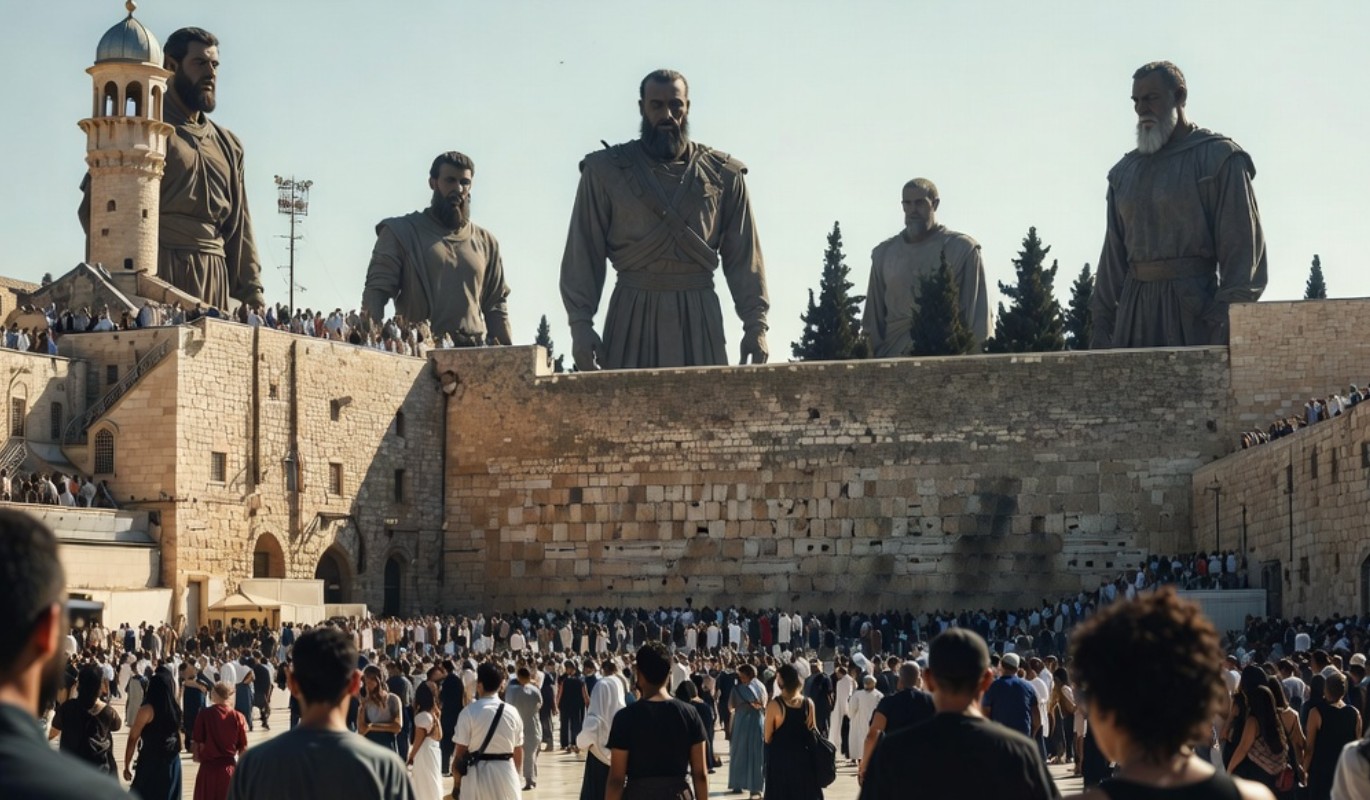
Imagine those ten spies reporting not on ancient Canaan, but on today’s Har HaBayit, the Temple Mount in Jerusalem. Their evil report, laced with fear and distortion, might sound eerily familiar: “The Dome of the Rock looms too strong, an impregnable symbol of foreign dominion. It is too dangerous to ascend; riots will erupt, the world will condemn us, and lives will be lost. The Torah forbids we ascend, for we are all impure without the red heifer’s ashes, and setting foot there risks karet, excision from the soul. Rabbis have decreed it assur, forbidden, lest ignoramuses misuse the site with leather shoes or irreverence. Better to pray at the Western Wall below, safe in our exile mentality, than provoke the giants above.”
This is the status quo narrative that echoes through our communities today, a modern meraglim’s (spies’) report that paralyzes action and perpetuates disconnection from Judaism’s holiest site. It is not just misguided; it is, in the words of Temple proponents like Yehuda Levy, “wrong and misleading.” The ten spies did not outright lie about the giants or the fortified cities; they exaggerated dangers and omitted faith, turning a divine command into a counsel of despair. Similarly, today’s opponents of ascending Har HaBayit cloak their fears in halachic garb, but a closer look reveals the distortion.
Let us dissect this “evil report” through the lens of Torah and halakha. Ascending, with respectful presence and preparation for rebuilding, is not only permitted but mandated. First, the claim of universal impurity: We are all tamei met, ritually impure from contact with death, without para aduma (red heifer) ashes to purify us. Yet, as the Rambam rules in Hilchot Beit HaBechira (6:14-15), even in times of impurity, Jews may enter permissible areas of the Mount. The sanctified zones are limited to about 13 percent of the platform, centered under the Dome of the Rock, as we know precisely from topography, mesorah, and sources such as the Radbaz, who states without doubt that the Even HaShtiya, the Foundation Stone, lies there. With buffer zones of 30 amot (about 50 feet) or more, we avoid any risk. The Mishnah in Middot (2:1-3) details the Temple’s measurements, allowing us to map safe perimeters today. Ascending impure? Halakha (Jewish law) permits it for mitzvot, as seen when Ezra’s generation rebuilt without full purity (Ezra 3:2-3).
Second, the fear of rabbinic prohibition: Many cite 1967 kol korei (an ultra-Orthodox authority) edicts declaring the Mount forbidden due to uncertainty or potential abuse. But as Levy argues, rabbis lack the authority to prohibit Torah commandments on the basis of hypothetical misuse. The Torah commands five active commandments on The Temple Mount today: (1) To ascend and seek the remains of the Temple(Deuteronomy 12:5-6, as per Rambam in Hilchot Melachim 1:3); (2) To build the Temple when possible (Exodus 25:8, obligatory per Ramban on the verse); (3) To fear the Temple through respectful conduct, like avoiding leather shoes or spitting (Leviticus 19:30, detailed in Rambam Hilchot Beit HaBechira 7:1-5); (4) To offer korbanot (sacrifices) if government permits, starting with the tamid twice daily offerings (Numbers 28:3-8, as Ezra did without a full Temple); and (5) To dwell in Israel and prevent enemy footholds (Deuteronomy 12:10-11, especially on this holiest spot). The Talmud in Yoma (9b) laments our failure to rebuild as a cause of ongoing exile. To say “forbidden” ignores these; it is like the spies ignoring Joshua and Caleb’s plea: “The land is very, very good” (Numbers 14:7).
Third, the escalation bogeyman: “Ascending will anger the Arabs and spark violence.” This inverts reality. Security experts like Dr. Mordechai Kedar and former Shin Bet operatives note that avoidance fuels opposition. Arabs claim the Temple Mount as Islam’s third-holiest site, yet treat it as a picnic ground, soccer field, or trash heap, as eyewitness accounts confirm. Every Gaza home displays Dome posters not from reverence, but as a symbol to resist Jewish apathy. Increased Jewish visits over the past decade, from mumbling prayers to open davening, have not ignited an apocalypse; tensions normalize with a visible presence. The spies’ report bred hysteria: “We seemed like grasshoppers” (Numbers 13:33). Today’s version does the same, handing the high ground to adversaries. As evidenced by 2025’s surge to 76,448 ascents without catastrophe, presence often normalizes tensions.
But the narrative does not end with despair. Joshua and Caleb, the two faithful spies, tore their garments and corrected the evil reports spewing forth: “Do not rebel against Hashem, and do not fear the people of the land, for they are our bread; their protection has departed from them, and Hashem is with us. Do not fear them” (Numbers 14:9). In our context, they would dismantle the distortions point by point. On the Soreg, the low fence marking the inner sanctified areas: “Actually stepping past the fence risks karet, true, but most of the Mount is accessible today halachically. The outer areas, akin to Machaneh Leviah (the encampment of the Levites surrounding the Tabernacle in the wilderness) permit entry even when impure, as per Rambam and the Mishnah in Kelim (1:8). We map them precisely; fear not the whole mountain.” This distinction echoes the encampments in the wilderness (Numbers 5:2-3), where levels of impurity dictated access, not blanket prohibition.
On calling permitted things forbidden: “It is forbidden to call assur what is permitted, a violation of bal tosif, not adding to the Torah (Deuteronomy 4:2). The Rambam warns against such overreach in Hilchot Mamrim (2:9); proclaiming the entire Mount off-limits misleads the masses and blocks mitzvot like awe of the Mikdash.” This rabbinic overextension, while well-intentioned, contravenes the principle in Devarim Rabbah (6:3) that one must not add fences that nullify commandments.
On obligatory offerings: “They must be done even if impure! The Talmud in Pesachim (80a) and Yoma (6b-7a) affirms that communal sacrifices, such as the tamid (twice daily) and musaf (additional offerings on Shabbat and holidays), are performed in impurity when the majority is impure. Everyone else stands behind the line, of course, but somebody better do the offering! It is not optional; it is a requirement, an obligation, as Hashem commands ‘tamid‘, literally eternally (Exodus 29:38). Ezra offered without purity; we can too, with trained kohanim (priests) ready.” This is reinforced in Rambam Hilchot Korban Pesach (4:1-2), where public offerings override individual impurity for the sake of the nation.
Now, transition to the external foes, embodied in Sanballat and Tobiah, from the Book of Nehemiah. These were not Jews, but Samaritans and Ammonite officials under Persian rule, mocking the exiles’ efforts to rebuild Jerusalem’s walls and Temple precincts. “What are these feeble Jews doing? Will they restore their wall?” they sneered (Nehemiah 4:2). They plotted sabotage, spread rumors, and appealed to higher powers to halt the work. Sanballat represents the Arab opposition: claims of exclusive holiness over Al-Aqsa, incitement like blaming Ariel Sharon’s 2000 visit for the Intifada (debunked by experts, including Hamas founder’s son), and manipulation of media to portray Jewish presence as aggression. Tobiah, with his alliances inside Jerusalem, symbolizes world opposition: UN resolutions demanding status quo, European condemnations of “provocations,” and even U.S. pressures to restrain for “peace.” Like the spies’ internal defeatism enabling external threats, our hesitation invites this coalition to fortify their hold, taunting from atop the Mount while we cower below.
Yet, Nehemiah prevailed not by force alone, but by faith-fueled action: arming workers, ignoring jeers, and completing the walls in 52 days (Nehemiah 6:15). The Maccabees later reclaimed a defiled Temple through bold revolt, restoring offerings despite impurity. We stand at a similar crossroads. Ascension means more than visiting; it is reclaiming sovereignty to build the Third Temple, erect an altar of uncut stones (as per Deuteronomy 27:5-6), and restore the tamid offerings (morning and evening lambs, per Exodus 29:38-42) and obligatory korbanot like the Pesach (Exodus 12:3-11). Preparations are in place: laser-cut stones ready for transport, trained kohanim, and even a portable mizbeach for initial use. The government could permit it tomorrow; the barrier is our will.
Reader, which report will you rally behind? The ten spies, dressed in pious warnings, that keep us wandering in spiritual exile? Or Joshua and Caleb’s, rooted in faith: “Do not fear the people of the land… Hashem is with us” (Numbers 14:9)? Do you follow Hashem’s commands to ascend, build, and serve, or bow to fear? The time has come. Let us scout not with dread, but with determination. The Mount awaits its rightful stewards. Ascend with courage, and together we can usher in the era of true redemption.
#AscendHarHaBayit
#AscendTheMount
Stand on the side of the 2 spies and support increased Jewish presence on Har HaBayit, preparations for the Beit HaMikdash, and educational outreach, consider donating or participating through organizations like:
- High on the Har https://www.highonthehar.com/ , focuses on Temple Mount education, guided ascents, and advocacy for Jewish presence
- The Temple Institute https://templeinstitute.org/ , which focuses on Temple vessels and research
- Beyadenu https://beyadenu.org/en/ , offering guided ascents and advocacy
- Temple Mount Yeshiva https://www.temple-mount.co.il/en/%D7%A8%D7%90%D7%A9%D7%99-english/
- Students for the Temple Mount https://www.facebook.com/templemountrights , engaging youth in awareness campaigns. Your involvement can help turn aspiration into action.