

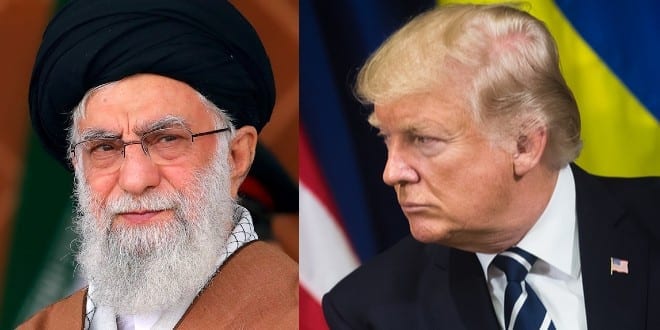
President Donald Trump called Saturday for the end of Supreme Leader Ali Khamenei’s 37-year rule in Iran, marking the sharpest escalation yet in the war of words between Washington and Tehran following mass protests that have left thousands dead across the Islamic Republic. The president’s declaration came hours after the 86-year-old Khamenei blamed Trump for the bloodshed, calling him a “criminal” responsible for the deaths of “several thousand” Iranians.
“It’s time to look for new leadership in Iran,” Trump told Politico in an interview Saturday. The statement represents the closest Trump has come to openly calling for regime change in Iran, though his criticism targeted Khamenei personally rather than the broader Islamic Republic system.
The situation unfolded across Iran on December 28, when economic protests exploded into a nationwide uprising demanding the dismantling of the clerical regime. Under an internet blackout imposed on January 8, Iranian security forces have killed at least 3,090 protesters, according to the US-based Human Rights Activists News Agency, with more than 22,000 arrests. The death toll exceeds any other period of unrest in Iran in decades, recalling the chaos of the 1979 revolution that brought the ayatollahs to power.
The confrontation took a sharp turn Saturday when Khamenei delivered a televised address marking a religious holiday. In his speech, the supreme leader acknowledged for the first time that “several thousand” Iranians had died during the protests—a rare admission from the regime about the scale of casualties. But Khamenei immediately blamed Trump for the bloodshed.
“We find the US President guilty due to the casualties, damages, and slander he inflicted upon the Iranian nation,” Khamenei wrote on Twitter. He accused Trump of encouraging the protesters by promising military support, calling it an “appalling slander” to characterize violent groups as representing the Iranian people.
Khamenei claimed Trump “openly encouraged” the protesters by promising them US “military support.” He described the demonstrations as “sedition” orchestrated by foreign powers, saying the protesters had damaged 250 mosques, educational centers, power infrastructure, banks, and medical facilities.
Trump’s response was swift and brutal.
“What he is guilty of, as the leader of a country, is the complete destruction of the country and the use of violence at levels never seen before,” Trump told Politico after being read Khamenei’s posts. “In order to keep the country functioning—even though that function is a very low level—the leadership should focus on running his country properly, like I do with the United States, and not killing people by the thousands in order to keep control.”
Trump went further, personally attacking Khamenei. “The man is a sick man who should run his country properly and stop killing people,” the president said. “His country is the worst place to live anywhere in the world because of poor leadership.”
Trump added: “Leadership is about respect, not fear and death.”
The exchange came just one day after Trump had struck a conciliatory note, thanking Iran’s leadership on Truth Social for allegedly canceling over 800 scheduled executions. “I greatly respect the fact that all scheduled hangings, which were to take place yesterday (Over 800 of them), have been cancelled by the leadership of Iran. Thank you!” Trump posted on Friday. When asked Saturday about the potential size of a US military operation in Iran, Trump referenced those executions: “The best decision he ever made was not hanging more than 800 people two days ago.”
The shifting tone reflects Trump’s week-long oscillation between threatening military strikes and expressing satisfaction with Iranian concessions. Earlier in the week, Trump had urged protesters to “take over institutions” and assured them that “help is on its way.” His pivot on Friday suggested his threat regarding protester deaths only applied to planned executions, not the thousands already killed during the regime’s crackdown.
Iran’s accusations of American and Israeli involvement in the unrest have been consistent throughout the crisis. On Friday, Iranian President Masoud Pezeshkian thanked Russian President Vladimir Putin in a phone call for Moscow’s support at the United Nations, stating that “the role and direct involvement of the United States and the Zionist regime in recent events in Iran is evident.”
Khamenei claimed Saturday that “those linked to Israel and the US caused massive damages and killed several thousand” during the protests. In his speech, the supreme leader said rioters fell into two categories: those supported, funded, and trained by the US and Israel, and “naive individuals whom the ringleaders manipulated.” He claimed the protesters were armed with live ammunition imported from abroad, though he did not name countries.
At Thursday’s UN Security Council session in New York, Russia’s UN ambassador accused the United States of “stoking tensions and fueling hysteria” regarding the Iranian protests, echoing Tehran’s narrative that foreign powers instigated the unrest.
Khamenei’s regime stands accused not only by Trump but by thousands of Iranian families who have lost loved ones—shot in the streets, killed on rooftops by security forces, massacred while demanding freedom and dignity.
One protester in Tehran described to CNN how government forces fired down from rooftops and used military drones overhead. “They were aiming with lasers and shooting people in the face,” the eyewitness said, speaking anonymously for security reasons. “They massacred people… They killed our most beautiful, most gorgeous and bravest, our kids.”
The protests began on December 28 over Iran’s failing economy and quickly evolved into mass demonstrations demanding an end to clerical rule. Witnesses and human rights groups report security forces opening fire on unarmed protesters in the streets. The Basij paramilitary group, established by Khamenei to suppress dissent, attacked demonstrators on motorcycles as protesters lit fires to counter teargas and blocked streets.
Iran has returned to an uneasy calm after crushing the protests through violence and an ongoing internet blackout. On Saturday morning, text messaging and limited internet services briefly resumed in parts of Iran, though overall connectivity remained at approximately two percent of normal levels according to cybersecurity watchdog NetBlocks. Iran’s semi-official Mehr News Agency reported Saturday that internet has been restored to “some subscribers,” saying the shutdown was enacted due to what it described as “terrorist unrest” and to “ensure the security of the country and its citizens.”
More than 24,000 protesters have been arrested according to HRANA. Tehran’s prosecutor said last week that some protesters could face the death penalty for their actions, according to semi-official Tasnim News Agency. In Saturday’s address, Khamenei vowed consequences for participants in the “riots” but did not elaborate on punishments. “We will not lead the country into war, but we will not let go of the domestic criminals and—more importantly—the international criminals,” he said.
Citing Monday’s pro-government rallies across Iran, Khamenei claimed Saturday that the protests have been “extinguished.” The supreme leader acknowledged Iran’s economic situation is “truly difficult” but called for people to unite “in defending the Islamic system and beloved Iran.”
The confrontation between Trump and Tehran comes as the Pentagon repositions military assets to the Middle East. Defense officials have confirmed redeployment of the USS Abraham Lincoln Carrier Strike Group and additional aircraft and land-based air defense systems to bolster security and prepare for potential Iranian retaliation.
What began as economic protests over inflation and hardship has transformed into the greatest challenge to Iran’s clerical regime since the 1979 revolution. Trump’s call for new leadership in Iran, delivered in the bluntest terms yet by an American president, signals that Washington has abandoned any pretense of seeking accommodation with Khamenei’s government. The question now is whether Trump’s words will be matched by action—and whether the Iranian people, having paid so dearly in blood, will rise again to finish what they started.
The regime can silence the internet and kill thousands in the streets, but it cannot kill the hunger for freedom. That hunger, once awakened, does not sleep.
