


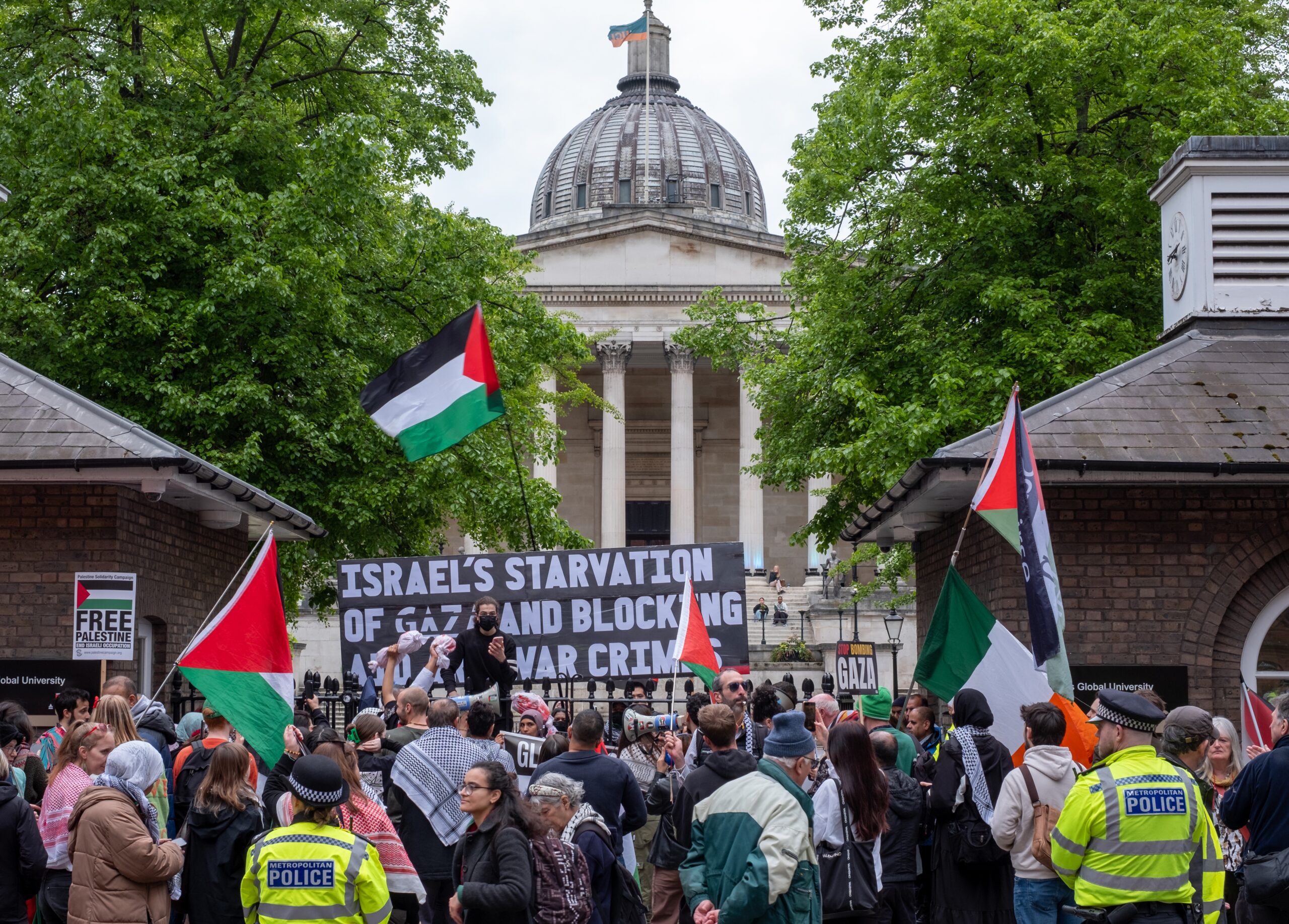
The decision by the United Arab Emirates to withdraw state funding from British universities reverberated across Western academic circles. A wealthy Muslim country, long seen as a partner of Europe, is now warning that the United Kingdom’s campuses pose a danger to its own students. Emirati officials are not discussing academic standards or costs. They are talking about ideology, radicalization, and the spread of Muslim Brotherhood networks inside institutions once regarded as elite and safe.
According to Financial Times reporting, confirmed by The Jerusalem Post, the UAE has removed all United Kingdom universities from its list of foreign institutions eligible for government scholarships, effective for the 2026 academic year. Nearly 40 other countries remain approved, including the United States, Australia, France, and Israel, with which the UAE normalized relations under the US-brokered Abraham Accords in 2020. This marks a sharp reversal from previous years, when hundreds of Emirati students studied in Britain with state support. In the year ending September 2025, just over 200 Emirati students received UK study visas, more than a 50 percent drop from 2022.
When British officials asked why their universities were excluded, Emirati counterparts were blunt. They did not want their students “to be radicalised on campus.” Officials told The Times that the concern centered on the influence of the Muslim Brotherhood, which the UAE designates as a terrorist organization and treats as an existential threat. Prime Minister Keir Starmer said the issue was under “close review,” but Britain has still not proscribed the Brotherhood, despite years of lobbying by Gulf states.
The irony has not been lost on observers. US Vice President JD Vance wrote on X that the headline was “absolutely insane,” noting that “some of our best Muslim allies in the Gulf think the Islamist indoctrination in certain parts of the West is too dangerous.” Emirati analyst Ahmed Alameri put it more sharply, saying that Western universities have become incubators for Islamist networks “disguised as tolerance.”
The UAE’s stance is not theoretical. Muslim Brotherhood ideology has been banned in the country since 2014. In 2024, 84 Emiratis were put on trial for ties to the group, with 43 ultimately sentenced to life in prison. In January 2025, the UAE designated eight UK-based organizations as terrorist entities and added them to its national terror list. In the Emirati system, antisemitism is a crime, not an opinion, and extremism is not protected as activism.
Emirati expert Amjad Taha stated that the UAE would not send its students “to become hostages of Islamist jihadist ideology disguised as campus activism.” He cited universities in Birmingham, Manchester, Leeds, Bradford, SOAS, Queen Mary University of London, and Newcastle as locations where Muslim Brotherhood–linked networks are reported to operate. Similar claims were made regarding campuses in Ireland. His language was stark and intentional, reflecting the Emirati view that Western institutions have failed to enforce red lines.
Bomb maker for the Muslim Brotherhood in Egypt, Abdelrahmen Adnan Abouelela, invaded the UK and was put up in a 4* hotel at the taxpayers expense.
— Tommy Robinson 🇬🇧 (@TRobinsonNewEra) October 16, 2025
He went on to rape a British woman in Hyde Park.
This is England 2025. pic.twitter.com/EET0Gtv4Wo
This concern is reinforced by years of research. A 2015 paper by Lorenzo Vidino of George Washington University documented how senior Muslim Brotherhood figures in Britain often arrived as students and later embedded themselves in academic and civic life. The Brotherhood’s UK ecosystem has included prominent academics such as Tariq Ramadan, a former Oxford professor and grandson of Hassan al-Banna, the movement’s founder. Student organizations such as the Federation of Student Islamic Societies, founded in 1963 and representing hundreds of thousands of students, have repeatedly been cited in studies examining Brotherhood influence.
Since October 7, scrutiny has intensified. Multiple university societies in Britain have been accused of ties to Hamas, a terrorist organization and an offshoot of the Muslim Brotherhood. In May 2025, 18 university societies endorsed a legal bid to de-proscribe Hamas under the Terrorism Act 2000. Others have been suspended for calling for violent “intifada” or hosting speakers linked to proscribed groups. During the 2023–24 academic year, 70 UK university students were reported for possible referral to the government’s Prevent deradicalization program; later data showed that referrals from higher education doubled and reached record levels, with 27 percent linked to Islamist radicalization.
The picture does not end in Britain. Qatar, a state deeply intertwined with Muslim Brotherhood ideology and leadership, has poured hundreds of millions of dollars into Western universities, including in the United States. Qatari funding has flowed into prominent American campuses through donations, partnerships, and endowed programs, often with little transparency. At the same time, US universities have seen an explosion of campus activism that crosses from protest into open support for terrorist organizations, especially after October 7. Student groups linked to Brotherhood-aligned networks have played a central role in shaping this environment, normalizing antisemitism and reframing jihadist violence as “resistance.”
Similarly, there are student groups on American campuses whose activism around the Israel–Hamas conflict has drawn scrutiny for supporting or glorifying Hamas and other designated terrorist organizations. Academia in the United States has seen a surge in pro-Palestinian activism since the October 7, 2023 Hamas terrorist attack, and some of these groups’ rhetoric and actions have crossed into praise for terror or activities that U.S. authorities and litigants say materially support Hamas.
One of the largest and most widespread is Students for Justice in Palestine (SJP), a network of campus chapters that has been at the center of anti-Israel protests and boycott campaigns. According to a report by the Anti-Defamation League, SJP chapters have justified terror attacks and engaged in rhetoric that stigmatizes Zionism and Jewish students, and they were central to nationwide encampments and protest actions in 2024. The network distributes organizing materials that celebrate the October 7 attack as a historic victory for Palestinian liberation.
BREAKING: STUDENTS ENCAMPMENT PROTESTS KICK OFF ACROSS THE UK
— Sulaiman Ahmed (@ShaykhSulaiman) May 1, 2024
Newcastle University Students Establish an Encampment for Gaza and Call on Students Everywhere to "Rise Up!" pic.twitter.com/K6zb35f4SF
At several universities, student actions connected to these groups have involved symbols or messaging that align with Hamas’s narratives. At the University of Washington, an SJP-linked group called SUPER UW (Students United for Palestinian Equality & Return) reportedly sold clothing featuring the image of a Hamas spokesperson as a fundraising tactic and hosted a leader of the Samidoun network, which is linked to Palestinian terror groups.
Protests and encampments at campuses such as Sarah Lawrence College included propaganda glorifying Yahya Sinwar, the leader of Hamas.
There have also been lawsuits alleging that campus groups functioned as propaganda arms for Hamas. In March 2025 a federal lawsuit filed in the Southern District of New York named several anti-Israel campus organizations, including Columbia Students for Justice in Palestine, Columbia University Apartheid Divest, and the activist group Within Our Lifetime (WOL) — alleging they furthered Hamas’s messaging and coordinated demonstrations in ways the plaintiffs say amounted to material support of a U.S.-designated Foreign Terrorist Organization.
It’s important to be precise: direct financial or operational links between Hamas leadership and these student groups are not publicly documented in the way state sponsorship is for terror infrastructure overseas. But the rhetoric, symbolism, and actions of some U.S. campus groups have been interpreted by critics, litigants, and watchdog organizations as aligning with or amplifying Hamas’s agenda.
At the same time, U.S. universities and courts grapple with First Amendment protections, free speech, and where to draw the line between activism and material support for terror — a debate that is ongoing and legally complex.
The UAE’s decision is therefore not isolationist. Wealthy Emirati families can still self-fund education in Britain. Military personnel may still receive scholarships. The policy targets state support and degree recognition, signaling that the Emirati government will not legitimize institutions it believes have lost control of their moral and ideological boundaries.

