



As mass protests and violent government crackdowns gripped Iran this week, senior Israeli rabbis moved swiftly to frame the unrest in theological terms. Rabbi Shmuel Eliyahu, chief rabbi of Safed (Tzfat) and a leading voice in Religious Zionist circles, published a prayer Thursday night calling for the destruction of Iran’s leadership. At the same time, a Chabad emissary in Beit Shemesh invoked ancient Talmudic prophecy to argue that Iran’s potential collapse at the hands of the United States marks the approach of the messianic era.
The rabbinic declarations came during what Israeli media described as a night of intense turmoil inside Iran, where protesters clashed with security forces amid a near-total internet blackout imposed by the regime. For Rabbi Eliyahu and others, the chaos was not merely a geopolitical event but a moment requiring urgent spiritual intervention and scriptural interpretation.
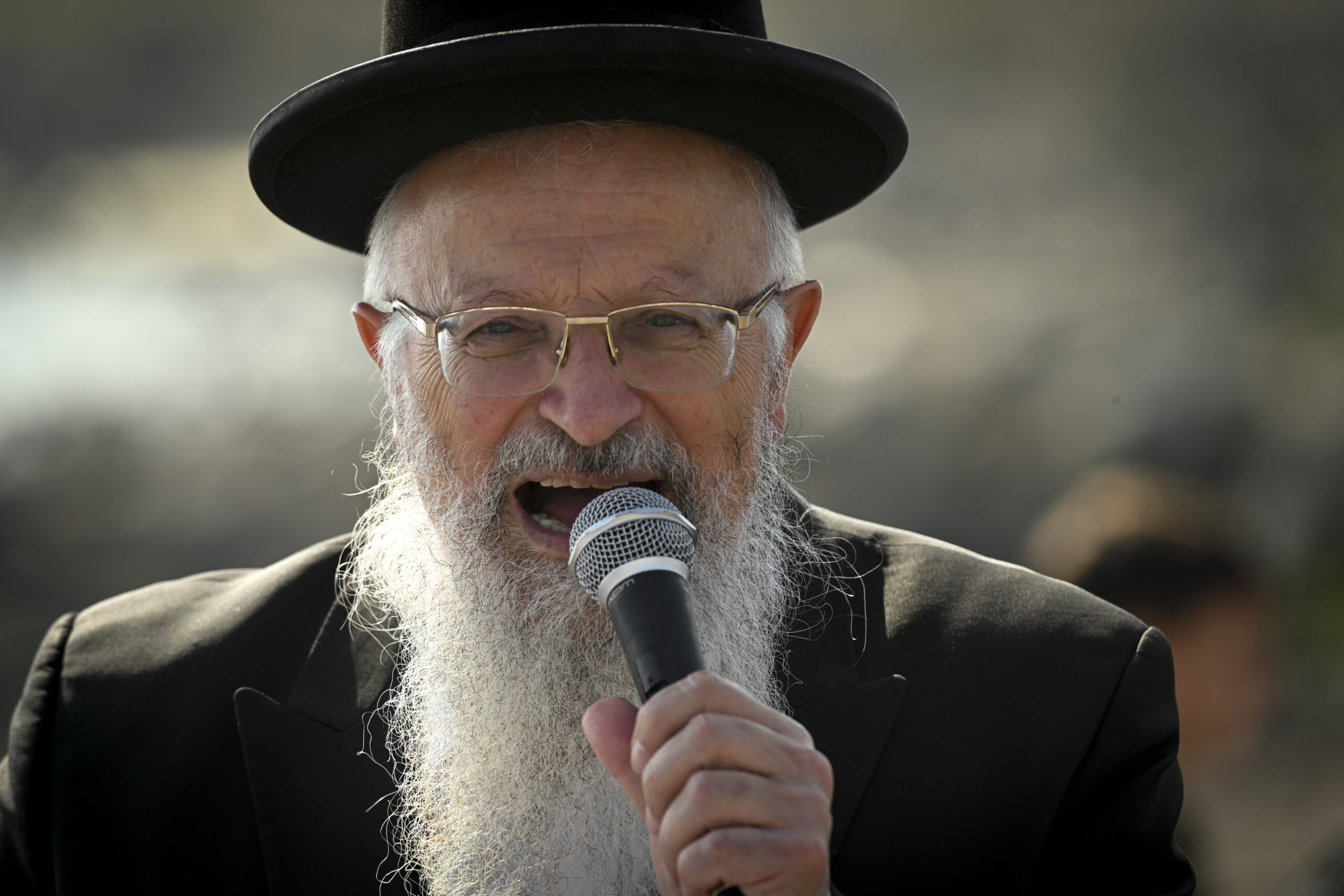
Two weeks earlier, at the start of the Iranian demonstrations, Rabbi Eliyahu delivered a video lesson on YouTube explaining how Jews should view the unrest. His teaching laid the theological groundwork for the prayer he would later issue. “How do we look at the riots in Iran that are shaking the ground beneath the feet of the tyrant leaders?” Rabbi Eliyahu asked. “On one hand, this is truly the God who avenges us from our oppressors, who repays in full all who hate us, who rejoices us with the downfall of our enemies, and avenges us against all who hate us. We see how the Holy One, blessed be He, strikes these tyrants. It is the vengeance of God, the vengeance appears.”
But Rabbi Eliyahu insisted the divine purpose extended beyond Israel’s immediate security concerns. “But truly, this is not only toward us, but this is also tikkun olam (repair of the world), because ultimately these tyrants oppress their own people. We know that the Holy One, blessed be He, has an interest in repairing the world, that the world should not be full of evil. Therefore, we say, ‘Let the peoples thank You, God, let all the peoples thank You. For You judge the peoples with equity, and You lead the nations on earth, Selah.'”
He then explained God’s dual method of intervention. “What does this mean? Sometimes God judges them, brings them droughts, raises up all kinds of earthquakes; this is direct. And sometimes the Holy One, blessed be He, guides the nations. He does not act directly. He enters into the heart of the people themselves, gives them strength to rebel against these tyrants, to bring them down. For this we say, ‘May God bless us, our God, may God bless us, and may all the ends of the earth fear Him. Amen and Amen.'”
In Rabbi Eliyahu’s framework, the Iranian protesters are not simply citizens demanding reform. They are instruments of divine will, empowered by God to overthrow a regime that embodies evil. The rabbi’s teaching positioned the internal rebellion as part of a cosmic process in which God either strikes directly through natural disasters or works indirectly by stirring the hearts of oppressed populations to rise against their rulers.
Rabbi Eliyahu’s prayer blended verses from the Torah and traditional liturgy with explicit contemporary petitions. He opened with thanksgiving: “We thank You, Lord, our God and God of our fathers, that You have given us the strength to strike our enemies, and You have fulfilled in us: ‘You shall chase your enemies, and they shall fall before you by the sword. Five of you shall chase a hundred, and a hundred of you shall chase ten thousand, and your enemies shall fall before you by the sword.'” (Leviticus 26:7-8)
He continued with a direct appeal: “Please, Lord, destroy and annihilate all who rise against us for evil. Rise up, Lord, and let Your enemies be scattered, and let those who hate You flee before You. Destroy the leaders of Iran who stand against us to annihilate us. Save us from their hand. Help all the people who are rising up against them. Protect them, put it in the heart of the army to assist and not to fight them.”
The prayer concluded with language drawn from the High Holiday liturgy: “Fulfill in us: ‘And wickedness shall vanish like smoke.’ For You will remove the reign of evil from the earth. And You alone, Lord our God, will reign speedily over all Your works, on Mount Zion, the dwelling place of Your glory, and in Jerusalem, Your holy city. As it is written in Your holy words: ‘The Lord shall reign forever, your God, O Zion, from generation to generation, Hallelujah.'”
Rabbi Eliyahu also organized a women’s prayer gathering with his daughter, Rebbetzin Rachel Bazak, which drew participants from around the world and was dedicated to “the success of the divine good and the fall of the Iranian regime.” Three years ago, during earlier waves of protest in Iran, Eliyahu issued a similar prayer in support of demonstrators challenging the Islamist government.
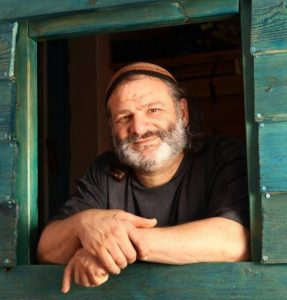
Rabbi Mendi Lifsh, a Chabad emissary in Beit Shemesh, took a different approach. According to the Jerusalem Post, Lifsh published an article interpreting current events through the Talmudic statement: “Persia will fall into the hands of Rome” (Yoma 10a). The passage in the Talmud reads: “Persia falls into the hands of Rome. Rome falls into the hands of Persia. And the Sages say: Persia will fall into the hands of Rome.” Lifsh identified modern Iran as the Talmud’s Persia and the Christian West, led by the United States, as Rome. He argued that an American role in the downfall of Iran’s regime would signal the proximity of the messianic era.
Lifsh framed his piece as interpretation rather than certainty, but the underlying logic was clear: the Talmud’s cryptic geopolitical vision was being activated in real time. For him and others in the Chabad tradition, the fall of Iran at Western hands is not a coincidence but a scriptural milestone.
The combination of prayer and prophecy reflects a view widespread in certain Israeli religious circles that Iran represents not just a political adversary but a spiritual enemy whose defeat is embedded in the Jewish redemptive narrative. The Sages taught that the empires of history rise and fall according to divine will, and that the final empire to challenge Israel before the coming of the Messiah would be subdued not by human might alone but by the hand of God working through nations.
Eliyahu’s prayer did not hedge or soften its language. It asked explicitly for the destruction of Iran’s leaders and the empowerment of internal resistance. It invoked the biblical promise that Israel’s enemies would fall “by the sword” and tied that ancient assurance to a modern geopolitical crisis. The prayer’s conclusion, drawn from the liturgy recited on the holiest days of the Jewish calendar, recasts the Iranian regime’s potential collapse as part of the cosmic removal of evil that precedes God’s universal kingship.
Lifsh’s Talmudic reading added another layer. If Iran falls to the West, he suggested, the script written nearly two thousand years ago in Babylonian study halls is playing out on the world stage. The Sages who debated the fate of Persia and Rome could not have known about nuclear programs or proxy militias, but Lifsh and those who think like him believe the categories remain valid. Persia is Iran. Rome is the West. And the fall of one into the hands of the other is a messianic sign.
The internet blackout inside Iran and the violent suppression of protests meant that details emerging from the country were fragmentary. Chabad.info published a security analysis by Avishai Afragon describing the unrest as a major internal crisis and noting the regime’s information chokehold. The piece also connected the moment to historic Jewish texts and figures, reinforcing the narrative that current events are being watched not just by analysts but by those searching ancient sources for meaning.
The rabbinic response to Iran’s turmoil reveals how Jewish tradition continues to shape the way some Israelis interpret global events. For Eliyahu, Lifsh, and others, the fall of Iran is not a matter of if but when, and when it happens, it will not be a secular milestone but a divine act foretold in Scripture and prayed for across generations. The ancient words are being spoken again, this time with Iran’s leaders in view and the messianic horizon drawing closer.

