

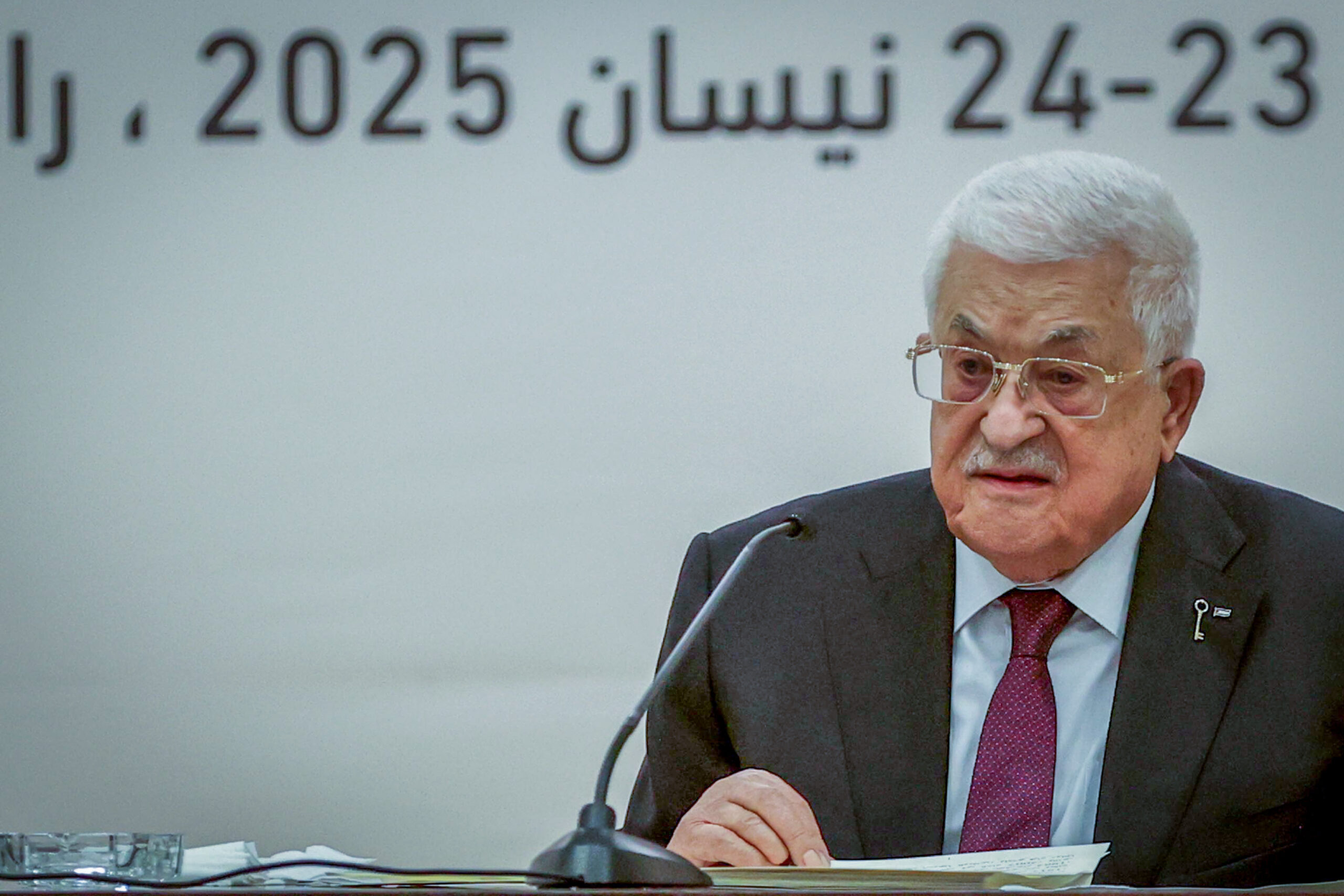
Mahmoud Abbas, the long-serving head of the Palestinian Authority, was quietly admitted and released this week after what his office described as “routine medical tests.” The scene was unremarkable in one sense—an elderly political leader undergoing evaluation—but the setting and the history behind it remain striking. Once again, the leader of a political body locked in conflict with Israel depended on Israeli medicine, Israeli doctors, and an Israeli health system to preserve his life.
According to the Palestinian Authority’s official WAFA news agency, Abbas was hospitalized and released the same day after receiving what it called “reassuring” test results. Saudi-based Asharq News reported that he had been evacuated for treatment earlier in the day. Abbas is 90 years old and in the 21st year of a four-year presidential term. His health has been a matter of public concern for years, and this episode fits a long and well-documented pattern.
Any assessment of Mahmoud Abbas’ repeated dependence on Israeli medical care is incomplete without confronting his record on the Holocaust. Abbas’s 1982 doctoral dissertation, completed at the Peoples’ Friendship University in Moscow, later served as the basis for his book The Other Side: The Secret Relationship Between Nazism and Zionism. In that work, Abbas rejected the historically established figure of six million murdered Jews, dismissing it as a “myth” and a “fantastic lie,” and claiming the number was closer to “a few hundred thousand.” He argued that Zionist leaders exaggerated Jewish suffering for political gain, an assertion long identified by Jewish organizations as Holocaust denial.
Abbas did not retreat from these claims over time. In August 2023, addressing the Fatah Revolutionary Council, he stated that Hitler murdered Jews not because of antisemitism but because of their “social role” as moneylenders. In the same speech, Abbas repeated the false claim that Ashkenazi Jews descend from the Khazars, a long-standing antisemitic trope used to deny Jewish historical connection to the Land of Israel. These statements were delivered decades after the Holocaust had been exhaustively documented and memorialized, and they came from a man internationally recognized as a head of government.
Abbas’s past is also entangled with one of the most notorious terror attacks in modern history. According to Abu Daoud, a senior Fatah figure involved in planning the 1972 Munich massacre, funds raised by Abbas were used—without his claimed knowledge—to support the operation. The attack resulted in the murder of eleven Israeli athletes at the Olympic Games, a crime that became a defining symbol of Palestinian terror on the global stage. Abbas has never accepted responsibility for the financial networks that operated under his authority during that period.
These facts sit uncomfortably alongside the image of Abbas as a frail elderly patient receiving careful treatment and reassurance from Israeli doctors. The same state whose legitimacy he has questioned, whose history he has distorted, and whose civilians were murdered by organizations he helped build has repeatedly acted to preserve his life. This is not reconciliation. It is a moral and civilizational divide made visible in a hospital ward.
Abbas himself has a long medical history tied to Israeli hospitals and Israeli physicians. In March 2018, an Israeli doctor treated him after a deterioration in his condition. In October 2019, Abbas underwent cardiac catheterization. Roughly two decades earlier, he had surgery following a diagnosis of prostate cancer. After decades of heavy smoking, he reportedly quit for health reasons. These treatments were not symbolic gestures. They were concrete interventions that extended his life.
This pattern is not unique to Abbas. In March 2018, senior Palestinian leader Jibril Rajoub, who has repeatedly voiced support for terror attacks and violence against Israelis, received treatment at an Israeli hospital. In January of that same year, the Palestinian Authority announced it would end medical referrals to Israel. In practice, thousands of Palestinians continued to be treated annually in Israeli facilities because no alternative system could match the level of care.
In October 2020, Saeb Erekat, secretary general of the Palestine Liberation Organization, was admitted to Hadassah Medical Center in Jerusalem after contracting Covid-19. He was placed on a ventilator in critical condition. Despite his long record of political warfare against Israel, he was treated by Israeli medical teams until his death.
The pattern extends into Hamas, a terrorist organization openly committed to Israel’s destruction. Several family members of Ismail Haniyeh, who led Hamas until his elimination in 2024, were treated in Israeli hospitals. At Soroka Medical Center in Beersheba, and according to some reports, Assaf Harofeh Hospital near Tel Aviv, Israeli surgeons removed a life-threatening brain abscess or tumor. Without Israeli intervention, the condition would likely have been fatal.
The most consequential case is that of Yahya Sinwar. In 2004, while serving multiple life sentences in an Israeli prison, Sinwar collapsed. Israeli doctors diagnosed a brain tumor and performed surgery that saved his life. Sinwar later rose to become the leader of Hamas in Gaza and the architect of the October 7 massacre of Israelis. The same state he dedicated his life to destroying preserved his life when he lay helpless in a prison hospital bed.
Abbas himself embodies this contradiction. Born on November 15, 1935, in Safed, he has led the Palestinian Authority since 2005. He is chairman of both the PLO and Fatah, organizations responsible for decades of violence against Israeli civilians. His academic work, completed in Moscow in 1982, formed the basis for a book that minimized the scale of the Holocaust and framed Nazi crimes through conspiratorial lenses. As recently as August 2023, Abbas repeated antisemitic claims about Hitler and Jewish history in a public address.
Yet when Abbas’ health deteriorates, it is Israeli medicine that stands between him and death. Mahmoud Abbas’ latest hospital visit is not a story about coexistence or peace slogans. It is a factual record of a moral asymmetry that no amount of propaganda can erase.
Israel saves lives. Even when those lives belong to its enemies.