
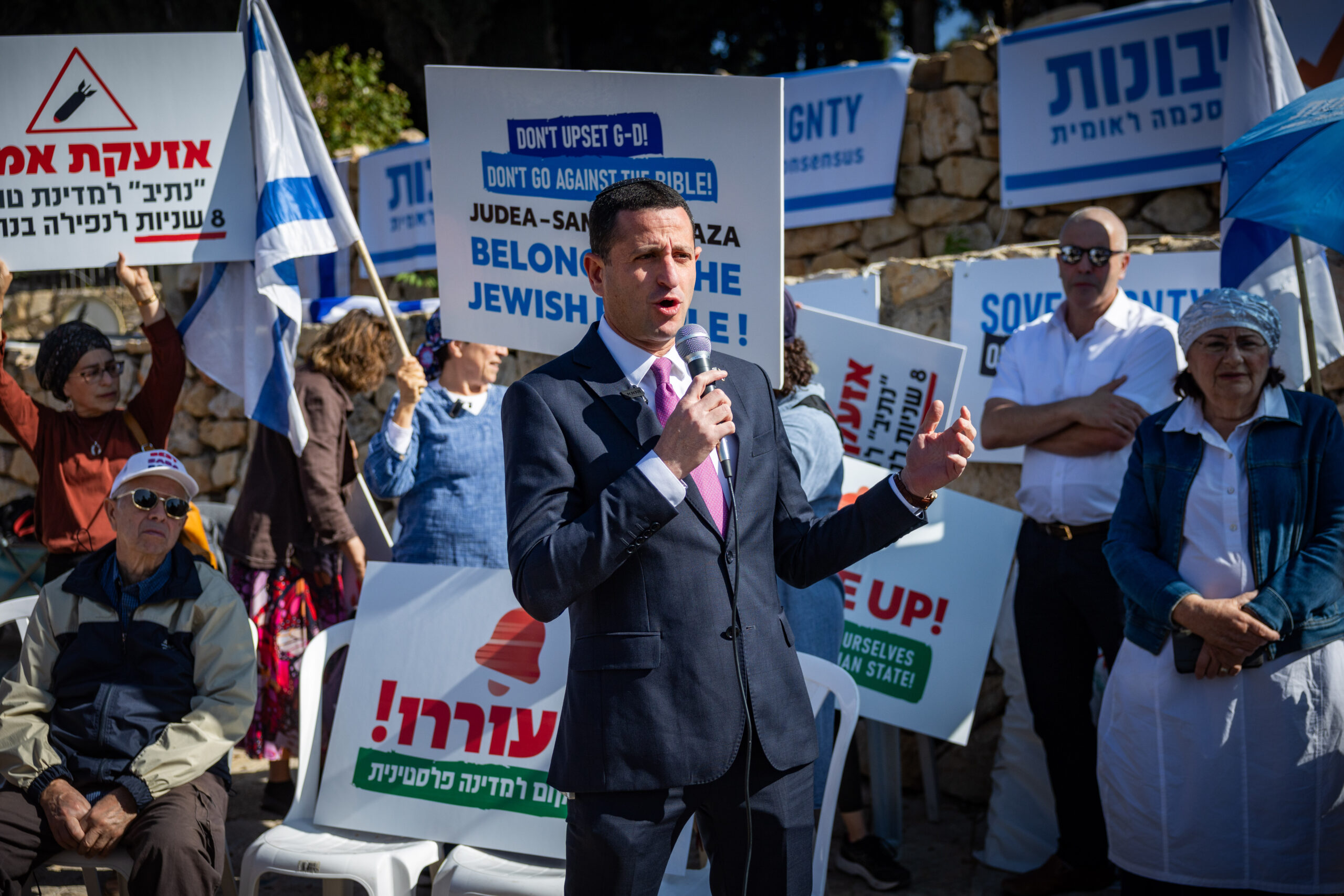
While Israeli soldiers fought on the ground in Gaza and Lebanon in 2025, one member of Knesset waged a different battle—spending more time abroad than any other Israeli lawmaker or minister. Religious Zionism MK Ohad Tal logged 68 days outside Israel this year, surpassing even Foreign Minister Gideon Sa’ar’s 64 days, according to data obtained by Channel 12 through freedom-of-information requests.
Tal, who chairs the Knesset Israel-U.S. Relations Caucus and serves on the Foreign Affairs and Defense Committee, defended his extensive travel as necessary frontline work in Israel’s war for international legitimacy. His office issued a statement declaring he is “proud to be among the few members of the Knesset who stands on the international front line defending the State of Israel.”
The numbers tell a striking story. Economy Minister Nir Barkat spent 60 days abroad, while Transportation Minister Miri Regev—whose international travel has drawn scrutiny—was out of the country for 57 days. Tourism Minister Haim Katz, who holds several portfolios, traveled for 41 days.
What drives an Israeli legislator to spend more than two months away from the Knesset at a time when Israel faces existential threats on multiple fronts?
The answer lies in understanding the nature of modern warfare. Today’s battles are not fought only with tanks and missiles. They are fought in congressional hearing rooms, television studios, and parliamentary chambers across the world. Tal’s extensive travel included meetings with U.S. Congress members and other parliamentarians, as well as interviews with international media outlets. According to his office, “The State of Israel should have done much more on this front—coordinating a comprehensive strategy for public diplomacy and Israeli influence in the international arena, especially among our friends around the world.”
This reflects a biblical principle found in the words of King Solomon: “There is a time for war and a time for peace” (Ecclesiastes 3:8). The Sages understood this verse to mean that different situations demand different strategies. When Israel’s enemies wage lawfare at the United Nations, spread propaganda through global media, and lobby foreign governments to impose sanctions, sending articulate defenders abroad becomes as critical as deploying troops to the battlefield.
The prophet Isaiah declared, “Zion shall be redeemed through justice, and those who return to her through righteousness” (Isaiah 1:27). Israel’s redemption requires more than military might. It demands voices willing to speak truth in hostile forums, to counter lies with facts, and to remind the world that the Jewish people have an eternal claim to their ancestral homeland. When antisemites masquerading as human rights activists spread blood libels in European capitals and American universities, Israel needs representatives who will confront these falsehoods directly.
Tal’s role as chair of the Israel-U.S. Relations Caucus places him at the center of Israel’s most vital diplomatic relationship. With President Trump back in the White House and a Republican Congress supportive of Israel, the opportunity to strengthen ties and advance shared interests has never been greater. Missing this moment would constitute strategic negligence.
The criticism of Tal’s travel overlooks a harsh reality: Israel is losing the information war. University campuses have become breeding grounds for antisemitism dressed as anti-Zionism. International organizations routinely pass resolutions condemning the Jewish state while ignoring genuine human rights violators. Terrorist organizations like Hamas receive sympathetic coverage in mainstream media outlets. If Israel’s elected officials do not aggressively counter these narratives abroad, who will?
Tal’s statement that Israel “needed to do much more” on the public diplomacy front exposes a critical gap in the nation’s defense strategy. For decades, Israel invested heavily in military superiority while neglecting the battle for hearts and minds. The result: a nation that wins wars but struggles to win arguments. A country that develops world-changing technology but cannot effectively communicate its right to exist.
The question is not whether Tal spent too many days abroad. The question is whether Israel has enough lawmakers willing to leave the comfort of the Knesset cafeteria to defend their nation in unfriendly territory. Based on these numbers, the answer appears to be no. One legislator cannot single-handedly reverse decades of successful Palestinian propaganda and rising global antisemitism.
Israel’s survival depends not only on the IDF’s ability to eliminate terrorists but on its representatives’ ability to eliminate lies. MK Tal’s 68 days abroad may represent not excessive travel, but a recognition of what the stakes demand—and a rebuke to those who remain silent while Israel’s enemies control the narrative.