



If you were to walk into our offices at Israel365, in Bet Shemesh, Israel, you would likely find me at my desk – typing away, sipping my coffee, and pondering how to tell more people about Bible Plus (our amazing online Bible study video platform). Yes, I had to put in a plug for that!
Most of my work is with Christians. Yet, on Wednesday, December 23rd, I sat in a room full of Rabbis and Jewish thought leaders to talk about why those relationships matter for both our futures.
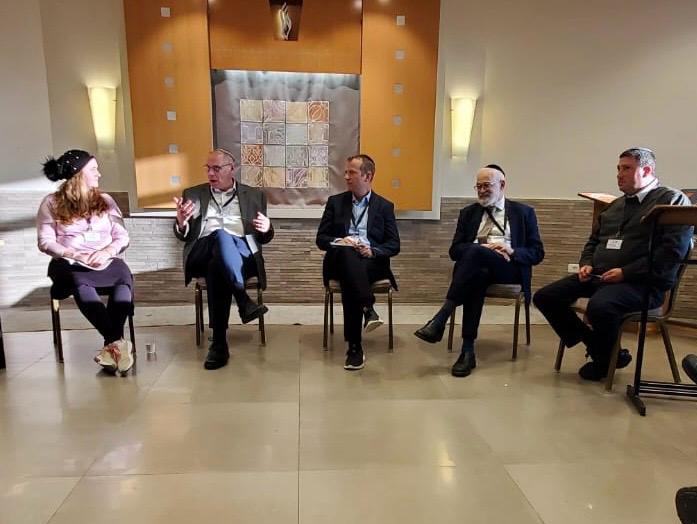
I had the privilege of participating in a panel titled “An Evolving Dialogue: Jewish-Christian Relations Today” at a conference for members of the Rabbinical Council of America who live in Israel.
The RCA is the largest organization of Orthodox rabbis in North America. This gathering brought together rabbinic leaders who carry both local responsibility in Israel and deep ties to Jewish communities abroad, making it a particularly meaningful setting for a conversation about Jewish-Christian relations at this moment in history.
The panel included Rabbi Mark Dratch, Chairman of the International Jewish Committee for Interreligious Consultations; Rabbi Tuly Weisz, founder of Israel365; Rabbi Yitzchok Adlerstein, Director of Global Faith Engagement at Israel365 and former Director of Interfaith Affairs at the Simon Wiesenthal Center; and was moderated by Rabbi Jay Weinstein, Director of Christian Friends of the Jewish Agency for Israel.
What made the conversation especially meaningful for me was the contrast between my daily work and the context of this panel. Much of my time is spent working closely with Christians. I am in regular contact with Bible Plus subscribers, collaborate with Christian partners on educational projects, write Daily Inspiration articles for a largely Christian audience, and over time have formed real friendships rooted in shared study, values, and concern for Israel.
What I spend far less time doing is speaking about that work to Jewish audiences, particularly rabbis and communal leaders who carry responsibility not only for engagement, but for boundaries, clarity, and continuity. Being part of that conversation, and hearing these issues examined through serious Jewish thought, was both grounding and clarifying.
The questions posed by the moderator were thoughtful and substantive. They explored why Jewish-Christian engagement matters at this moment, where the risks and boundaries lie, how rabbis and community leaders can engage responsibly, and how a vision of partnership translates into real life.
Rabbi Tuly Weisz framed much of his contribution around what he calls Universal Zionism, the idea that the next chapter of Israel’s story is inseparable from its relationship with the non-Jewish world, particularly Christians. He argued that the Jewish-Christian partnership emerging after October 7 is not a side note, but central to Israel’s future and to the moral direction of Western civilization.
He spoke about the unprecedented response from Christians worldwide in the aftermath of October 7. At the same time that antisemitism surged to levels not seen in decades, hundreds of millions of Christians expressed public, emotional, and sustained support for Israel, often with a depth that surprised many Jews. Rabbi Weisz situated this moment within a long arc of Jewish history, from the biblical promise to Abraham that all families of the earth would be blessed through him, to modern Zionism in its political, religious, and now universal expressions.
Rabbi Mark Dratch brought a complementary perspective shaped by decades of institutional interreligious dialogue. As head of the International Jewish Committee for Interreligious Consultations, which represents world Jewry in dialogue with the Vatican and major Christian bodies, he spoke about the slow and careful work of building trust, navigating difference, and maintaining Jewish integrity while engaging meaningfully with others.
As the conversation unfolded, a recurring theme began to emerge. Again and again, the panel returned to the idea that education and advocacy, while important, are not enough on their own.
At Israel365, Rabbi Elie Mischel, the Director of Education, often describes engagement with the Hebrew Bible as an “inoculation against hate.” When people encounter the Bible detached from its Jewish context, history, and values, it becomes easy to distort, misuse, or weaponize. Grounded study restores depth, responsibility, and moral clarity.
Yet the discussion made clear that this principle extends beyond texts. Connection itself may be the most powerful inoculation we have. When people learn together, build relationships, and encounter one another as human beings rather than abstractions, hatred has far less room to take hold. Relationships do what arguments and slogans cannot.
When the conversation turned to implementation, I spoke about the need to begin at home. If a partnership is going to be meaningful and lasting, it cannot live only at the level of institutions or conferences. It has to shape how families learn, speak, and pass values on to the next generation.
One of the great challenges we face today is that many children, Jewish and Christian alike, encounter the Bible in fragments, slogans, or distorted narratives, often shaped by social media rather than serious study. That vacuum does not remain empty. It is quickly filled by misinformation, hostility, and confusion about Israel and the Jewish people.
We need better tools and resources for families, resources that help parents and children build a deeper, more thoughtful relationship with the Hebrew Bible and with Israel. Teaching children how to learn these texts, and why they matter, is not only an educational project. It is a moral one.
I also encouraged the Rabbinic and community leaders to consider the relationships already within reach. Partnership does not always begin with grand initiatives. It often starts with individual connections, with learning together, and with the willingness to engage thoughtfully rather than retreat.
This conversation did not resolve every tension, nor was it meant to. Questions of boundaries, responsibility, and sustainability remain complex and require ongoing reflection. But the panel succeeded in something just as important. It reframed the conversation away from fear or defensiveness and toward shared responsibility.
In a world where hatred spreads quickly and relationships are often absent, Jews and Christians are not standing on opposite sides of history waiting to persuade one another. Increasingly, we are standing together, shoulder to shoulder asking how to live responsibly in a fractured world.
This partnership, grounded in faith, learning, and human connection, may be one of the most important of our time.

