

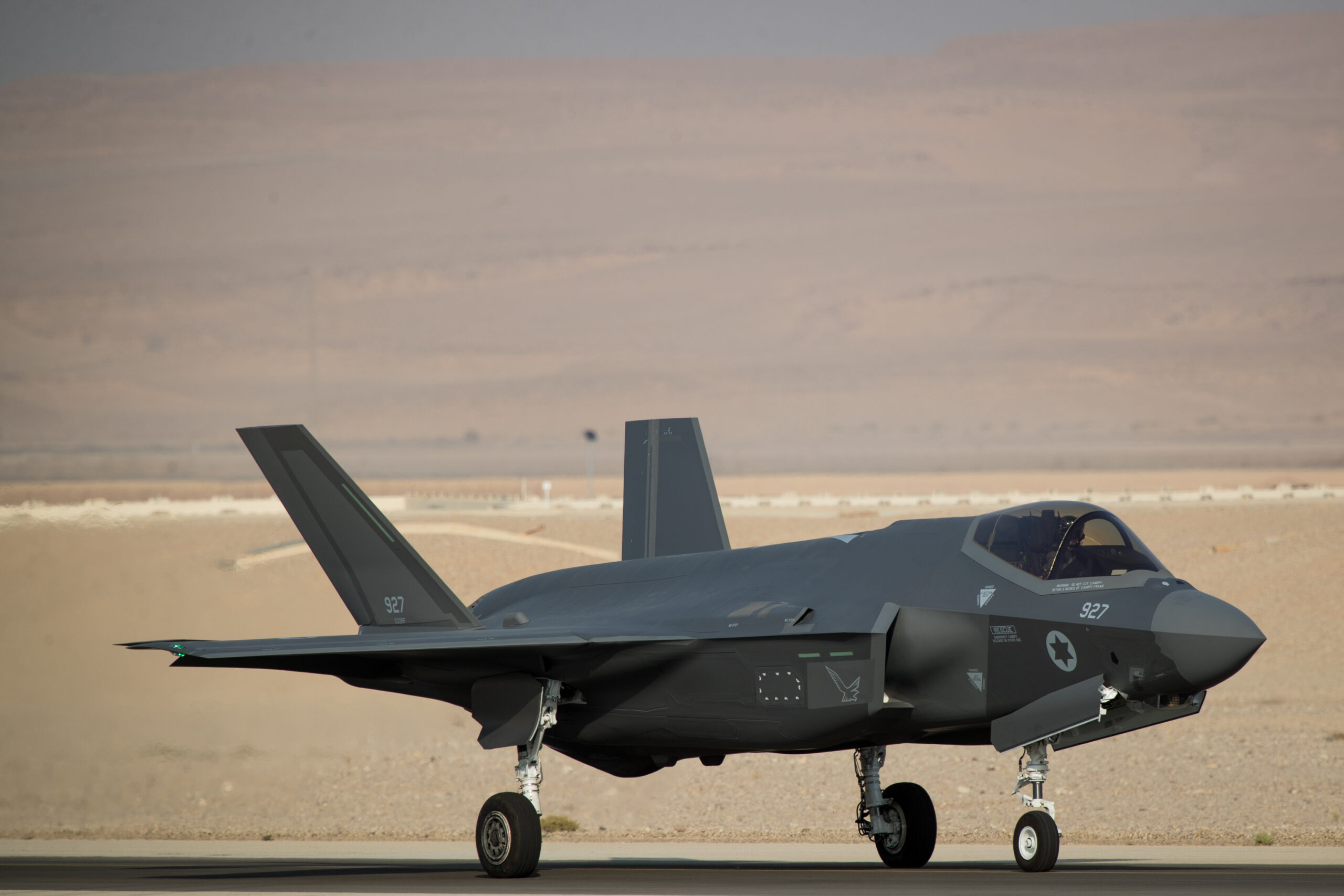
Israel turned America’s biggest military flop into a superweapon—now Turkey wants it.
The F-35 fighter jet nearly bankrupted America’s defense industry. Then Israel used it to disable Iran’s entire air force in a single night. Israel took a $55 billion disaster and transformed it into the deadliest aircraft on earth. Now Turkey—the top patron of Hamas and the Muslim Brotherhood—wants one.
In a fascinating interview with Rabbi Pesach Wolicki, Executive Director of Israel365 Action, former Israeli Ambassador Yoram Ettinger revealed why handing the F-35 to Erdogan’s Turkey wouldn’t just threaten Israel—it could topple every pro-American government in the Middle East and turn the region into a launching pad for anti-Western terrorism.
From Disaster to Dominance: How Israel Saved the F-35
In 2018, the F-35 was America’s most expensive mistake. After burning through $55 billion in research and development, the stealth fighter was plagued by mechanical failures. Aerospace experts wrote it off as a boondoggle that would never work in real combat.
Then Israel got its hands on it.
“It was supposed to be a bane rather than boon for American defense,” Ettinger said. But Israel became the first nation to use the F-35 in actual combat operations—and everything changed.
Israeli engineers didn’t just fix the plane’s problems. They revolutionized it. Through battlefield testing and relentless innovation, the Israeli Air Force transformed the F-35 into something unprecedented: a fighter jet that could strike anywhere, evade any defense system, and return home without needing to refuel mid-flight.
Ettinger compared Israel’s impact to Michael Jordan’s effect on Nike—a game-changer that turned a struggling product into a global phenomenon. “Lockheed Martin has its own Michael Jordan in the form of the Jewish state,” he said.
The proof came in June 2025, when Israeli F-35s struck deep into Iran, crippling Tehran’s air force and air defenses in a single coordinated assault. The mission cleared the path for U.S. forces to hit three major Iranian nuclear facilities—”absolutely unimpeded,” Ettinger emphasized.
Israel’s latest innovation adds external fuel tanks that extend the F-35’s range to over 1,000 miles each way without sacrificing its stealth capabilities. This breakthrough has implications far beyond the Middle East—it could reshape U.S. strategy in a potential Pacific conflict with China.
Why Turkey Getting the F-35 Changes Everything
Now Turkey wants in. And Israel is watching in alarm.
Recent reports reveal ongoing discussions between Washington and Ankara about Turkey rejoining the F-35 program. President Trump has signaled openness to the deal. U.S. Ambassador to Turkey Tom Bareric laid out the condition: Turkey must give up its Russian S-400 air defense system.
But there’s a problem. As Ettinger put it bluntly: “Turkey is the number one strategic patron of the Muslim Brotherhood and Hamas.”
Think about what that means. The superweapon that Israel perfected—the aircraft that can penetrate any airspace and disable any defense system—in the hands of Hamas’s biggest state sponsor.
“For Turkey to receive the F-35 could be a gamechanger in the Middle East balance of power,” Ettinger warned. This isn’t about Turkey having another fighter jet. It’s about giving game-changing military technology to a regime that actively works to destabilize America’s Arab allies.
The Domino Effect That Could Reshape the Middle East
Saudi Arabia, the UAE, Bahrain, Egypt, Jordan—every pro-American Arab government views the Muslim Brotherhood as an existential threat. And Turkey is the Brotherhood’s military muscle.
“They feel the machete of the Muslim Brotherhood at their throat,” Ettinger said, “and the machete is held in many respects by Turkey.”
Now imagine that machete backed by the world’s most advanced stealth fighter—funded by Turkey’s closest ally Qatar, the financial engine of the Muslim Brotherhood.
This Isn’t Just Israel’s Problem—It’s America’s
Since the early 1990s, U.S. law has required maintaining Israel’s qualitative military edge—not as charity, but as a cornerstone of American strategy. When Israel loses its military superiority, the entire region destabilizes.
“Undermining Israel’s qualitative military edge would mean undermining Israel’s posture of deterrence,” Ettinger explained. “That would provide an inducement for more terror, for more wars in the region.”
The dominoes fall fast: A weakened Israel emboldens terrorists. Jordan’s pro-American regime falls, becoming a launching pad for Islamic terrorism. Instability spreads to Egypt’s Sinai, threatening the Sisi government and every oil-producing Gulf state that cooperates with America.
“Undermining Israel’s qualitative military edge is not only an Israeli concern—it is an American concern,” Ettinger said.
The Irony Turkey Won’t Admit
As Netanyahu prepares to meet Trump in Washington, Ettinger’s advice is clear: Frame this as American interests, not Israeli concerns.
But here’s the ultimate irony: Turkey and Saudi Arabia only want the F-35 because Israel made it work. In 2008, it was headed for the scrap heap. Today it’s the world’s premier combat aircraft because, as Ettinger put it, “Lockheed Martin has its own Michael Jordan in the form of the Jewish state.”
So Turkey is demanding access to technology that exists only because of Israeli ingenuity—technology it would use to threaten the very nation that perfected it.
The question facing President Trump is stark: Will America hand its most advanced military technology to a regime that sponsors Hamas and threatens every pro-American government in the Middle East?
Israel transformed the F-35 from America’s biggest defense failure into its greatest strategic asset. Now the world is watching to see if Washington will use that asset to strengthen its allies—or arm its adversaries.