

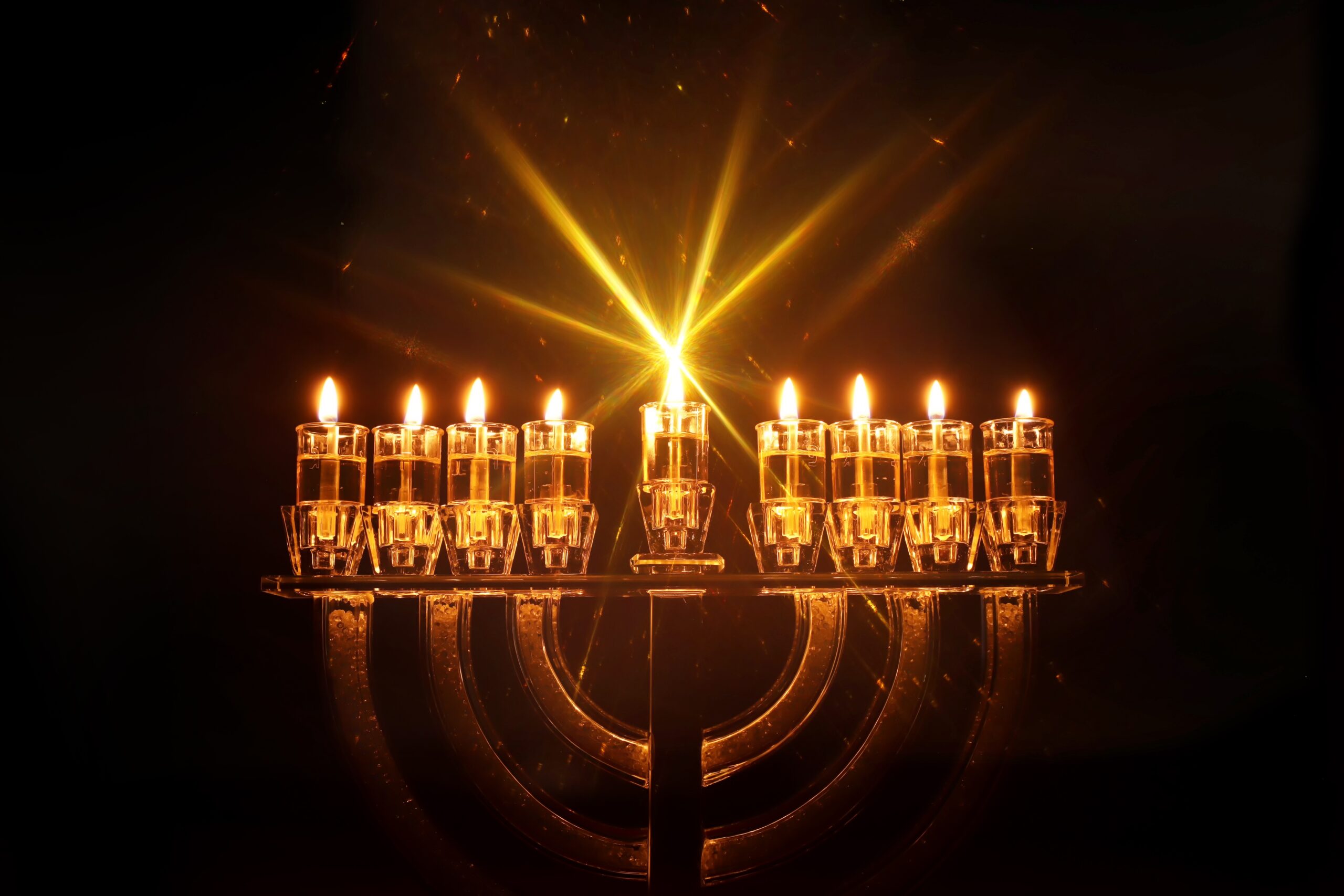
Returning from a recent speaking tour across the US, I was overwhelmed by how many times I spoke about the significance of Chanukah to Christians. Chanukah is the Jewish holiday to which Christians are the least connected. Part of it is that it’s not one of the big three Biblical pilgrimage holidays – Passover, Shavuot (Pentecost), and Sukkot (Tabernacles). Part of it is that it is celebrated in the late fall and early winter, and overshadowed by Christmas. Even in countries, cultures, and communities where public celebration of Jewish holidays is not forbidden, albeit more dangerous, many view Chanukah as a Jewish Christmas.
Many associate the light of Chanukah and the various metaphors around it with the light of Jesus. Especially in the world today, and particularly in Israel and pro-Israel audiences since the October 7 Hamas attack and massacre, the idea that one candle, a single light, can cast away the darkness, resonates as we – Jews and Christians – are confronting the same dark, evil enemies.
As I explained in my speech, Chanukah is primarily a celebration of a military victory by the Jewish Maccabees, led by Judah, and a miracle related to the rededication of the Temple in Jerusalem after the Greek invaders desecrated it by sacrificing pigs and erecting idols. The miracle is that the only enough pure oil to kindle the menorah in the Temple was found for one day but lasted for eight days, leading to the symbolic lighting of a Chanukah menorah for eight nights, and eating tasty but unhealthy foods fried in oil.
While these are nice associations, and it’s often called the Festival of Lights, the significance of Christians connecting to Chanukah is more profound and should be illuminated, especially at Christmas.
Many people don’t know this, or know it but don’t think of it, but, interestingly, there is no reference to Chanukah in the Hebrew Bible, Tanach. Except for the Catholic church canonizing the Book of Maccabees, there is only one reference to Chanukkah in the New Testament. In John 10:22, “It was the Feast of Dedication in Jerusalem, and it was winter. And Jesus walked in the temple, on Solomon’s porch.”
I was speaking with a Christian friend the other day, and we wondered whether, when Jesus was in the Temple celebrating Chanukkah, if the tradition was already to eat fried foods. It’s something we need to research. But it’s clear that not only was he in Jerusalem, in the Temple, to celebrate Chanukah, but that for him the events of Chanukah were relatively modern history. By way of comparison, as Americans gear up to celebrate 250 years of independence, the events of the Greek invaders being defeated – and Jews not only rededicating the Temple but being able to resume Jewish worship and customs that the Greeks had banned – had taken place between 160-166 BCE, less than 200 years from when Jesus celebrated it.
One might say that Judah Maccabee was the Biblical George Washington.
When I was speaking, I would add to that association. If it had not been for Judah Macabee, there may have been no Jesus. Had the Greeks remained in control, not just occupying the Land of Israel and crushing Jewish practices and culture, minimally Jewish life in the First Century would have been radically different.
If the Greeks had won and remained, and had nearly two centuries to eviscerate Jewish life, who’s to say that Mary or Joseph would have even been alive? Or if Jesus had been born, would the apostles have been born? As an Orthodox Jew, would the Greeks have allowed him to preach? Even if all of this had occurred, with no Jewish practices in the Temple and a fully Hellenized Jewish life, how much of the New Testament accounts of Jesus and his ministry would have been different—or even possible—without the victory of Judah Maccabee and his brothers?
Of course, God can do any miracle He wants, so it’s never possible to say never. But intuitively and historically, barring a wide sweeping set of miracles, it’s safe to say that without Judah, there would have been no Jesus.
There’s another reason Christians should connect with Chanukah beyond the metaphor of light and darkness. The story of the Maccabees, which the Catholic church embraces as biblical truth and is an indisputable historical reality, also depicts that the Jewish people are the indigenous people of the Land of Israel. The Greeks were foreign occupiers, as were the Romans who followed and renamed Judea, Palestina. The Romans were followed as foreign occupiers by the Byzantines, and then by early Moslem conquerors. The Crusaders pushed out the Moslems, and were followed by the Ayyubid and Mamluk, and then the Ottomans, until the British in the early 20th century and the restoration of Jewish sovereignty.
Historically, it’s indisputable that all these were foreign occupiers. The Jewish people remained indigenous, albeit subjugated, for two millennia.
It’s the same sources of darkness today that need to be cast out, which deny and undermine Jewish history, and therefore undermine the New Testament accounts of Jesus as a First Century Jew. When anti-Israel voices today dispute Jewish history in the Land of Israel and say that there was no Temple, and it’s the Jewish people who are desecrating the Temple Mount today, they deny Biblical and historic truth. It’s a narrative of lies with no foundation, one that undercuts both Judaism and Christianity.
Indeed, if the Greeks had eradicated the Temple and Jewish life, as they intended before the military victory of Chanukah—an outcome modern antisemites still seek—where would Jesus have overturned the tables of the money changers?
Once, in a briefing and prayer event with Christian leaders throughout Africa, a pastor who did not know the significance of Chanukah said that it sounded like such an important holiday, we should celebrate it more often. While charming, that’s not the answer. Rather than conflating the festival of light to be about Jesus, Christians should connect with and celebrate Chanukah – as Jesus did – because without Chanukah, there may not have been a Jesus.
Metaphors of light and darkness are nice and feel good. But the reality is that Chanukah was an essential military victory against an enemy that’s similar to the one we face today, and who we – as Jews and Christians – need to rise up against together, and defeat.