

In the rolling hills of Canaan, after decades of trials, exile from his homeland, deceit at the hands of Laban, the wrenching loss of Rachel, and reconciliation with Esau, Jacob yearned for peace. He had built his family, weathered storms, and returned to the land of his fathers. Who could blame him for seeking to dwell securely, to “settle” as the Torah describes in Genesis 37:1? Yet, this moment of intended tranquility became the threshold of greater upheaval: the sale of Joseph, descent into Egypt, and ultimately, the miraculous Exodus that revealed God’s power not just to Israel, but to the entire world.
Jacob’s story whispers a timeless truth: True settlement in the Land is not about retreating into comfort amid challenges. It is about aligning with a divine purpose that extends far beyond our borders. Today, as Jews return to Israel in fulfillment of ancient prophecies, we must affirm that living in the Land is no mistake. It is a commandment, a blessing, and a step toward redemption. Views that once questioned this, held by some groups in the diaspora, are evolving as the reality of our homeland draws hearts closer. But here’s the heart of the matter: Settlement without sanctuary risks missing the point. Like Ezra and the returnees from Babylonian exile, who wasted no time in restoring the altar and laying the Temple’s foundations despite opposition (Ezra 3), we are called to prioritize God’s House, a beacon not just for us, but for all nations.
Consider Joseph’s journey as a blueprint. Cast into servitude in a foreign land, he did not merely survive. He thrived, blessing every household he served: Potiphar’s, the prison warden’s, and Pharaoh’s own (Genesis 39:2-5). “The Lord made all that he did prosper in his hand,” the Torah recounts. This was not coincidence. It stemmed from a deep ethic of care for others, perhaps rooted in the teachings of Shem and Eber, the ancient academies that preserved a “Torah of Exile,” principles of integrity and service amid dispersion. Joseph’s dreams, prophetic visions of stars and sheaves bowing, pointed not only to his personal rise but to an end-times fulfillment where blessings flow outward.
Jews have echoed this pattern throughout history. Scattered among nations, we have managed “houses” with remarkable success, from the courts of medieval Europe to the boardrooms of modern America, infusing innovation, ethics, and prosperity wherever we go. Yet, like Joseph, we have often faced false accusations and expulsions, reminders that our role is not perpetual wandering but preparation for a greater gathering. In exile, we learned to think beyond ourselves, to steward the welfare of our hosts. Now, back in the Land, that lesson must evolve: Not isolation in our victories, but extension of that blessing to a world starving for spiritual direction.
In our contemporary reality, Israel stands as a miracle, a nation reborn, defending itself against existential threats while achieving technological and cultural wonders. We have won big battles, built thriving communities, and nurtured families in the face of adversity. But amid this hard-earned stability, a subtle shift can occur: We nuzzle into routines, fearing world leaders more than revering the Divine, content to live among lingering shadows of enmity without fully igniting the light we are meant to share. The world today gropes in moral twilight, unaware of the God who split seas and thundered at Sinai. Nations need a compass, a House where they can encounter that wonder, not as intruders, but as cherished guests.
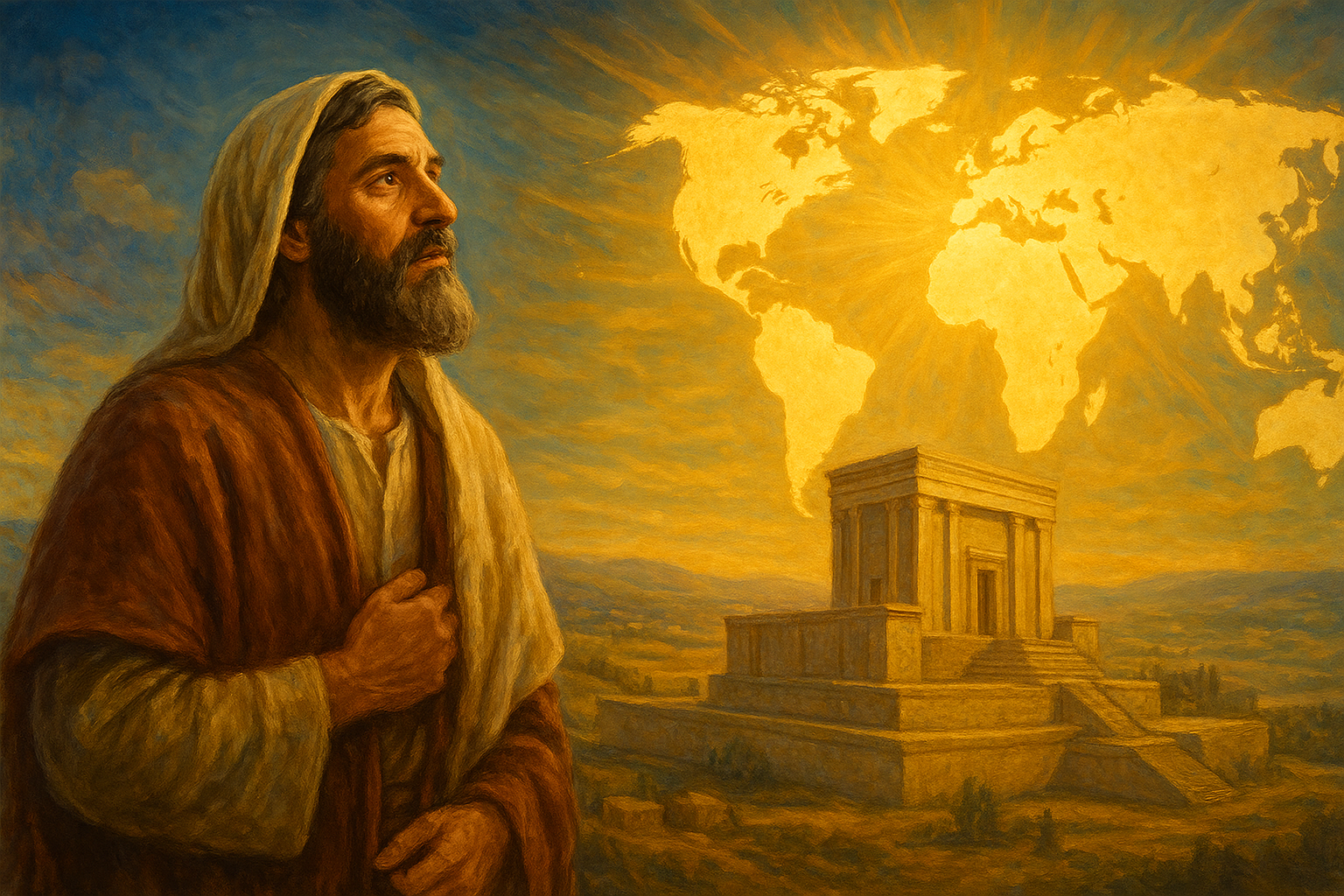
This is where the prophets’ vision comes alive. Isaiah declares, “My house shall be called a house of prayer for all peoples” (Isaiah 56:7). King Solomon, dedicating the First Temple, prayed explicitly for the foreigner who turns toward it, that “all the peoples of the earth may know Your name and fear You” (1 Kings 8:41-43). Even in the sages’ teachings, the Temple is not an exclusive club. It is humanity’s spiritual epicenter, with Israel as its devoted servant. Ramban and others emphasize that our offerings and rituals radiate outward, drawing Gentiles to recognize the One God. In Zechariah’s prophecy (14:16), survivors of the nations ascend to Jerusalem yearly, transforming potential conflict into communal celebration.
Yet the path to that House remains blocked by a deeper impurity, the spiritual corpse contamination that has lingered since the destruction of the Second Temple. The Torah teaches that voluntary offerings, the free-will gifts of the heart, require the ashes of the red heifer for purification (Numbers 19). Many have waited for that perfect red heifer to appear as a sign. But perhaps the order is reversed. The obligatory altar offerings, the tamid and musaf sacrifices commanded daily and on festivals, remain binding upon us even now. Though current authorities withhold permission, this refusal stands in error against the Torah’s clear mandate. Even the pagan king Cyrus, whom Hashem called “My anointed” (Isaiah 45:1), issued a decree allowing the Jews to return and rebuild the Temple, explicitly authorizing the resumption of offerings. Today’s leaders in Israel, who bear the responsibility of a sovereign Jewish state, fall short of that standard when they hinder what the Torah requires. When we earnestly pursue what is required of us today, rebuilding the altar through sincere advocacy and preparation, placing God first in our national priorities, then Hashem may grant the red heifer, clearing the way for full purification, voluntary korbanot, and the ultimate restoration of the House of Prayer for all nations.
Ezra’s generation understood this urgency: Upon return, they rebuilt the altar “as it is written” (Ezra 3:2), even before walls or homes, placing God first to invite divine presence back. The time is now. We do not rebuild through force or folly, but through teshuvah, returning to Hashem with hearts aflame. Imagine: An Israel that prioritizes spiritual restoration, where Torah study groups welcome seekers from afar, where ethical innovations in tech, medicine, and ecology embody divine wisdom for global good, and where acts of kindness bridge divides. By serving as custodians of this universal sanctuary, we fulfill Joseph’s prophetic arc, blessing the “master’s house” that is the world Hashem loves so dearly. No longer do we risk corrective exiles. Instead, we co-author a voluntary Exodus, where nations stream to Sinai not in chains, but in awe.
This is not about abandoning the Land, far from it. It is about inhabiting it fully, as commanded, with eyes on the horizon. When we put God’s House first, we honor the struggles of Jacob, Joseph, and Ezra. We transform settlement from mere survival to sacred service. And in that shift, the flicker of Hashem’s fear becomes a blazing light, drawing all peoples to witness His love. Let us move forward together, not in complacency, but in courage, rebuilding, revealing, and redeeming. The world awaits, and so does our destiny.