




Massive foundations uncovered beneath a park in Alexandria may belong to the royal tomb built by Ptolemy IV, the Greek ruler who stormed the Temple in Jerusalem, and possibly the resting place of Alexander the Great. The Greek empires the Maccabees defeated are rising from the earth as Jews prepare to light the menorah.
A Greek archaeological mission has uncovered the foundations of a massive limestone building in the ancient royal quarter of Alexandria, Egypt, that may be the long-lost royal tomb of the Ptolemies, the Greek dynasty that ruled Egypt and the Land of Israel after the death of Alexander the Great. Egypt’s Ministry of Tourism and Antiquities announced the discovery on November 24.
The remains lie beneath the Shallalat Gardens, a public park in the center of the modern city. The excavation uncovered the limestone foundations of a large building surrounded by walls, with a tunnel running north beneath it. The square shape of the foundations indicates they once supported a large, tall structure.
The dig is led by Kalliopi Limnios-Papakosta of the Hellenic Research Institute of the Alexandrian Civilization, who has excavated the site for about 20 years in search of the lost tomb of Alexander the Great. Minister of Tourism and Antiquities Sherif Fathy appointed a committee of specialists in Greek and Roman history and archaeology from the universities of Alexandria and Tanta to examine the find. The committee, headed by Ayman Ashmawy of Egypt’s Supreme Council of Antiquities, concluded that the building’s features point to a possible funerary purpose. If confirmed, the structure could be the royal tomb of Ptolemy IV Philopator, who ruled from 221 to 204 BCE, as described by the ancient geographer Strabo.
The committee stressed that the identification is a preliminary hypothesis. Ashmawy said further excavation and architectural study are needed to determine the building’s function and its relationship to nearby structures. Hisham El-Leithy, secretary-general of the Supreme Council of Antiquities, said the discovery “opens new avenues for research into royal structures” in Ptolemaic Alexandria.
The Tomb That Held Alexander
The stakes are enormous. According to ancient historians, Ptolemy I, one of Alexander’s generals, seized the conqueror’s body after his death in 323 BCE and brought it to Egypt. Ptolemy IV later built a grand mausoleum in Alexandria’s royal quarter, known as the Sema, where he gathered the bodies of his ancestors and laid Alexander to rest among them. Roman emperors, including Augustus, visited the tomb. By the fourth century CE it had vanished, and its location has remained one of archaeology’s great mysteries ever since. A royal tomb of Ptolemy IV is the strongest candidate for Alexander’s final resting place.
The King Who Tried to Enter the Holy of Holies
For Jews, Ptolemy IV is far more than a name on a tomb. He stands near the beginning of the story that ends with the miracle of Hanukkah.
In 217 BCE, Ptolemy IV defeated the Seleucid king Antiochus III at the Battle of Raphia, near today’s Gaza border. According to the Third Book of Maccabees, a Jewish work written in Hellenistic Alexandria, the victorious king then came to Jerusalem and demanded to enter the Holy of Holies, the innermost chamber of the Temple where only the High Priest could go, and only on Yom Kippur. The priests and the people of Jerusalem cried out in prayer. As the king pressed forward, he was struck down and collapsed, and his attendants dragged him away.
According to the same account, the humiliated king returned to Egypt and took his revenge on Alexandria’s Jews. He ordered them rounded up in the city’s hippodrome to be trampled by drunken war elephants. The elephants turned instead on the king’s own soldiers, and the Jews of Alexandria established a festival to celebrate their deliverance.
The Third Book of Maccabees is outside the Hebrew Bible, and historians debate how much of its account took place. The Jewish historian Josephus tells a similar story of elephants turning on their handlers, but places it under a later king, Ptolemy VIII. Whatever its details, the story preserves the memory of a Greek king of Egypt who reached for the holiest place in Jerusalem and was thrown back.
From Alexander to Antiochus
The prophet Daniel saw the entire rise and fall of the Greek empire centuries before it happened. In his vision, a he-goat charged from the west, moving so fast it did not touch the ground, and shattered a ram with two horns, representing the Persian empire. Then the goat’s great horn broke, and four horns rose in its place. The angel Gabriel explained the vision:
“And the rough he-goat is the king of Greece; and the great horn that is between his eyes is the first king. And as for that which was broken, in the place whereof four stood up, four kingdoms shall stand up out of the nation, but not with his power” (Daniel 8:21-22).
The great horn is Alexander. When he died at 32, his empire was carved up among his generals. Two of those kingdoms shaped the history of the Jewish people: the Ptolemies in Egypt and the Seleucids in Syria. Daniel 11 describes their wars in detail as the struggle between “the king of the south” and “the king of the north,” with the Land of Israel trapped between them. Judea belonged to the Ptolemies for more than a century, until Antiochus III of the Seleucids took it around 200 BCE.
His son, Antiochus IV Epiphanes, outlawed the Shabbat, circumcision, and Torah study, and set up an idol in the Temple in 167 BCE, the abomination Daniel foresaw: “and they shall profane the sanctuary, even the fortress, and shall take away the continual burnt-offering, and they shall set up the detestable thing that causeth appalment” (Daniel 11:31). Three years later, on the 25th of the Hebrew month of Kislev, the Maccabees liberated Jerusalem, purified the Temple, and relit the menorah. The single cruse of pure oil burned for eight days.
Alexander Bowed in Jerusalem
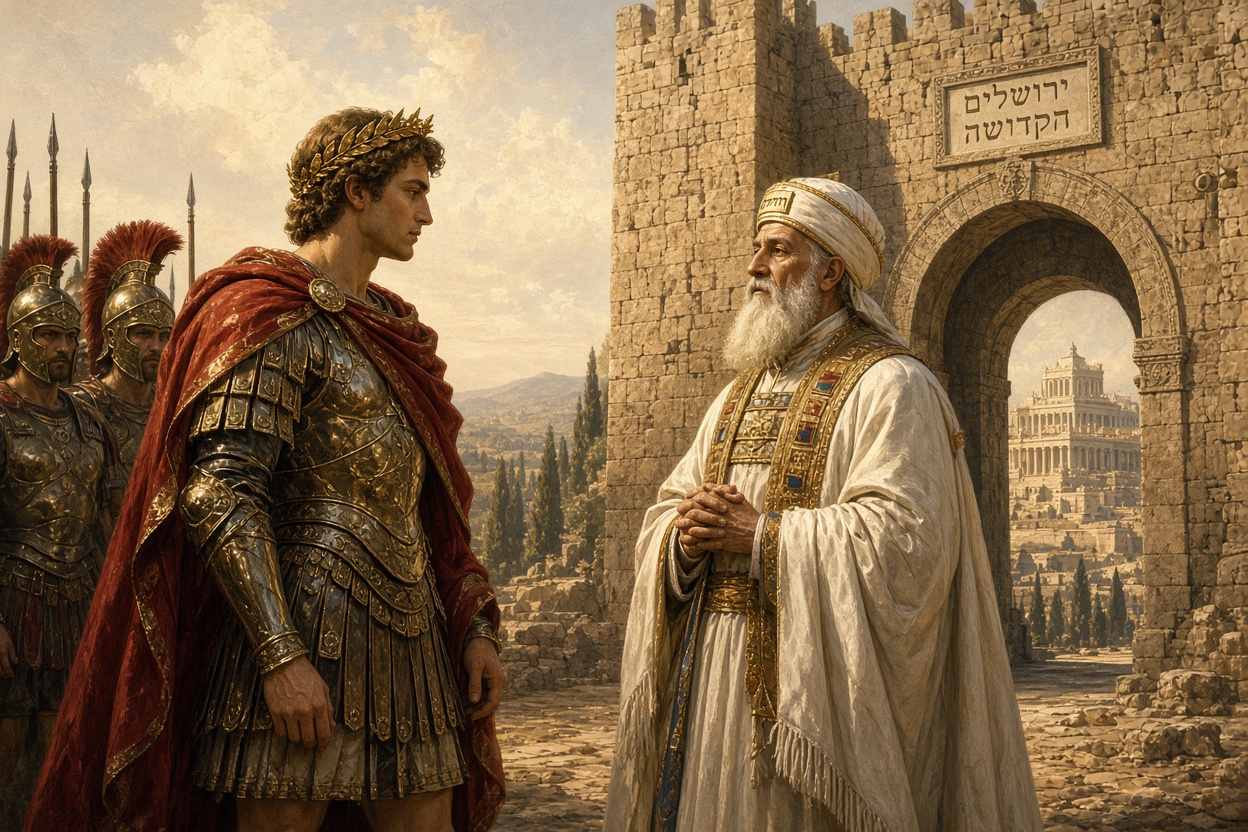
The Sages preserved their own memory of Alexander. The Talmud (Yoma 69a) records that when Alexander marched toward Jerusalem, the High Priest Shimon HaTzaddik (Simon the Just) went out to meet him dressed in his priestly garments. When Alexander saw him, he stepped down from his chariot and bowed before him. His astonished officers demanded to know why the master of the world bowed to a Jew. Alexander answered that the image of this man appeared before him in his victories on the battlefield. The day became a minor festival in the Jewish calendar.
The Talmud’s verdict on Alexander’s successors was harsh. The Ptolemies brought the Greek world into the heart of Jewish life. The Talmud (Megillah 9a) relates that King Ptolemy, called Talmai in rabbinic literature, gathered 72 elders, placed each in a separate room, and ordered each to translate the Torah into Greek. The Sages recorded that each translator was inspired to make the same changes. The translation became the Septuagint. Tractate Soferim (1:7) compares the day the Torah was translated into Greek to the day the Israelites made the golden calf, and the 8th of Tevet, the date tradition assigns to the translation, was later marked as a day of mourning.
Greece Was Darkness
The Midrash (Bereshit Rabbah 2:4) reads the second verse of Genesis as a map of the four exiles. “Darkness was upon the face of the deep” refers to Greece, which darkened the eyes of Israel with its decrees. The Greek empire sought to replace the light of the Torah with the light of human reason and to make the Jewish people forget the covenant. In the Al HaNissim prayer recited throughout Hanukkah, Jews thank God for the days when “the wicked Greek kingdom rose up against Your people Israel to make them forget Your Torah.”
The Greeks built the most magnificent city of the ancient world in Alexandria, with its lighthouse, its great library, and the tomb of the man who conquered the known world. That city now lies buried under five million people, and archaeologists dig through a public park to find a few foundation stones. The menorah the Greeks tried to extinguish stands lit in Jerusalem, and in a few days Jews around the world will kindle the Hanukkah lights in their windows.
The Talmud teaches that the Hanukkah lights are placed at the entrance of the home, facing outward, pirsumei nisa, to publicize the miracle. This Hanukkah, as the bones of Greek kings come up from the earth, the lights carry a fresh message: the empire that tried to darken Israel is buried in Alexandria’s soil, and the light of the

