



Arab attackers poisoned the herd at a Jewish farm in northern Samaria as the campaign of “agricultural terror” spreads from Binyamin to the Mount Hebron region
Arabs poisoned the cattle herd at the Jewish Har Bezek Farm in northern Samaria this week, killing five cows and leaving several more dying, the Judea and Samaria Situation Room (JSR) reported on Wednesday. The group posted video of the dead and dying animals under a warning of disturbing footage. “Arab attacks on animals continue in Judea and Samaria,” JSR wrote.
Five cows dead, more dying in agony, after being deliberately poisoned by Palestinian attackers at Har Bezek Farm in Samaria.
— Israel Foreign Ministry (@IsraelMFA) November 25, 2026
Torturing innocent animals to drive Israeli farmers off their land is terror. https://t.co/xJcdehRNlH
Another JSR report described a second attack in the Mount Hebron region, where Arabs poisoned a guard dog belonging to a Jewish farm. The dog was rushed to a veterinary clinic and is in serious condition.
𝗔𝗿𝗮𝗯 𝗔𝘁𝘁𝗮𝗰𝗸𝘀 𝗼𝗻 𝗔𝗻𝗶𝗺𝗮𝗹𝘀 𝗖𝗼𝗻𝘁𝗶𝗻𝘂𝗲 𝗶𝗻 𝗝𝘂𝗱𝗲𝗮 𝗮𝗻𝗱 𝗦𝗮𝗺𝗮𝗿𝗶𝗮!
— JSR – The Judea & Samaria Situation Room (@JSR_EN) November 25, 2026
Arabs poisoned a dog from Man Farm in the Mount Hebron region.
The dog was taken to a veterinary clinic and is in serious condition.
𝗝𝗦𝗥 𝗦𝗶𝘁𝘂𝗮𝘁𝗶𝗼𝗻 𝗥𝗼𝗼𝗺 pic.twitter.com/IQfWQuQeiT
Har Bezek Farm, also known as the new Amiel Farm, was founded in 2025 on Ras a-Salameh, a peak just south of the 713-meter summit of Mount Bezek. The mountain links the Gilboa Ridge to the hills of Samaria and overlooks the Jezreel Valley, the Jordan Valley, the mountains of Gilead, and the Lower Galilee. The town of Tubas sits below it.
Until roughly a year ago, the mountain served as a main smuggling route into Jenin, which organizers of farm tours in the region call the capital of terror. Golani recruits once trained on its trails until the army abandoned its bases there under the Oslo Accords. The IDF has since returned, and four new Jewish farms now ring the mountain.
A campaign of poison
The Har Bezek attack is the latest in a long run of poisonings aimed at the Jewish chavot (farms) of Judea and Samaria. Hatzalah Yosh, the region’s rescue organization, counted 19 poisoning incidents at farms since the start of the year, according to Walla. In late October, after a flock was poisoned at Or Nachman Farm near the Arab village of al-Mughayyir, Israel’s Foreign Ministry declared that Palestinian attackers had targeted livestock for the 17th time this year.
The poisonings are part of a broader surge. JSR recorded 634 incidents of terrorism and violence against Jews in Judea and Samaria during the olive harvest season, from September 20 to November 22. That figure is 159 more than the 475 incidents JSR logged in the two months before, a jump of about 33.5 percent. Among the victims was a Jewish shepherd wounded in an Arab stone-throwing attack on October 31.
“Sheep poisoned and left to die,” the ministry wrote on X. “This is calculated cruelty. Poisoning innocent animals to inflict suffering on the people who care for them. A vicious act of violence. No excuses. No justification.”
JSR reported at the time that most of this year’s poisonings originated from al-Mughayyir. The Binyamin Regional Council documented at least 11 incidents between June 2025 and September of this year at the farms between al-Mughayyir and Alon Road, in which dozens of sheep, goats, cows and dogs were killed or sickened.
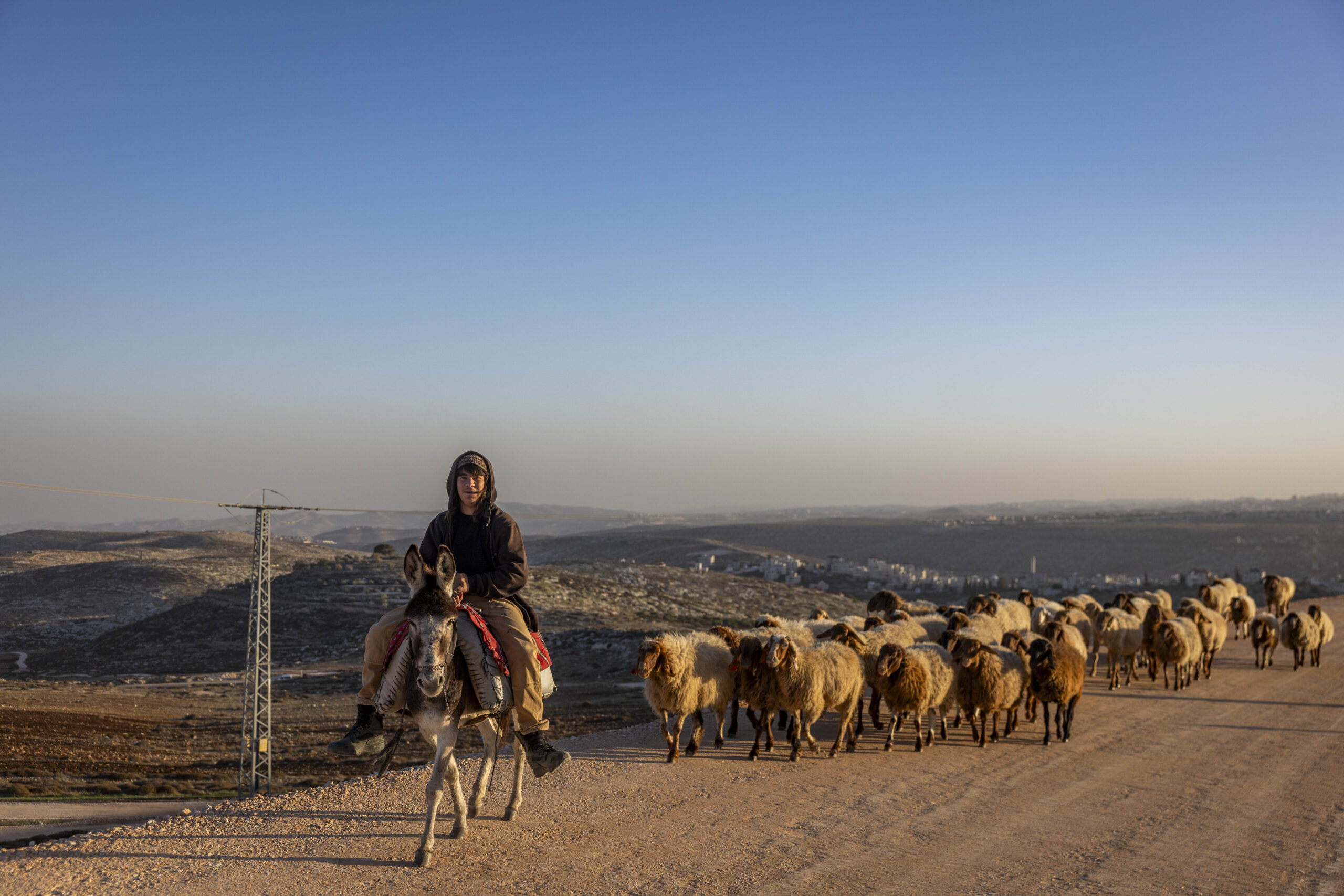
The attacks have reached the northern Samaria farms before Har Bezek. At the Shuva Israel farm east of Homesh, built to connect Mount Bezek and Mount Gadir with the communities of northern Samaria, residents have recorded at least four poisonings in which cows, goats and sheep died, along with another attempted poisoning.
In July, two guard dogs at Givat Tel Talpiot near Shiloh collapsed and died within minutes of reaching poisoned bait laid ahead of the flock. “The terror of poisonings has become the enemy’s weapon of choice, and the defense establishment treats it with indifference,” residents of the hilltop told Channel 14. “This has become a fixed pattern.”
Last week, an Israeli security source told Fox News Digital that military officials now describe the poisonings as “agricultural terror.” The source spoke of “dozens of cases as we have seen in recent weeks.”
Evyatar Karo of Metzudat David Farm in Binyamin described what the poison does. “We lost 25 animals. It’s a terrible thing. The animals just die in your hands. They scream and cry. You can see them choking. It’s a horrible substance,” he said. Karo identified one of the poisons as Lannate, a carbamate insecticide, used in highly concentrated form. “The poison is lethal,” he said. “It starts with animal lives, but eventually they can hurt people.”
Yisrael Ganz, head of the Binyamin Regional Council and chairman of the Yesha Council, warned that the attackers are testing a weapon. “They killed goats, dogs and cows,” Ganz said. “If they’re able to poison our water sources, they could hurt thousands of people.” He said donors had funded dozens of body cameras for shepherds as an immediate response, and stressed that the cameras cannot replace action by the authorities.
COGAT told Fox News that the Civil Administration “takes reports of suspected poisoning involving grazing areas, water sources or animals very seriously,” and that investigation and enforcement fall to the Israel Police. Palestinian Authority media have answered with accusations of their own. The PA news agency WAFA quoted a sheep owner near al-Auja, north of Jericho, who claimed that settlers sprayed toxic substances where his flock grazed. Farmers in Judea and Samaria note that despite the steady stream of attacks on Jewish herds over the past year, arrests remain rare.
Oxen at Bezek
The name of the mountain where the cows died carries one of the most dramatic cattle stories in the Bible.
Early in Saul’s reign, Nahash the Ammonite besieged the Israelite town of Jabesh-Gilead across the Jordan and offered its people surrender on one condition: he would gouge out every man’s right eye as a disgrace upon all Israel. The elders sent messengers to Saul’s hometown of Gibeah. The messengers found the new king coming in from the field behind his oxen. When Saul heard the news, the spirit of God came upon him, and he turned his own herd into a summons to war.
“And he took a yoke of oxen, and cut them in pieces, and sent them throughout all the borders of Israel by the hand of messengers, saying: ‘Whosoever cometh not forth after Saul and after Samuel, so shall it be done unto his oxen.’ And the dread of the LORD fell on the people, and they came out as one man.” (1 Samuel 11:7)
The tribes answered. “And he numbered them in Bezek; and the children of Israel were three hundred thousand, and the men of Judah thirty thousand” (1 Samuel 11:8). From Bezek, Saul crossed the Jordan, broke the siege at dawn and saved Jabesh-Gilead. The small Bedouin village of Abziq on the mountain today still carries the ancient name.
Bezek appears earlier in the Bible as well. After Joshua’s death, “Judah went up; and the LORD delivered the Canaanites and the Perizzites into their hand; and they smote of them in Bezek ten thousand men” (Judges 1:4).
The biblical oxen at Bezek were an alarm. Saul cut up his own animals so that every tribe would see that an enemy threatened all of Israel and that standing aside was no longer an option. The cows lying dead at Bezek this week send the same message. The attackers are aiming at Jewish livelihoods and at the Jewish presence on the land, and Ganz and Karo have both warned that people are the next target.
The Bible treats cruelty to animals as a measure of the soul. “A righteous man regardeth the life of his beast; but the tender mercies of the wicked are cruel” (Proverbs 12:10). The Sages derived from the Bible a prohibition called tza’ar ba’alei chayim, causing suffering to living creatures, and they ranked it as a commandment of the Bible itself. A Jew may not leave an animal in pain. The men who laid poison for the herd at Bezek chose the cruelest death they could find for animals that had done them no harm, and they chose it precisely because the Jewish farmers love those animals.
The farmers of Har Bezek returned to a mountain that Israel had abandoned under Oslo. Three thousand years after a farmer-king numbered the tribes of Israel on that same ground, Jews are again herding cattle on Bezek. The dead cows are a summons, and the people of Israel are being called to answer it as one man.

“They had no defense”: Palestinian Authority quietly pays Rabbi Leo Dee over murder of his wife and daughters
Sarah Katz