




A red-flanked bluetail bound for China flew thousands of kilometers off course and came down near Moshav Ashalim. It is only the third ever recorded in Israel. The Sages teach that the birds went into exile with Israel and came back when the Temple’s foundations were laid.
A tiny blue-tailed songbird that hatched this summer in the forests of northern Russia, bound for Southeast Asia, landed last Friday in a grove near Moshav Ashalim in the Negev, thousands of kilometers off course. The Talmud teaches that when the Babylonians destroyed the First Temple, the birds went into exile with the Jewish people, and for 52 years not a single bird flew over the Land of Israel. They came back only when the exiles returned to lay the foundations of the Second Temple. Each new species now arriving in the Land is a sign that it is being prepared for the Third Temple.
Birder Andrea Diak spotted the red-flanked bluetail (Tarsiger cyanurus) on November 20. According to the Israeli news site Srugim, it is only the third time the species has been recorded in Israel. The Society for the Protection of Nature in Israel (SPNI) called it “a truly special bird.”
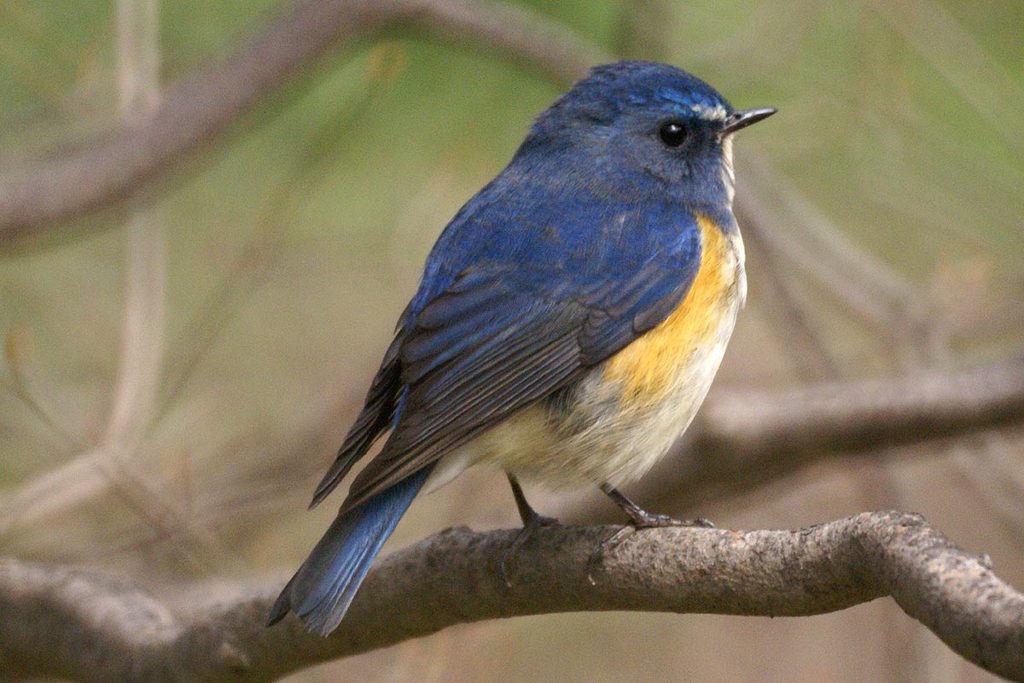
The bluetail breeds in the taiga forests of northern Russia, with a small population in Finland. Adult males have bright blue upperparts. Females and young birds like this one are gray above with a blue tail. It feeds on insects and other small invertebrates.
“Their regular migration route runs southeast, to southern China and Southeast Asia,” said Dr. Yoav Perlman, director of SPNI’s Israel Ornithological Center. He explained that long-distance migrants, especially young ones, can wander: “straying from the migration route can lead them to destinations very far from the original direction.”
Perlman praised the birders who came to see the visitor. He said they kept their distance and let the bird, exhausted from its journey, rest undisturbed.
A bridge in the sky
The lost bluetail landed in one of the busiest bird corridors on earth. About 500 million birds from roughly 550 species pass over Israel each year, according to the Israel Ornithological Center. The Land sits where Europe, Asia and Africa meet, and the narrow strip between the Mediterranean Sea and the deserts to the east funnels the birds through its airspace twice a year.
“Every year, some half a billion birds pass through our country out of about 11 billion migratory birds worldwide, twice each year, in autumn and spring,” an Israeli ornithologist told Ynet this fall. “That makes us a true migration super-power.” Israel’s Foreign Ministry has described the African-Eurasian flyway that crosses Israel as the second most important migration route in the world.
In autumn, most of the birds head south to winter in Africa. In spring, they return north to breed in Europe and Asia. Large birds such as storks, pelicans and eagles ride rising columns of warm air by day and avoid crossing open sea, which forces them over the land bridge of Israel. Small songbirds like the bluetail fly under their own power, mostly at night.
Some species cross Israel almost in their entirety. About half a million white storks stop in the Land to rest and feed, nearly the whole population from Europe and Asia. Some 40,000 of the world’s 250,000 to 300,000 pelicans fly over Israel in each direction. Tens of thousands of cranes winter in the Hula Valley.
The traffic is heavy enough to endanger pilots. A joint study by the Israeli Air Force and SPNI produced flight rules that cut collisions between aircraft and birds by 88 percent.
When the birds fled the Land
The skies over Israel were once empty. The prophet Jeremiah, mourning the coming destruction of Jerusalem, described a land abandoned even by its wildlife:
For the mountains will I take up a weeping and wailing, and for the habitations of the wilderness a lamentation, because they are burned up, so that none can pass through them; neither can men hear the voice of the cattle; both the fowl of the heavens and the beast are fled; they are gone. (Jeremiah 9:9)
The Sages understood that the birds went into exile along with the Jewish people. The Talmud (Shabbat 145b) raises the question while discussing why the birds of Babylonia were so plump, and the answer given is that they had never been exiled. The Gemara then asks whether the birds of the Land of Israel went into exile. It answers yes, citing Rabbi Yehuda: for 52 years after the Babylonians destroyed the First Temple, no bird was seen flying over the Land of Israel. He derives the number from the Hebrew word behemah, “beast,” in Jeremiah 9:9, whose letters add up to 52.
In the Sages’ reading, the of hashamayim, the birds of the heavens, shared the fate of the people of Israel. When the Jews were driven out, the creatures of the Land left with them, and the Land stood empty of both.
The birds’ exile ended when the people’s exile ended. Rashi, Rabbi Shlomo Yitzchaki, the foremost commentator on the Talmud, explains exactly where the 52 years fall. They run, he writes, “from when they were exiled in the days of Zedekiah, at the destruction of Jerusalem, until they were remembered in the days of Cyrus, and then some of them went up to found the House.” Rashi adds that this was 18 years before the Second Temple was completed at the end of the 70 years of exile, in the second year of Darius, citing the Talmud in Megillah 11b.
The birds’ return did not wait for the completed Temple. They came back to the Land in the same years the first exiles went up under Cyrus to lay its foundations, l’yased et habayit, “to found the House.”
The connection between the birds and the House of God runs through the Bible. King David described the birds making their home at the Temple altar:
Yea, the sparrow hath found an house, and the swallow a nest for herself, where she may lay her young, even thine altars, O LORD of hosts, my King, and my God. (Psalms 84:4)
Birds were part of the Temple service itself. Turtledoves and young pigeons were brought as offerings, and they were the sacrifice of the poor, who could not afford a sheep or a goat. A Temple without birds was missing part of its service. A Land without birds was a Land without a Temple.
The Sages taught that the Land itself announces the redemption. In the Talmud (Sanhedrin 98a), Rabbi Abba says there is no clearer sign of the end of exile than Ezekiel’s promise to the mountains of Israel: “But ye, O mountains of Israel, ye shall shoot forth your branches, and yield your fruit to my people of Israel; for they are at hand to come” (Ezekiel 36:8). When the Land comes back to life, the people and the Temple are close behind.
The prophets promised that the return would come the same way, with the people and the creatures together. Hosea foretold a renewed covenant with the natural world:
And in that day will I make a covenant for them with the beasts of the field, and with the fowls of heaven, and with the creeping things of the ground: and I will break the bow and the sword and the battle out of the earth, and will make them to lie down safely. (Hosea 2:18)
Isaiah compared the returning exiles to birds streaming home: “Who are these that fly as a cloud, and as the doves to their windows?” (Isaiah 60:8). The Bible connects kibbutz galuyot, the ingathering of the exiles, to the flight of birds returning to their nests.
Creatures returning to the Land
The bluetail joins a long line of creatures that have found their way back to the Land of Israel, and Israel365 News has tracked them.
In 2016, a Canadian couple, Gil and Jenna Lewinsky, flew a flock of Jacob’s Sheep to Israel, a rare spotted breed they believe descends from the flock of the patriarch Jacob. A mystical rabbi, Rabbi Vaknin, told them that bringing the sheep to Israel would be “an essential part of the geula,” the redemption. The first 119 sheep landed on November 30 of that year, the same day the rains finally broke a long drought.
In 2023, flamingos that had once only passed through began staying. “They used to pass through during the two migration seasons,” Inbar Shlomit Rubin of the KKL-JNF Hula Lake Park explained, and several hundred began remaining in Israel longer than ever. In 2013, a rare black flamingo, the only one known in the world, settled in Eilat for two years.
The sea has followed the sky. In October 2025, a whale shark nicknamed Ofek became the first documented on Israel’s Mediterranean coast. In June 2026, researchers recorded sperm whales 35 kilometers west of Ashdod, recalling the Leviathan that the Sages say will be served at the feast of the righteous. This month, several dozen endangered sharks returned to the warm waters off Hadera for the winter, as the prophets foretold that fish would fill the Land’s waters. Last week, a video of Indonesian children playing on a giant python brought Isaiah’s vision of the nursing infant and the serpent to life.
The Negev itself is part of the story. Israel365 News reported this year on five new communities in the South, part of a prophetic return to the desert that the Sages describe as a stage of the geula. Now a bird bound for China has come down in a Negev grove to rest.
The voice of the turtledove
King Solomon described the end of a long winter with the sound of birds:
The flowers appear on the earth; the time of the singing of birds is come, and the voice of the turtle is heard in our land. (Song of Songs 2:12)
The Midrash reads kol hator nishma b’artzenu, “the voice of the turtledove is heard in our land,” as the voice of the King Messiah announcing the redemption. After the First Temple fell, the skies of Judea stood empty for 52 years, and the birds returned as the Jews came home to rebuild. Today half a billion birds cross the Land every year, species never before recorded here keep appearing, and a young songbird from Siberia has found its way to a moshav in the Negev.
The birds went into exile with the Jewish people, and Rashi teaches that they returned in the very years the exiles went up to found the Second Temple. Their return was tied to the building of the House of God. Today, the Land the birds abandoned in the destruction has become their crossroads, and species never seen here before keep arriving. By the measure the Sages gave, the birds are announcing that the time has come to build the Third Temple.