
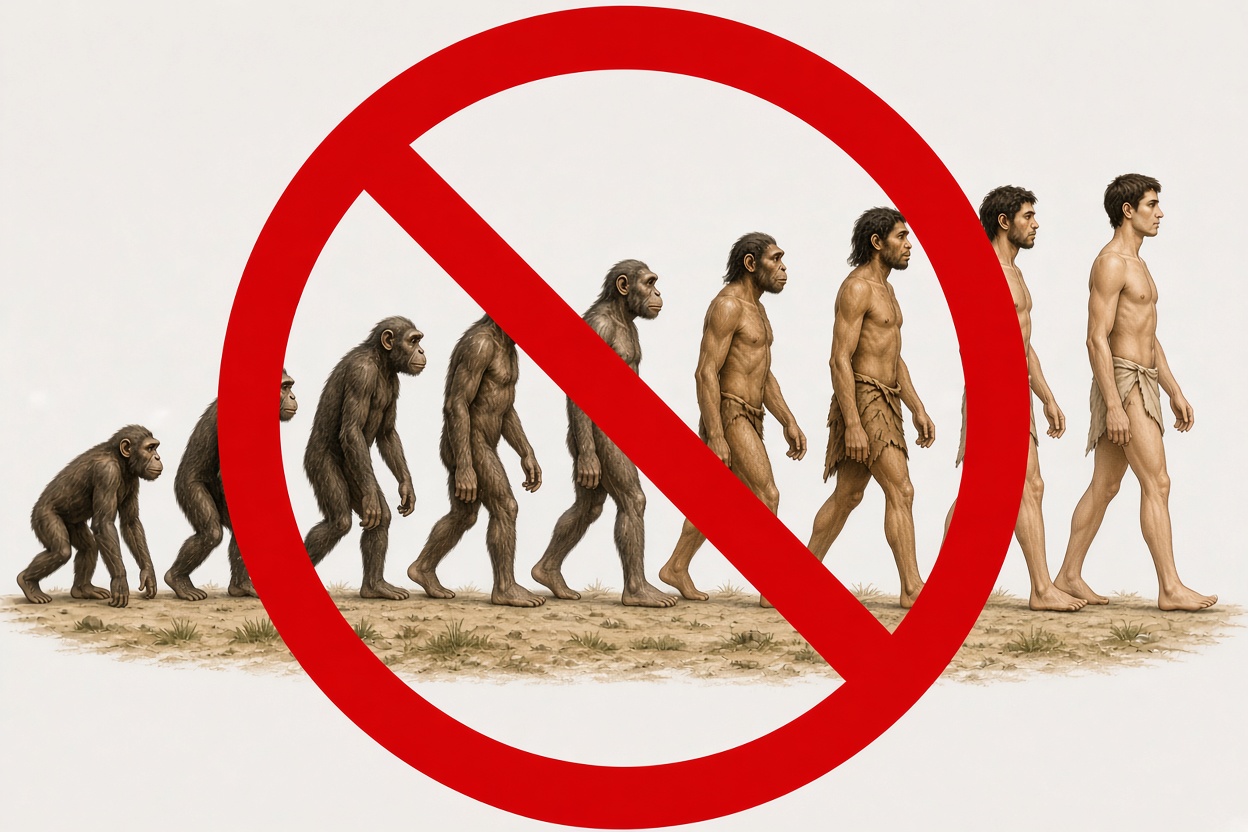
From a rewritten human family tree to a misread three-million-year-old skull, science keeps redrawing the map Darwin promised the fossils would fill in. Each new discovery moves the evidence further from blind, gradual chance and closer to the Bible’s account of a world created with purpose.
On November 24, 1859, Charles Darwin published On the Origin of Species, and evolutionists around the world mark the anniversary as “Evolution Day.” This year the celebration arrives with an awkward headline. Scientists now say the human family tree, the iconic diagram that has hung in classrooms for generations, may need a radical rewrite. In the same week, a second study found that one of the most famous fossils in the history of human evolution had been misread for a hundred years.
The first study comes from Dr. Ian Towle, a research fellow at the Monash Biomedicine Discovery Institute in Australia. In a paper titled “Clades, Grades, and the Genus Problem: A Case for Revising Hominin Taxonomy,” published in the American Journal of Biological Anthropology and featured by ScienceDaily on November 21, Towle argues that the lines scientists drew between humans and their supposed ancestors no longer hold up.
For decades, textbooks divided human ancestors into separate groups, or genera: Homo, which includes modern humans, and the more ape-like Australopithecus and Paranthropus. Towle proposes erasing those boundaries and folding every species from the past four to five million years into Homo.
“Recent fossil discoveries and advances in evolutionary and genetic analysis make this an ideal time to reconsider whether our traditional taxonomy still accurately reflects human evolution,” Towle said.
The groups scientists have used for decades, he explained, “do not necessarily represent distinct evolutionary branches, or ‘clades.'” The traits once used to separate early humans from their supposed ancestors, including large brains, sophisticated tool use and certain anatomical features, turned out to be shared more widely. Some members of Homo had surprisingly small brains. According to Towle, the “differences in behavior and ecology once used to distinguish them have also become increasingly difficult to maintain.”
“The more we learn about our ancestors and close fossil relatives, the more we realize how complex and non-linear our family tree is,” he said.
Towle’s solution makes the classification stable by making the category bigger. Expanding Homo, he said, “will allow us to account for differences without regularly reclassifying particular groups.” The proposal is an argument within evolutionary science. No scientific body has adopted it.
A child’s skull overturns a century of assumptions
The second blow came from South Africa. The Taung Child, a small fossil skull discovered in 1924, became the founding specimen of the species Australopithecus africanus and was hailed as the first concrete evidence that humanity originated in Africa. For a century, scientists classified dozens of other fossils as belonging to the same species.
A new study led by Prof. Gabriele Macho of the Vrije Universiteit Brussel dates the Taung Child to between 2.96 and 3.03 million years ago and compares its tooth structure and brain development with the other fossils. Several adult fossils long classified under the same species grew differently, suggesting they belong to different species altogether. The Taung Child now stands as the only fossil that can be identified with certainty as Australopithecus africanus. Scientists named a species and then spent a hundred years filling it with fossils that, according to this study, never belonged there.
“For over 100 years, we assumed the Taung Child was just one of many similar fossils from the era,” Macho said. “Our findings turn that on its head.”
She described what the evidence shows now: “The human family tree wasn’t a neat, straight trunk — it was a chaotic, tangled bush driven by climate shifts.”
Earlier this year, a jawbone from Egypt’s Wadi Moghra also challenged the map. Researchers led by Shorouq Al-Ashqar of Mansoura University described Masripithecus moghraensis, an ape they date to 17 to 18 million years ago, in the journal Science in March. The find suggests the ancestors of modern apes emerged in North Africa rather than East Africa, where the search has focused for decades. In a commentary in the same journal, David Alba and Júlia Arias-Martorell wrote that paleontologists “might have been looking for crown-hominoid ancestors in the wrong place.”
Darwin’s own test
Darwin himself understood that the fossil record would make or break his theory. In On the Origin of Species, he acknowledged that the transitional forms his theory required must have been “truly enormous” in number, and he asked, “Why then is not every geological formation and every stratum full of such intermediate links?” He conceded that geology reveals no “finely graduated organic chain,” and he called this “perhaps, the most obvious and gravest objection which can be urged against my theory.”
“The explanation lies, as I believe, in the extreme imperfection of the geological record,” Darwin wrote. Future discoveries, he expected, would fill in the gaps. He staked his entire theory on that explanation: “He who rejects these views on the nature of the geological record, will rightly reject my whole theory.”
The sharpest form of that problem sits at the bottom of the fossil record. In what scientists now call the Cambrian explosion, beginning about 538 million years ago, nearly all the major animal body plans that exist today appear in the rocks within roughly 13 to 25 million years, a blink in geological time. According to London’s Natural History Museum, trilobites with hard exoskeletons appear within a few million years of each other in places as far apart as Spain, Morocco, Siberia, China and Australia. Older rocks hold simpler organisms, such as the soft-bodied Ediacaran creatures, and they hold no long, gradual chain of ancestors leading to the complex animals that burst onto the scene.
Darwin knew of this sudden appearance in the lowest fossil-bearing rocks of his day, and he admitted he could not explain it. “The case at present must remain inexplicable; and may be truly urged as a valid argument against the views here entertained,” he wrote.
The Cambrian explosion strikes at the heart of the Darwinian mechanism. A theory built on random mutations accumulating slowly over immense stretches of time requires a long, gradual ramp. The rocks show a sudden burst of complex, fully formed body plans appearing all at once. Scientists still debate what triggered it, proposing rising oxygen levels, changes in ocean chemistry and genetic developments, and the question remains open more than 160 years after Darwin first raised it.
MIT-trained physicist Dr. Lee Spetner spent decades exposing the weakness at the heart of Darwinism. In his books Not By Chance! and The Evolution Revolution, Spetner showed that the random mutations scientists have actually observed destroy genetic information rather than create it. The Cambrian explosion turns that problem into a crisis. Dozens of complex body plans, each requiring enormous amounts of new genetic information, appear in the rocks within a geological instant. Gradual random mutation is the keystone of Darwin’s theory, and it is supposed to build new organs and organisms one small copying error at a time, with natural selection preserving the rare useful change. The Cambrian rocks show no trace of that slow, step-by-step ramp.
Generations of digging later, the fossils have produced the opposite of a finely graduated chain. Each major find forces scientists to redraw the tree they built from the last one.
The cracks keep widening
These studies join a long line of findings Israel365 News has covered that challenge the Darwinian story.
Exactly one year ago, Israel365 News reported on research from Israel and Ghana that struck at the central pillar of the theory, the claim that mutations occur purely by chance. A team led by Dr. Daniel Melamed found that a mutation that protects against African sleeping sickness occurs far more often in sub-Saharan Africa than in Europe. Prof. Adi Livnat of the University of Haifa found the same pattern with the hemoglobin S mutation, which protects against malaria. Livnat said the evidence “contradicted the commonly held random mutation belief held by Darwinists.” In 2019, Israel365 News covered a petition signed by more than 1,000 scientists questioning Darwin’s theory. Physicist Dr. Gerald Schroeder pointed out that Darwin himself never claimed evolution happened by chance, citing the final paragraph of On the Origin of Species.
Rice University chemist Prof. James Tour, one of the world’s leading synthetic chemists, told this outlet that the building blocks of life are so complex that random processes cannot account for them, and that science “underscores the magnanimity of God.”
The scientific establishment has also shown what happens to researchers who break ranks. Paleontologist Dr. Günter Bechly’s turn away from Darwinism began in 2009, when he prepared a display for the 150th anniversary of On the Origin of Species. Bechly found that random mutation could not explain his own findings in paleontology, and his career paid the price. Bar-Ilan University physicist Prof. Nathan Aviezer told Breaking Israel News at the time, “Darwin has become God.”
Harvard-trained cell biologist Dr. Nathaniel Jeanson built his case against Darwin’s theory on the evidence of DNA itself.
The researchers behind this week’s studies remain committed evolutionists, and they present their work as a refinement of the theory. Their own words describe a field whose central diagram keeps falling apart. The “neat, straight trunk” that students memorized has become, in the scientists’ own words, “a chaotic, tangled bush.”
One father for all mankind
The Bible draws a very different family tree, and it has never needed a rewrite. It has a single root.
“And God created man in His own image, in the image of God created He him; male and female created He them” (Genesis 1:27).
The Bible describes the creation of man as a distinct act. The Hebrew name Adam comes from adamah, the earth, and the Bible records how man was formed:
“Then the LORD God formed man of the dust of the ground, and breathed into his nostrils the breath of life; and man became a living soul” (Genesis 2:7).
The Sages teach that God created all of humanity from one man on purpose. The Mishnah (Sanhedrin 4:5) explains that Adam was created alone for the sake of peace among people, so that no one could say to another, “My father is greater than your father.” Every human being on earth belongs to the same family, descended from the same father, and carries the same tzelem Elokim (image of God).
That teaching gives every human life its value. The Mishnah continues that whoever destroys a single life is considered as if he destroyed an entire world, and whoever saves a single life is considered as if he saved an entire world. Human worth in the Bible rests on the breath God placed in Adam, a gift that belongs to every one of his descendants equally.
The tree that stands
167 years after Darwin published his book, his heirs are still redrawing the branches. Each new fossil forces a new chart, and each new chart erases the one before it. Scientists now admit that their family tree has no clean trunk and that the lines they drew between man and beast were never as clear as the textbooks claimed.
Darwin’s own book changed too. On the Origin of Species went through six editions in Darwin’s lifetime, and he revised it constantly. The first printing sold out quickly, and a second edition followed in January 1860, only weeks later. According to the Darwin Online project, in that edition alone Darwin dropped nine sentences, added 30, and altered 483.
One of those changes stands out above the rest. The closing sentence of the first edition described life as “having been originally breathed into a few forms or into one.” In the second edition, Darwin added three words, and the sentence became one of the most famous in the history of science: “There is grandeur in this view of life, with its several powers, having been originally breathed by the Creator into a few forms or into one; and that, whilst this planet has gone circling on according to the fixed law of gravity, from so simple a beginning endless forms most beautiful and most wonderful have been, and are being evolved.”
The words “by the Creator” remained in every edition that followed, through the sixth and final edition published in Darwin’s lifetime. Darwin himself had second thoughts. In an 1863 letter to the botanist Joseph Hooker, he wrote, “I have long regretted that I truckled to public opinion & used Pentateuchal term of creation, by which I really meant ‘appeared’…” He left the words in the book all the same.
The word Darwin reached for at the climax of his book comes straight from the Bible: “Then the LORD God formed man of the dust of the ground, and breathed into his nostrils the breath of life” (Genesis 2:7). Whatever Darwin regretted in private, the father of evolutionary theory closed his masterpiece by pointing to a Creator who breathed life into the world. The family tree in the book of Genesis begins in the same place, with one man formed by the hand of God, and every human being alive today traces his lineage to him. On Evolution Day, as the scientists sharpen their pencils for another revision, the Bible’s account of man’s origins stands exactly where it has always stood.