


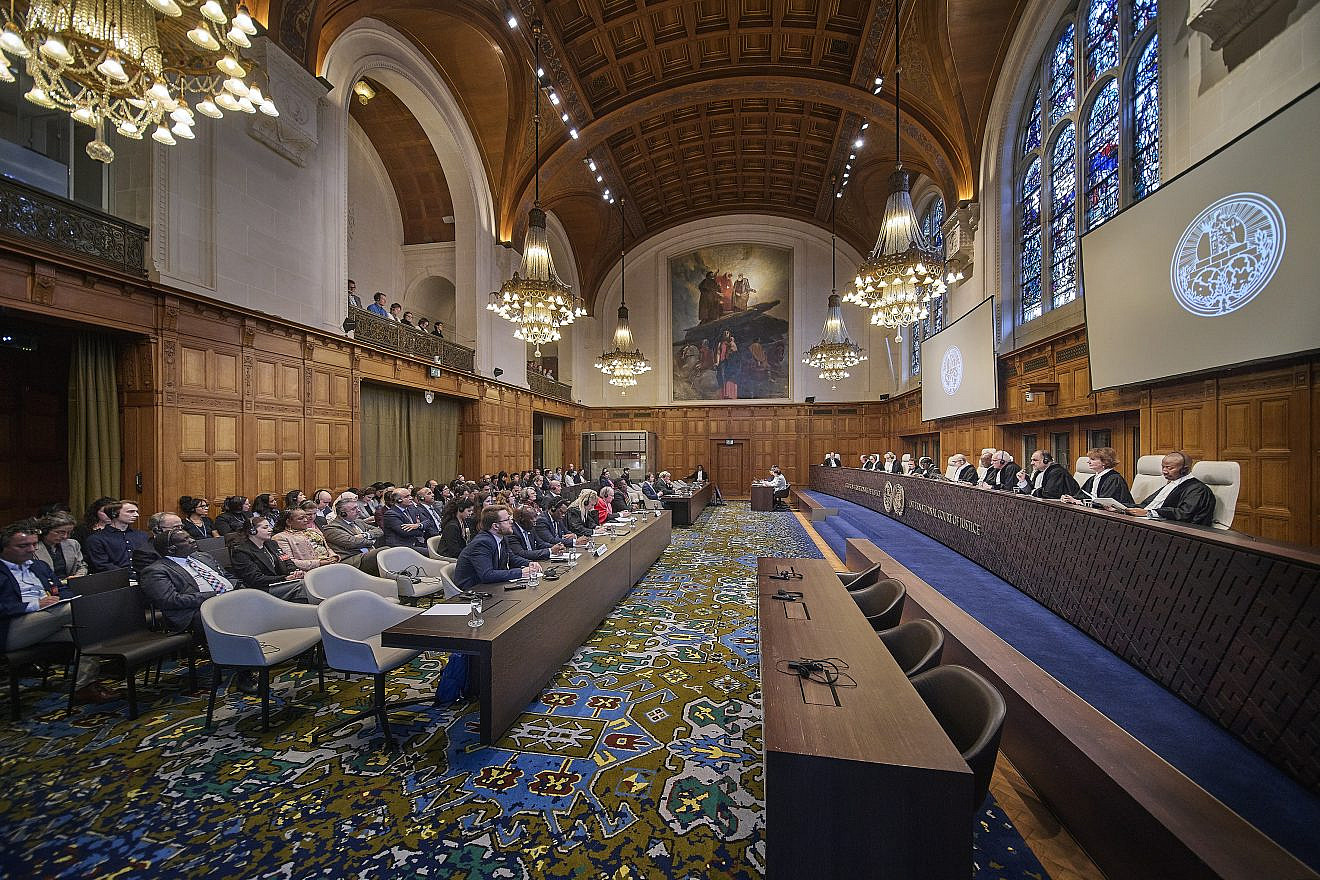
Two South African judges and the Nobel laureate who accused Israel of genocide helped convict Myanmar. The precedents they set point directly at Gaza.
The International Court of Justice (ICJ) ruled on Thursday that Myanmar committed genocide against its Rohingya Muslim minority. It is the first time in the court’s 80-year history that it has found a state guilty of the crime. The vote was 9-6. In Jerusalem and Washington, the verdict was read as a preview of the case South Africa has brought against Israel over the war against Hamas in Gaza.
The case concerned a 2017 military crackdown in northern Rakhine State in which about 10,000 Rohingya were killed and hundreds of thousands were driven into Bangladesh. Myanmar argued that its forces were responding to attacks by armed militias. The court rejected Myanmar’s defense that the campaign was a legitimate counterinsurgency operation. Israel has argued throughout the war that its operations in Gaza are a response to the October 7 massacre and are aimed at Hamas, a terrorist organization that hides behind civilians.
“The court concludes that all the evidence before it, taken together, supports a reasonable inference that Myanmar security forces acted with genocidal intent,” ICJ President Judge Iwasawa Yuji said as he read the ruling.
A Lower Bar, Written in The Hague
Until Thursday, the ICJ’s standard for genocide was among the strictest in international law. In Bosnia v. Serbia and Croatia v. Serbia, the court held that intent to destroy the target group “must be the only reasonable inference which can be drawn from the pattern of conduct.” Under that test, the court found in 2007 that the Srebrenica massacre was genocide but that Serbia was not responsible for committing it.
Iwasawa repeated the formula on Thursday, saying “the only reasonable inference that can explain Myanmar’s actions is an intention to destroy a substantial part” of the Rohingya in northern Rakhine. The ruling, however, rests on evidence “taken together,” which is the holistic approach South Africa and its allies have urged on the court for three years.
“Parts of the ICJ ruling have arguably harmed Israel’s ability to mount a defense by lowering the standard of proof needed to be met to determine genocide against a country,” the Jerusalem Post reported.
The judgment sets three precedents that line up directly with South Africa’s case.
The first is about destroyed homes. The court found that widespread destruction of housing can support a finding of genocide even without the killing of particular people. South Africa’s filings rely heavily on the destruction of buildings in Gaza, much of it caused by Hamas fighting from homes, schools and hospitals, and by the tunnel network beneath them.
The second is about acts by others. The court ruled that acts committed by non-military actors can be attributed to a state that fails to stop them. That reasoning opens the door to holding the State of Israel responsible for alleged acts by civilians in Gaza or in Judea and Samaria, where activists and UN bodies have spent years building files on “settler violence.”
The third is about numbers. The court found that killing 10,000 people out of a population of about 815,000, or 1.2%, is sufficient for genocide. The Jerusalem Post called this a significant downscaling of a term defined by the Holocaust, in which six million Jews were murdered, and by Rwanda, where more than 800,000 people were killed. South Africa’s case relies on casualty figures from the Hamas-run Gaza health ministry, which makes no distinction between civilians and terrorists.
The court also signaled how it treats UN inquiries. Before the verdict, legal analysts said the ruling would show how the ICJ weighs the conclusions of UN fact-finding reports, which have accused both Myanmar and Israel of genocide.
The Courts Themselves Have Not Found Genocide in Gaza
The International Criminal Court (ICC), the tribunal most hostile to Israel’s leadership, has never charged genocide. When Prosecutor Karim Khan requested arrest warrants in May 2024, legal scholar David Luban noted in Just Security the conspicuous absence of the charge of genocide. The ICC judges narrowed the case further. When they issued warrants for Netanyahu and former Defense Minister Yoav Gallant on November 21, 2024, they did not retain the charge of extermination as a crime against humanity.
Khan has held that position into this year. In a May 2026 interview with Mehdi Hasan, he declined to label Israel’s campaign in Gaza as genocidal, called accusing Israel of genocide for political purposes “reckless,” and said prosecutors must follow evidence and legal standards rather than political narratives. Germany’s Bild reported that Khan currently sees insufficient evidence of genocide by Israel in Gaza.
The judge who presided over South Africa’s case at the ICJ corrected the record herself. Joan Donoghue, ICJ president from February 2021 to February 2024, told BBC HARDtalk that the court decided Palestinians had a plausible right to be protected from genocide and that South Africa had the right to present that claim. The court, she said, “didn’t decide that the claim of genocide was plausible.”
Experts: The Intent Is Not There
The most detailed rebuttal came from Israeli researchers. The Begin-Sadat Center for Strategic Studies (BESA) and the Hebrew University of Jerusalem published “Debunking the Genocide Allegations: A Reexamination of the Israel-Hamas War (2023-2025),” which analyzed humanitarian reporting and casualty data. The study, led by Prof. Danny Orbach, found “no evidence to suggest a systematic Israeli policy of targeting or massacring civilians.” It also found that the UN grossly overestimated the number of food trucks entering Gaza before the war, which produced faulty assumptions about starvation. One chapter is devoted to the Gaza Health Ministry’s data and its manipulations.
John Spencer, chair of Urban Warfare Studies at the Madison Policy Forum and a retired US Army major, made eight trips into Gaza during the war. He called the genocide accusation “the greatest lie in modern history.” Spencer argues that the IDF is taking more precautions than any army in history to limit civilian harm, and that Hamas wants and needs the deaths of its own children, according to its own words.
Orde Kittrie of the Foundation for Defense of Democracies (FDD) draws the same contrast. Myanmar deliberately slaughtered Rohingya civilians, while Israel undertook extraordinary precautions to minimize harm to civilians in Gaza, including daily pauses in fighting.
South Africa Helped Write the Verdict
The vote breakdown shows how closely the two cases are linked. The nine judges in the majority were President Iwasawa Yuji of Japan, Hilary Charlesworth of Australia, Leonardo Nemer Caldeira Brant of Brazil, Juan Manuel Gómez Robledo of Mexico, Sarah Cleveland of the United States, Bogdan-Lucian Aurescu of Romania, Dire Tladi of South Africa, Mahmoud Hmoud of Jordan, and Navi Pillay of South Africa, the ad hoc judge nominated by Gambia. Pillay voted with the majority on all 13 rulings.
South Africa, the country that brought the genocide case against Israel, supplied two of the nine votes that convicted Myanmar.
Pillay was awarded the Nobel Peace Prize in October. She also led the UN commission that accused Israel of genocide. Before the ruling, US Ambassador to the UN Mike Waltz said Washington “will not allow globalist, faux judges to weaponise the law against our troops.” He accused Pillay of tipping the scales to lower the legal threshold for genocide so that it could later be turned against American and allied soldiers fighting terrorists who hide behind civilians.
Kittrie predicted this two weeks ago. He wrote that submissions from some states in the Myanmar and Israel cases sought a looser test, assessed “comprehensively and holistically,” that leans heavily on politicized UN reports and NGO sources. He warned that a lowered threshold would make it easier for South Africa’s case against Israel, and for Nicaragua’s case accusing Germany of contributing to genocide by arming Israel, to succeed. Lowering the bar, he wrote, would show the ICJ acting as “a legislature instead of a court.”
The six dissenters were Vice-President Julia Sebutinde of Uganda, former ICJ presidents Peter Tomka of Slovakia and Ronny Abraham of France, former Vice-President Xue Hanqin of China, Georg Nolte of Germany, and Claus Kress of Germany, Myanmar’s ad hoc judge. Several of them backed rulings ordering Myanmar to investigate suspects, punish perpetrators and compensate victims, while opposing the central genocide finding. In January 2024, Sebutinde was the only judge to vote against every provisional measure the court imposed on Israel in South Africa’s case, writing that the conflict between Israel and the Palestinians is political rather than legal.
Washington Weighs Sanctions
ICJ judges took advice on protecting their assets from possible US sanctions before the verdict, concerned that Washington would read a genocide ruling as lowering the threshold for the crime. The US has already imposed crippling sanctions on ICC judges after that court issued its arrest warrant for Netanyahu. Kittrie expects the Trump administration to respond to a lowered genocide standard with similar sanctions. No sanctions on the ICJ had been announced as of Thursday afternoon.
Genocide Without Inference
The Bible records an explicit genocidal decree against the Jewish people. Haman’s letters, sealed with the king’s ring and sent to every province of Persia, stated his intent in three verbs: l’hashmid, la’harog, u’l’abed, “to destroy, to kill, and to cause to perish.”
“And letters were sent by posts into all the king’s provinces, to destroy, to kill, and to cause to perish, all Jews, both young and old, little children and women, in one day, even upon the thirteenth day of the twelfth month, which is the month Adar, and to take the spoil of them for a prey.” (Esther 3:13)
King David described the same declared aim among the nations surrounding Israel. “They have said: ‘Come, and let us cut them off from being a nation; that the name of Israel may be no more in remembrance.'” (Psalms 83:5)
Haman left nothing to inference, and neither does Hamas. Its 1988 charter cites the hadith in which the stones and trees call out that a Jew is hiding behind them, to be killed. Weeks after October 7, Hamas official Ghazi Hamad told Lebanese television that the terrorist organization would repeat the massacre again and again until Israel was destroyed.
Israel answered with phone calls, text messages and leaflets warning civilians before strikes, with evacuation corridors, and with humanitarian pauses. The Sages taught that Purim requires the Jewish people to recognize Haman in every generation. The ICJ has now adopted reasoning under which the nation that warned civilians before every strike can be convicted, while the organization that announced its genocidal intent in writing is not a party to the case.
A final ruling in South Africa’s case is not expected before 2029. The legal tools it will use against the Jewish state were handed to it in The Hague on Thursday, with two South African judges in the majority.


