


Weeks before Jews light the first Hanukkah candle, descendants of Aaron the High Priest are being invited to sign up for hands-on training on a full-size replica of the altar that stood in the Temple courtyard. The Mamlechet Kohanim (Kingdom of Priests) Institute has announced the opening of a new cohort for its priestly training program. Har HaBayit Chadashot (Temple Mount News), a Hebrew-language news site covering the Temple Mount, reported on the course under the headline “Toward the renewal of the Temple service.”
The institute is running two courses. The basic course, called Kohen Mukhshar (Qualified Kohen), meets weekly in groups of eight to 10 kohanim (Jewish priests). The theory portion covers the laws of the Temple service, the types of sacrifices, the priestly garments, the washing of the hands and feet at the laver, the terumat ha’deshen (the daily removal of ashes from the altar), the blood rites, the incense, and the lighting of the menorah. Students then train hands-on, wearing priestly garments and using replica Temple vessels. The course requires no prior knowledge and ends with a test and a certificate. The regular price of 300 shekels has been cut by 40 percent, to 180 shekels, for anyone who registers before Hanukkah, which begins at sundown on December 4.
Graduates move on to the Tamid course, a full rehearsal of the daily offering, complete with the Levites’ singing. It runs on Rosh Chodesh, the first day of each Hebrew month, and graduates earn the institute’s “Qualified Kohen” certificate. The Tamid course normally costs 100 shekels and has been reduced to 60 for Hanukkah.
Lectures are held at 12 HaNevi’im Street in Jerusalem. The practical sessions take place at Chavat Lechatchila, a farm near Mitzpe Yericho in the Binyamin region, where the institute keeps a model altar with its ramp, the kevesh, built at true height. Classes are offered in Hebrew, English, and Yiddish. The registration form asks applicants whether they are kohanim and offers three answers: yes, no, and “not sure.” The institute warns that “the number of places is limited.” In April, Har HaBayit Chadashot reported that the institute’s operators expect the training site to remain in use after the Temple is rebuilt as a place where kohanim will practice before serving inside the sacred precinct itself.
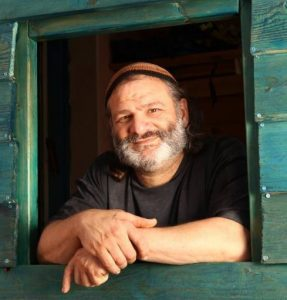
Kohanim practiced on the replica altar at the farm on December 21, 2025. The priestly community behind the course is organized by Nathan Huberman, a 32-year-old Canadian-born physician, IDF veteran, and veteran Temple Mount guide who sits on the board of Beyadenu. Huberman told JNS in January that the community had grown to nearly 100 members within about a month.
“These communities are professional communities, founded on four principles,” Huberman said. “Identity, an identity that comes with responsibility, knowing the actions you are meant to perform, and setting professional standards for those actions.”
He described the effort as “sort of like an outreach movement, like a Chabad for priestly families,” and said he receives calls every day from kohanim in Israel and abroad, including Jews who are not religiously observant. “I want it to be the most inviting that it can be to every Kohen,” he said.
The institute lays out its case for training now in a series of essays by Yehoshua Landau, published on its website this month. Landau builds the argument on God’s command to Moses in the desert:
“And let them make Me a sanctuary, that I may dwell among them.” (Exodus 25:8)
Landau cites Maimonides, who rules that the verse is “a positive commandment to build a house for God, prepared for offering sacrifices in it” (Laws of the Chosen House 1:1). He also cites the Sefer HaChinuch, the 13th-century catalog of the 613 commandments, which says the commandment applies “at all times.” From there he raises the practical question he says almost nobody asks: once the Temple stands, who will actually perform the service?
“When the Temple is built,” Landau writes, “there will need to be kohanim who know what to do and when.”
The priesthood passes from father to son as a birthright. The Bible gave it to Aaron and his descendants alone:
“And thou and thy sons with thee shall keep your priesthood in everything that pertaineth to the altar, and to that within the veil; and ye shall serve; I give you the priesthood as a service of gift; and the common man that draweth nigh shall be put to death.” (Numbers 18:7)
Two thousand years after the Destruction, priestly families have kept their lineage alive through family names, traditions handed down from father to son, and family testimony. Maimonides rules that a man with a chazakah, a presumptive status built on that unbroken family transmission, is treated as a kohen in Jewish law. Kohanim still recite the Priestly Blessing every day in Israeli synagogues and still avoid contact with the dead. Landau notes that almost none of them ever learned the Temple service itself, because no institution existed to teach it. Mamlechet Kohanim was founded to fill that gap.
In Temple times, the priests were divided into 24 mishmarot, or watches, and each one served a week at a time. All 24 gathered in Jerusalem for the three pilgrimage festivals, and the tasks within each watch were assigned by daily lottery. Young kohanim learned the service from their elders while doing it, as the Talmud describes in Tractate Ta’anit. Landau calls the service a skilled craft whose details have to be known by heart and by hand. He urges the kohanim of today, whom he estimates number in the hundreds of thousands in Israel, to study, practice, verify their lineage, and form study partnerships now. In his view, the preparation is part of the commandment itself.
The center of the training is the Tamid, which Landau calls the service that defines the Temple. Two lambs were offered as whole burnt offerings every day of the year: one at dawn and one “between the evenings,” in the late afternoon. That added up to more than 700 Tamid offerings a year, more than any other sacrifice. The Mishnah rules that “the daily offerings precede the additional offerings” (Zevachim 10:1), so even on Shabbat and Yom Kippur the Tamid came first. The morning service, drawn from Tractate Tamid, ran in nine steps. It began with the lottery among the priests, the clearing of the ashes and the arranging of the wood. Next came the slaughter of the lamb at dawn on the north side of the Temple courtyard, followed by the receiving and sprinkling of its blood. The priests then carried the parts up the ramp and poured the libations. The service closed with the incense and the trimming of the menorah’s lamps inside the sanctuary, and finally the Priestly Blessing. Landau writes that a priest who masters the Tamid holds the “backbone” of the entire Temple service.
The course is one piece of a greater effort. The institute says its mission is to prepare in advance everything that can be prepared, so that the Temple’s commandments can be performed as soon as that becomes possible. Its completed work includes the following:
- Blowing silver trumpets on the Temple Mount on Rosh Hashanah.
- Preparing the shtei ha’lechem, the two loaves of the Shavuot offering, according to Jewish law, and having a kohen in priestly garments raise them.
- Producing about 2.5 liters of pure olive oil for the menorah, enough to light it for only two days.
- Dyeing threads of tekhelet, argaman, and tola’at shani (sky-blue, purple and crimson) for the priests’ sashes.
- Buying a single day’s supply of the incense spices.
Projects in planning include priestly garments in several sizes, fine flour from wheat grown in the Land of Israel for the meal offerings, portable ovens for roasting the Passover offering, an annual barley harvest for the Omer, research toward the ashes of a red heifer, and architectural plans for the Temple drawn up by a team of rabbis and an architect.
The institute is also building a portable altar to the minimum dimensions required by Jewish law: one cubit by one cubit and three cubits high, with a base, horns, and a ramp. It is being built from uncut stones that no iron has touched, and 12 of the roughly 60 required blocks are finished. The standard comes straight from the Bible:
“And if thou make Me an altar of stone, thou shalt not build it of hewn stones; for if thou lift up thy tool upon it, thou hast profaned it.” (Exodus 20:22)
The course’s own timing raises the question at the center of the story: why does a program that trains priests on a model altar point its registration deadline at Hanukkah?
The answer is in the name of the holiday. Chanukah means “dedication,” and the dedication the holiday commemorates is chanukat ha’mizbe’ach, the rededication of the altar. The Book of Maccabees records that after the Hasmoneans drove the Greeks out of Jerusalem in 164 BCE, they found the altar defiled. They chose priests who had remained faithful, removed the desecrated stones, and built a new altar of whole stones according to the law. They dedicated it on the 25th of Kislev with eight days of offerings and song. The Hasmoneans were themselves a family of kohanim. Mattathias and his sons were priests, and the war they led was a war to restore the Temple service.
The Sages built this into the holiday’s Bible reading. The Mishnah (Megillah 3:6) rules that on Hanukkah, the reading comes from the passage of the tribal princes in the Book of Numbers, which describes the gifts each prince brought when Moses dedicated the altar in the desert. Rashi explains the choice in four words: Hanukkah “is also the dedication of the altar.” On the eighth day, known as Zot Chanukah, the reading ends with the verse that gives that day its name:
“This was the dedication-offering of the altar, in the day when it was anointed, at the hands of the princes of Israel: twelve silver dishes, twelve silver basins, twelve golden pans.” (Numbers 7:84)
Jewish law has held for centuries that the altar comes first. The Talmud (Zevachim 62a) records that three prophets came up with the exiles returning from Babylon. One testified about the altar, one testified about its exact place, and the third testified that sacrifices could be offered there even before the Temple building stood. Maimonides codified the ruling: the holiness of the Temple Mount was never cancelled, so all the offerings may be brought even when no Temple stands (Laws of the Chosen House 6:15).
Malachi, the last of the prophets, described exactly what the priests training above Jericho are preparing for:
“And he shall sit as a refiner and purifier of silver, and he shall purify the sons of Levi, and purge them as gold and silver; and there shall be they that shall offer unto the LORD offerings in righteousness. Then shall the offering of Judah and Jerusalem be pleasant unto the LORD, as in the days of old, and as in ancient years.” (Malachi 3:3-4)
For two thousand years, the knowledge of how to serve at the altar lived only in books, cut off from the elders who once passed it hand to hand in the priestly watches. The Hasmonean priests who rededicated the altar in 164 BCE did not wait for a palace to be built around them. They rebuilt the altar first, and the light followed. This winter, as Jews kindle eight nights of Hanukkah candles, a new cohort of kohanim will climb a full-height ramp in the hills above Jericho and rehearse the morning offering by hand, while 12 uncut stones wait for the other 48. Malachi promised that the offering of Judah and Jerusalem would again be pleasant to God “as in the days of old.” The men signing up before Hanukkah intend to be ready when it is.
